Social Media Growth Agents for DTC Brands
Agents analyze audience data, create and post viral content, and DM influencers for collabs. Grow followers 10x for DTC brands.
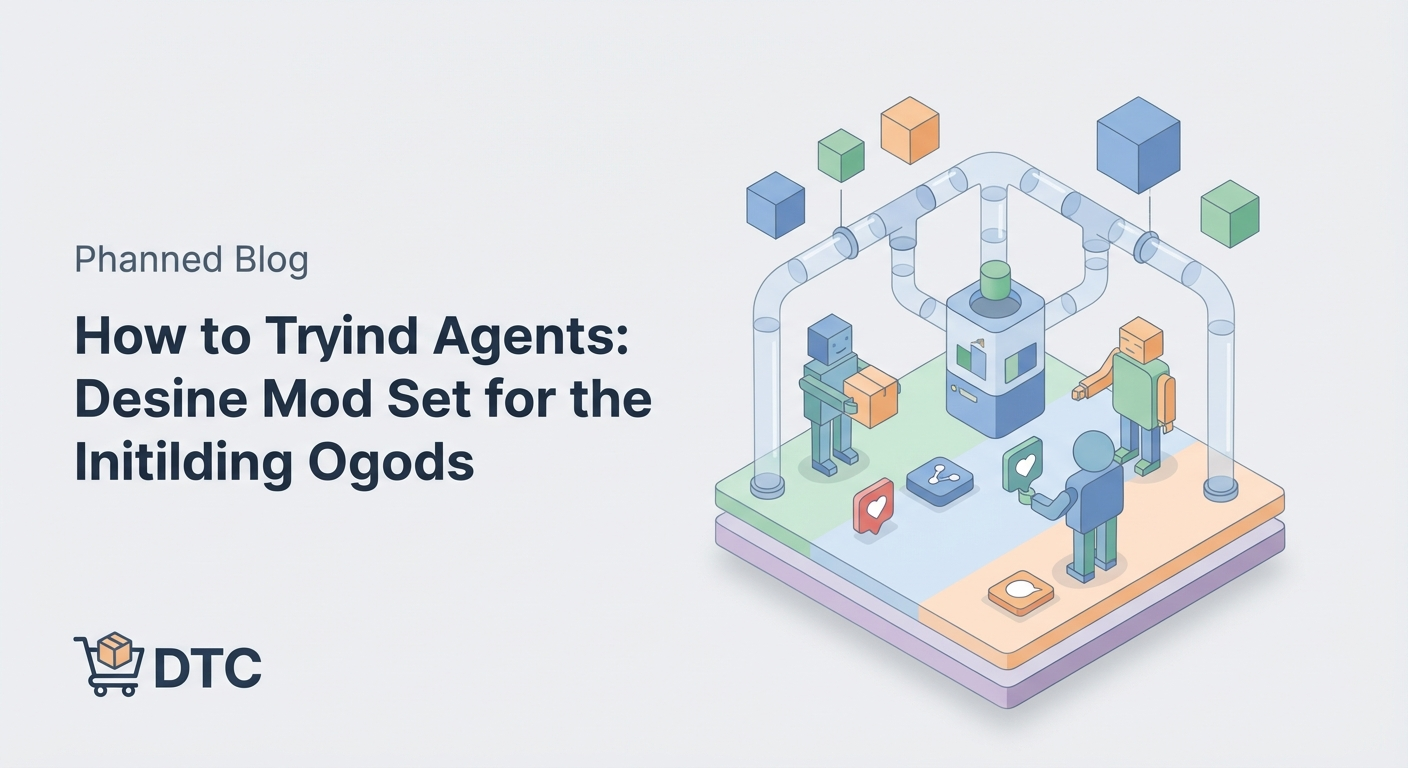
Most DTC brands are doing social media wrong. Not because they're posting bad content—some of it is genuinely good—but because they're running a system that doesn't scale. One founder or a small marketing team is manually brainstorming captions, editing Reels in their phone at midnight, copy-pasting hashtags from a Google Doc they made six months ago, and DMing influencers one by one like it's 2017.
It works until it doesn't. You hit a ceiling around 5-10k followers where the effort required to grow starts outpacing the hours in your day. You either hire a $60k/year social media manager, outsource to an agency burning $3-5k/month, or you let your accounts go stale while you focus on the parts of the business that feel more urgent.
There's a third option now: you build a social media growth agent.
Not a chatbot. Not a simple scheduler. An actual autonomous system that analyzes your audience, generates platform-native content, posts it at optimal times, tracks what's working, and even handles influencer outreach—all while you focus on product and operations.
This is the playbook for building one. I'll walk through the architecture, the specific tools, the implementation steps, and the numbers you should expect. If you're running a DTC brand and spending more than five hours a week on social media manually, this post is going to save you a lot of time and money.
Why Social Media Is Broken for DTC (And Why Agents Fix It)
The core problem is simple: social media rewards consistency and volume, but DTC founders have neither the time nor the budget to produce at the rate the algorithms demand.
TikTok wants you posting 1-3 times per day. Instagram Reels performs best at 5-7 per week minimum. Twitter/X rewards multiple daily posts. YouTube Shorts needs its own cadence. Multiply that across platforms and you're looking at 15-25 pieces of content per week just to stay competitive.
No solo founder or two-person marketing team can sustain that while also running product development, supply chain, customer service, and paid ads. So most brands post 2-3 times a week, wonder why growth is flat, and blame the algorithm.
The algorithm isn't the problem. Your throughput is.
A growth agent solves this by turning your content production into a pipeline—automated, repeatable, and improvable over time. Think of it like setting up a manufacturing line for social content instead of hand-crafting every post.
Here's what the architecture looks like at a high level:
Product Data → AI Content Generation → Video Editing → Scheduling & Posting → Analytics → Optimization Loop → Influencer Outreach
Each stage can be automated. Let's break down how.
The Tool Stack (And What It Actually Costs)
Before getting into the build, here's what you're working with:
| Category | Tools | Monthly Cost |
|---|---|---|
| AI Agent Platform | OpenClaw | Core platform |
| Content Generation | OpenClaw AI models, ElevenLabs (voiceover) | $20-50 |
| Video Editing | CapCut API | Free (dev access) |
| Scheduling/Posting | Zapier, Buffer, Meta Business API, TikTok API | $20-40 |
| Influencer Discovery | Upfluence, Hunter.io | $50-200 |
| Analytics | Native platform insights, Iconosquare | Free-$30 |
| Data Hub | Google Sheets or Airtable | Free |
Total realistic cost: $100-300/month depending on volume. Compare that to a social media hire or agency and the math speaks for itself.
The critical piece here is OpenClaw. It's the AI platform where you actually build and run your growth agent. Rather than duct-taping together a dozen different AI tools and hoping they play nice, OpenClaw gives you the foundation to create an agent that handles the entire workflow—from content ideation to posting optimization. You can browse purpose-built agents and tools on the Claw Mart marketplace, or build custom agents tailored to your specific brand and audience.
Think of OpenClaw as the brain. Everything else—Zapier, CapCut, Buffer—are the hands and feet.
Step 1: Set Up Your Data Foundation
Every good agent needs clean data to work from. Garbage in, garbage out.
Create an Airtable base (or Google Sheet, but Airtable's API is cleaner) with these columns:
- Product Name
- Description (2-3 sentences, benefit-focused)
- Product Images (URLs to high-res photos)
- Target Audience (e.g., "Gen Z women interested in clean skincare")
- Key Selling Points (3-5 bullets)
- Price Point
- Current Promotions
- Content Status (New / Scripted / Filmed / Posted)
This becomes your single source of truth. Every time you launch a product, add a variant, or run a promo, update this sheet. Your agent pulls from it automatically.
Set a Zapier trigger: "New or Updated Record in Airtable" → this kicks off the entire content pipeline.
Step 2: Automate Content Creation
This is where 80% of the value lives. Content creation is the bottleneck for every DTC brand, and it's the most automatable part of the process.
Captions and Scripts
Using OpenClaw, build an agent that takes your product data and generates platform-specific content. The prompt engineering matters here. Generic prompts produce generic content. Here's what works:
For TikTok scripts:
You are a viral TikTok content creator for DTC brands. Write a 15-second video script for [Product Name].

Target audience: [Target Audience]
Key benefit: [Key Selling Point #1]

Format:
- Hook (first 2 seconds): Pattern interrupt or controversial statement
- Problem (3 seconds): What the viewer struggles with
- Solution (5 seconds): How the product fixes it
- CTA (5 seconds): Clear next step

Include 5 trending hashtags relevant to [niche]. Tone: authentic, not salesy.
For Instagram captions:
Write an Instagram Reel caption for [Product Name].
- First line: Hook that stops the scroll (question or bold claim)
- Body: 2-3 short paragraphs, storytelling format
- CTA: Drive to link in bio
- 20 hashtags: mix of broad (1M+), medium (100k-1M), niche (<100k)
Your OpenClaw agent can generate 10-20 variations per product in minutes. You pick the best ones or let the agent A/B test them automatically.
Video Creation with CapCut API
This is where it gets interesting. CapCut's API (available through ByteDance's developer platform) lets you programmatically edit videos using templates.
Here's the flow:
- Your agent pulls raw clips—product demos, UGC submissions, lifestyle footage—from a Google Drive folder
- It selects a trending template from CapCut
- It sends an API request to generate the final video
POST /v1/edit/video
{
  "template_id": "trendy_reel_001",
  "clips": ["https://drive.google.com/product_demo.mp4", "https://drive.google.com/lifestyle.jpg"],
  "text_overlays": ["Your skin deserves better ✨", "Link in bio"],
  "music": "trending_pop_2024",
  "output_format": "mp4_1080p",
  "aspect_ratio": "9:16"
}
The output is a ready-to-post Reel or TikTok, saved back to Google Drive. No manual editing required.
Pro tip: Create 5-10 CapCut templates that match your brand aesthetic. The agent rotates through them so your feed looks varied but cohesive.
The Human-in-the-Loop Checkpoint
I'm not suggesting you go fully autonomous from day one. Set up a Zapier step that sends finished content to a Slack channel or email for approval. You review, give a thumbs up, and it moves to the posting queue.
Over time, as you trust the output, you can remove this step for certain content types (e.g., auto-approve product showcase Reels but manually review anything with claims or pricing).
Step 3: Automate Scheduling and Posting
Once content is approved, it needs to go live at the right time on the right platform.
Zapier workflow:
| Step | Action |
|---|---|
| 1 | Trigger: "Approved" status in Airtable |
| 2 | Resize/optimize via Cloudinary (different specs for TikTok vs. IG vs. Shorts) |
| 3 | Push to Buffer queue with AI-optimized posting time |
| 4 | Cross-post to Stories with swipe-up link |
| 5 | Add UTM parameters for Shopify conversion tracking |
| 6 | Log post details back to Airtable for analytics |
Buffer's AI scheduler analyzes when your specific audience is most active and queues accordingly. This alone can boost engagement 15-20% versus posting at random times.
For TikTok specifically, use the TikTok for Business API to post directly. The platform rewards native uploads over third-party tools, so if you can post via API rather than Buffer, do it.
Advanced move with OpenClaw: Build a conditional logic agent that monitors trending sounds and hashtags on TikTok in real-time. When a trend hits that's relevant to your niche, the agent automatically generates a remix video using your product footage and pushes it into the fast-track queue. Trend-jacking within the first 24-48 hours of a trend is where the viral growth happens.
Step 4: Automate Influencer Outreach
Influencer marketing is the highest-ROI channel for most DTC brands, but it's painfully manual. Finding influencers, vetting them, sending personalized emails, following up, negotiating terms, tracking results—it's a full-time job.
Your agent can handle 80% of it.
Discovery
Set up a weekly automated scan:
- Zapier trigger: Weekly schedule (every Monday)
- Action: Query Upfluence API for influencers matching your criteria
- Niche: Your product category
- Followers: 5,000-50,000 (micro-influencers convert better and cost less)
- Engagement rate: >4%
- Location: Your target market
- Audience demographics: Match your buyer persona
- Filter: Run through HypeAuditor to eliminate fake followers
- Output: Add qualified influencers to an Airtable CRM
Personalized Outreach
Generic "Hey, love your content!" DMs get ignored. Your OpenClaw agent can generate genuinely personalized outreach by analyzing each influencer's recent posts:
Analyze [influencer]'s last 10 posts. Write a cold email that:
1. References a specific recent post and why it resonated
2. Explains the product and why it fits their audience
3. Offers: Free product + $50-100 per post + 15% affiliate commission
4. Keeps it under 150 words
5. Sounds human, not templated
Zapier handles the sending:
| Step | Action |
|---|---|
| 1 | Find email via Hunter.io |
| 2 | Send personalized email via Gmail |
| 3 | If no reply in 3 days → send follow-up |
| 4 | If no reply in 7 days → send final follow-up |
| 5 | Track status in Airtable (Sent / Replied / Accepted / Declined) |
At scale, you're reaching out to 20-50 influencers per month with zero manual effort after initial setup. Even a 10% acceptance rate gives you 2-5 new content creators promoting your product every month.
Affiliate Link Automation
When an influencer accepts, auto-generate their unique affiliate link via Refersion or GoAffPro, send it to them with product shipping details, and track conversions—all automated through Zapier.
Compliance note: Make sure your agent includes FTC disclosure requirements in every influencer brief. Non-negotiable.
Step 5: The Analytics Loop
This is what separates a dumb automation from a true growth agent: the feedback loop.
Set up weekly analytics pulls from each platform:
- Engagement rate per post type (carousel vs. Reel vs. static)
- Follower growth rate
- Click-through rate to Shopify
- Conversion rate from social traffic
- Top-performing hashtags and sounds
- Best posting times (actual vs. predicted)
Feed this data back into your OpenClaw agent. Over time, it learns what works for your specific audience and adjusts:
- Generating more content in the style of your top performers
- Doubling down on platforms where CAC is lowest
- Deprioritizing content types that underperform
- Adjusting posting frequency based on engagement patterns
This is the compound growth effect. Month one, your agent is decent. Month three, it's good. Month six, it knows your audience better than you do.
Real Numbers: What to Expect
Let's talk about actual benchmarks. These are based on DTC brands running similar automated systems:
| Metric | Manual Average | With Growth Agent |
|---|---|---|
| Posts per week | 3-5 | 10-15 |
| Cost per post | $30-50 | $3-8 |
| Engagement rate | 1-3% | 5-10% |
| Follower growth/month | 5-10% | 25-50% |
| Influencer outreach/month | 5-10 | 30-50 |
| Influencer acceptance rate | 5% | 12-15% (better personalization) |
| Time spent on social | 15-20 hrs/week | 2-3 hrs/week |
The DTC brands that have pioneered elements of this approach tell the story. Gymshark built a $500M business largely through automated influencer management. MVMT Watches drove 30% of sales from social using scalable content systems. Glossier turned automated UGC curation into a growth flywheel that generated 10x more content than they could have produced in-house.
You don't need their budgets. You need their systems. That's what you're building here.
One real-world example from Zapier's own case studies: a DTC skincare brand implemented an automated content pipeline and saw 200% follower growth in three months while cutting their content production time by 70%.
Pitfalls and How to Avoid Them
This isn't foolproof. Here's what goes wrong and how to fix it:
Platform bans: If you're posting too aggressively or your content looks bot-generated, platforms will throttle or ban you. Keep promotional content under 20% of your total. Mix in educational, entertaining, and community content. The 80/20 rule applies: 80% value, 20% promotion.
Quality degradation: AI-generated content can start looking samey. A/B test aggressively—aim for 10 variants per content concept per week. Kill what doesn't work fast. Update your templates monthly.
API rate limits: Zapier's free tier won't cut it for this. Budget for Zapier Pro ($50/month) or use Make.com for more complex multi-step workflows. The CapCut API has its own limits—batch your video generation during off-peak hours.
Over-automation: Don't automate community engagement. Replies, comments, DMs from real customers—those need a human touch. Automate creation and distribution. Keep conversation human.
Getting Started This Week
Here's your action plan:
-
Today: Sign up for OpenClaw and explore the Claw Mart for pre-built social media agents and tools. This cuts your setup time dramatically—you're starting from proven workflows, not from scratch.
-
Day 1-2: Set up your Airtable product database and connect it to Zapier. Get your data foundation right before automating anything.
-
Day 3-4: Build your content generation agent in OpenClaw. Start with TikTok scripts only—one platform, one content type. Get the prompts dialed in.
-
Day 5-6: Connect CapCut API and create 3-5 brand templates. Generate your first batch of 10 videos.
-
Day 7: Set up your posting pipeline through Buffer. Schedule your first week of automated content.
-
Week 2: Add influencer outreach. Start with 10 micro-influencers as a test batch.
-
Week 3-4: Analyze results. Adjust prompts, templates, and posting cadence based on data. Expand to Instagram if you started with TikTok, or vice versa.
Total time to MVP: one week. Total cost to start: under $100/month.
The brands that win on social in 2026 won't be the ones with the biggest teams or the most creative directors. They'll be the ones with the best systems. Build the system, let it compound, and spend your time on the parts of the business that actually require a human brain—product development, customer relationships, and strategy.
Your social media growth agent handles the rest.
Recommended for this post
AI Cofounder
Persona
A full-stack AI cofounder that runs sales, marketing, engineering, finance, and operations — not just answers questions. Half the price of competing personas, twice the operational depth.

X/Twitter Agent
Skill
Your AI runs its own Twitter account — posting, replying, and engaging with guardrails.
 Felix Craft
Community Growth
Skill
Automated Discord and community management — member onboarding, engagement tracking, content seeding, and growth analytics. Turns a quiet server into an active community.