Automate Performance Review Collection and Report Generation with AI
Automate Performance Review Collection and Report Generation with AI
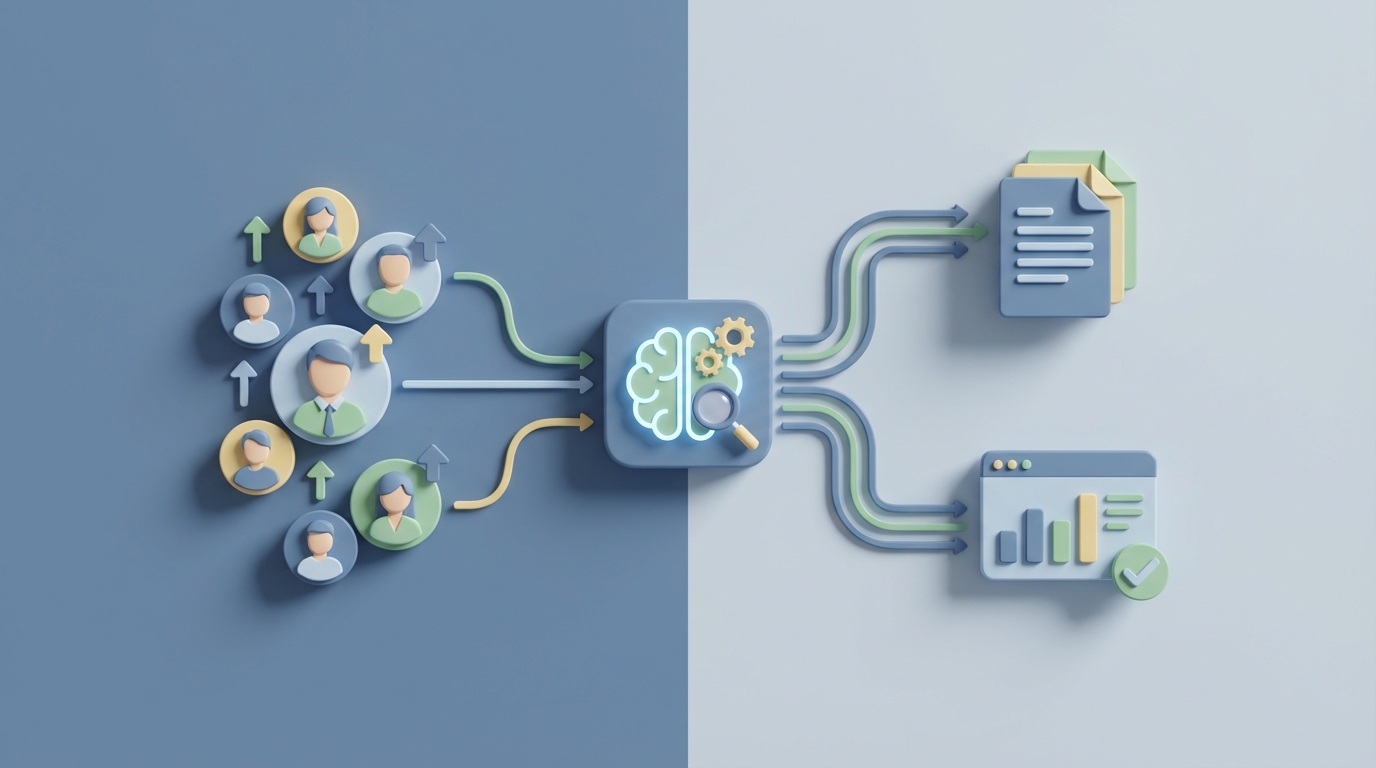
Let me be real with you: performance reviews are one of those processes that everyone agrees is broken, but nobody actually fixes. Not because the fix is complicated, but because the pain is distributed across so many people that no single person feels enough of it to do something about it.
That changes when you actually look at the numbers.
The Manual Workflow Today (And Why It Eats Your Calendar Alive)
Here's what a typical annual review cycle looks like, step by step, at a company with 100 employees and 12 managers:
Step 1: Goal Setting (Beginning of Cycle) Manager and employee sit down and agree on objectives for the year. These get typed into a spreadsheet, an HRIS, or a Google Doc that nobody will look at again until eleven months later. Time: 30–60 minutes per employee.
Step 2: Ongoing Data Collection (All Year) This is where things fall apart immediately. Managers are supposed to note accomplishments, incidents, and feedback throughout the year. Almost none of them do this consistently. They rely on memory, which means they effectively remember the last 8–12 weeks when review time comes. Time: theoretically ongoing, practically zero until panic sets in.
Step 3: Self-Assessment Employee fills out a form rating themselves on competencies and describing their accomplishments. Most people either undersell themselves or write a novel. Time: 30–60 minutes per employee.
Step 4: Manager Assessment The manager writes detailed feedback, rates competencies, and justifies ratings. This is the biggest time sink in the entire process. A conscientious manager spends 45–90 minutes per direct report just on the writing. A manager with 8 reports? That's 6–12 hours of writing. Time: 45–90 minutes per employee.
Step 5: Peer/360 Feedback Collection The manager (or HR) solicits feedback from 3–8 peers per employee. Those peers each spend 15–30 minutes writing responses. Then someone has to actually read, synthesize, and summarize all of it. For a team of 8, that's potentially 40+ individual feedback submissions to process. Time: 2–4 hours of compilation per manager, plus all the peer time.
Step 6: Calibration Meetings Managers meet with their peers and HR to normalize ratings across teams. "Your 'exceeds expectations' is my 'meets expectations'" — that kind of thing. These meetings are long, political, and exhausting. Time: 2–4 hours per manager.
Step 7: Final Review Meeting The actual conversation with the employee. Time: 45–90 minutes per employee.
Step 8: Documentation and Archiving Everything gets entered into the official HR record. Follow-ups get scheduled. Development plans get drafted. Time: 20–30 minutes per employee.
Total time per manager per cycle: 40–80 hours.
For a company with 12 managers, you're looking at roughly 480–960 hours of collective manager time per review cycle. That's 12–24 full work weeks consumed by a process that only 12–14% of employees say provides meaningful feedback (Gallup, 2023).
Let that sink in. Hundreds of hours spent on something that almost nobody finds valuable in its current form.
What Makes This So Painful
The time cost is only part of the problem. Here's what else goes wrong:
Recency bias destroys accuracy. Managers remember the last 2–3 months clearly and everything before that is fog. An employee who crushed Q1 and Q2 but had an average Q4 gets rated as "average." The data exists to paint a more accurate picture, but nobody has time to go dig through project management tools, CRMs, and old Slack threads to find it.
Inconsistency across managers is rampant. One manager's "meets expectations" is another manager's "exceeds expectations." Calibration meetings exist specifically to fight this, but they're blunt instruments. The underlying problem is that each manager is applying their own subjective framework to narrative feedback, and no amount of meeting time fully fixes that.
The writing is terrible. Most managers aren't good writers. They produce vague feedback like "good communicator" or "needs to be more strategic" — phrases that sound meaningful but give the employee absolutely nothing to work with. Writing specific, actionable, evidence-based feedback is a skill most people haven't been trained in.
Administrative overhead crushes HR. HR teams report spending up to 40% of their time on performance process administration (SHRM and Gartner data). That's scheduling, chasing people for overdue submissions, formatting reports, running calibration sessions, and entering data into systems.
The cost is staggering when you quantify it. Multiple consulting reports estimate the total organizational cost at $35,000+ per manager annually when you include opportunity cost of time. For a 12-manager company, that's north of $400,000 per year spent on a process most people dread.
And here's the real kicker: most of this work is aggregation, summarization, and draft writing. Exactly the kind of work that AI handles exceptionally well right now.
What AI Can Handle Today
Let me be specific about what's realistic with current AI capabilities, because there's a lot of hype in this space and I don't want to add to it.
AI is genuinely good at these tasks right now:
-
Pulling and aggregating data from multiple systems. CRM numbers, project management tool activity, support ticket resolution rates, GitHub commits, OKR progress — all of this can be collected automatically and organized into a coherent picture of someone's work output.
-
Summarizing qualitative feedback. If you have 6 peer reviews for one employee, AI can read all of them and produce a coherent summary that identifies themes, highlights specific examples, and flags areas of disagreement between reviewers.
-
Drafting initial review narratives. Given aggregated data and summarized feedback, AI can produce a solid first draft of a performance review that a manager can then edit and personalize. Companies using these kinds of tools report 30–50% time savings on the writing portion alone.
-
Detecting bias in language. AI can flag gendered language, recency bias patterns, and inconsistencies in how different managers rate similar performance levels.
-
Automating the administrative workflow. Sending reminders, routing forms, scheduling meetings, tracking completion status — all of this can run on autopilot.
AI should not be doing these things:
- Making final rating decisions
- Determining compensation or promotion outcomes
- Delivering feedback to the employee
- Assessing context that only a human would know (personal circumstances, team dynamics, unclear expectations)
- Handling politically sensitive situations
The sweet spot is treating AI as a research assistant and first-draft writer, not as the decision-maker. That's exactly where an AI agent built on OpenClaw fits.
Step-by-Step: Building the Automation with OpenClaw
Here's how to set this up practically using OpenClaw as your AI agent platform.
Phase 1: Data Collection Agent
Build an OpenClaw agent that connects to your existing tools and automatically collects performance-relevant data throughout the review period. No more relying on manager memory.
Data sources to connect:
- Project management (Asana, Jira, Monday, Linear)
- CRM (Salesforce, HubSpot)
- Communication (Slack message sentiment, meeting notes)
- Code repositories (GitHub, GitLab)
- Support platforms (Zendesk, Intercom)
- OKR/goal tracking tools
- Time tracking systems
- Customer feedback/NPS data
The agent runs on a schedule — weekly or biweekly — pulling relevant metrics and storing them in a structured format. Think of it as building a continuous "performance diary" that nobody has to manually maintain.
What the agent captures per employee per period:
{
  "employee_id": "emp_12345",
  "period": "2026-Q1",
  "projects_completed": 4,
  "projects_in_progress": 2,
  "tickets_resolved": 47,
  "avg_resolution_time": "4.2 hours",
  "peer_recognitions_received": 3,
  "goals_on_track": ["Q1 revenue target", "Customer onboarding redesign"],
  "goals_at_risk": ["Documentation overhaul"],
  "customer_feedback_mentions": [
    {"source": "NPS survey", "sentiment": "positive", "quote": "Sarah was incredibly responsive..."}
  ],
  "notable_contributions": [
    "Led incident response for March 12 outage",
    "Shipped redesigned onboarding flow 2 weeks ahead of schedule"
  ]
}
This alone eliminates recency bias. When a manager sits down to write a review, they have a full year of data organized and ready instead of relying on whatever they can recall from the past few weeks.
Phase 2: Feedback Collection and Summarization
Set up an OpenClaw agent to handle the peer feedback workflow end-to-end.
The agent handles:
- Distribution — Automatically sends feedback requests to the right peers based on project collaboration data (not just whoever the manager remembers to ask).
- Reminders — Follows up with people who haven't submitted, escalating appropriately without HR having to chase anyone.
- Summarization — Once all feedback is in, the agent synthesizes responses into a structured summary.
Example summarization output:
## Peer Feedback Summary: Sarah Chen
### Review Period: January – December 2026
### Feedback Received From: 6 peers (5 submitted, 1 declined)

**Consistent Strengths (mentioned by 4+ reviewers):**
- Technical problem-solving ability, particularly under pressure
- Clear and proactive communication with cross-functional stakeholders
- Willingness to help teammates unblock on technical issues

**Areas for Development (mentioned by 2+ reviewers):**
- Tendency to take on too much work rather than delegating or pushing back
- Could improve documentation of architectural decisions
- Sometimes moves to implementation before fully aligning with product on requirements

**Notable Specific Feedback:**
- "Sarah's handling of the March outage was the best incident response I've seen
   at this company." — Engineering peer
- "I'd love to see Sarah mentor more junior engineers. She has a lot of knowledge
   that could scale better if shared more broadly." — Engineering Manager (adjacent team)

**Sentiment Distribution:**
- Highly Positive: 3 reviewers
- Positive: 2 reviewers
- Mixed: 0
- Negative: 0
This saves the manager 2–4 hours of reading, re-reading, and manually synthesizing free-text peer responses. It also produces a more balanced and complete picture because it identifies themes across reviewers rather than letting one particularly vocal (or critical) peer dominate the narrative.
Phase 3: Draft Review Generation
This is where the biggest time savings happen. The OpenClaw agent takes the aggregated performance data and the summarized peer feedback, combines it with the employee's self-assessment and goal progress, and generates a complete first draft of the performance review.
What goes into the draft:
Input Sources:
1. Quarterly performance data snapshots (from Phase 1)
2. Peer feedback summary (from Phase 2)
3. Employee self-assessment (submitted by the employee)
4. Goal/OKR progress data
5. Previous review cycle notes (for trajectory analysis)
6. Company competency framework and rating rubric
What the agent produces:
A structured review document that follows your company's format, including:
- Performance summary narrative (2–3 paragraphs)
- Competency-by-competency assessment with specific evidence
- Suggested rating with justification (manager reviews and adjusts)
- Recommended development areas with specific action items
- Comparison to previous cycle (improvement trajectory)
The manager then reviews this draft, edits it based on their direct knowledge, adjusts ratings as needed, and adds their own perspective. What used to take 45–90 minutes of staring at a blank text field now takes 15–20 minutes of editing and refining.
Phase 4: Calibration Support
Build an OpenClaw agent that prepares calibration data for the manager meeting. Instead of managers showing up with subjective arguments about why their people deserve certain ratings, the agent provides:
- Rating distribution across teams (visual)
- Evidence density per rating (how much data supports each rating)
- Language consistency analysis (flagging managers who use significantly different standards)
- Historical comparison (how this cycle's ratings compare to previous cycles)
- Bias flags (patterns in how ratings correlate with demographics, tenure, or team membership)
This doesn't replace calibration meetings, but it makes them dramatically more productive and evidence-based. A 3-hour calibration meeting can become a focused 60–90 minute session.
Phase 5: Final Report Generation and Archiving
After the manager finalizes the review and has the conversation with the employee, the OpenClaw agent:
- Generates the final formatted review document
- Creates a summary for HR records
- Extracts action items and development goals for follow-up tracking
- Schedules check-in reminders for the next quarter
- Updates the employee's development plan
- Feeds data back into the system for the next cycle
What Still Needs a Human
I want to be explicit about this because automating the wrong parts of performance management will backfire spectacularly.
Humans must own:
- The final rating. The AI suggests; the manager decides. Full stop. You need a human who can weigh context, judgment calls, and factors that don't show up in any system.
- The conversation. The review meeting is a relationship moment, not an information-transfer moment. AI can prepare you. It can't sit across from someone and have a genuine conversation about their growth.
- Contextual judgment. Was someone's performance impacted by a family emergency? A toxic teammate? A pivot that invalidated their goals? Only a human manager knows this.
- Compensation and promotion decisions. These have legal, ethical, and interpersonal dimensions that require human accountability.
- Handling underperformance. Putting someone on a PIP or managing them out requires empathy, legal awareness, and human judgment that no AI should be trusted with.
The principle: AI handles the research, aggregation, summarization, and first-draft writing. Humans handle the judgment, relationships, and consequences.
Expected Time and Cost Savings
Based on what companies using AI-assisted performance tools are reporting (Deloitte 2026 data, vendor case studies from Lattice and Leapsome, and internal benchmarks from early OpenClaw adopters):
| Task | Before (per manager, per cycle) | After (with OpenClaw agent) | Savings |
|---|---|---|---|
| Data collection | 5–10 hours | 30 min (review automated output) | ~90% |
| Peer feedback management | 3–5 hours | 30 min (review summaries) | ~85% |
| Writing reviews | 8–15 hours | 2–4 hours (editing drafts) | ~70% |
| Calibration prep | 2–3 hours | 45 min | ~65% |
| Admin/documentation | 2–4 hours | 15 min | ~90% |
| Total | 20–37 hours | 4–6 hours | ~80% |
For a 12-manager organization, that's roughly 190–370 hours saved per review cycle. At an average fully-loaded manager cost of $75–100/hour, you're looking at $14,000–$37,000 in savings per cycle — and that's before accounting for improved quality, reduced bias, and better employee experience.
The ROI is straightforward: you're not replacing the human parts of performance management. You're eliminating the tedious parts that no one does well anyway.
Get Started
If you're spending dozens of hours per cycle on review writing and feedback wrangling, this is one of the highest-leverage automations you can build.
Browse the Claw Mart marketplace to find pre-built OpenClaw performance review agents, feedback collection workflows, and HR data integration templates that you can deploy and customize for your organization. If you don't see exactly what you need, post it as a Clawsourcing request — describe your review process, your tools, and your pain points, and let the community build a custom solution for you.
The performance review process doesn't need to be reinvented. It just needs to stop wasting everyone's time on the parts that machines handle better than humans do.