AI Warranty Administrator: Process Claims and Track Coverage 24/7
Replace Your Warranty Administrator with an AI Warranty Administrator Agent
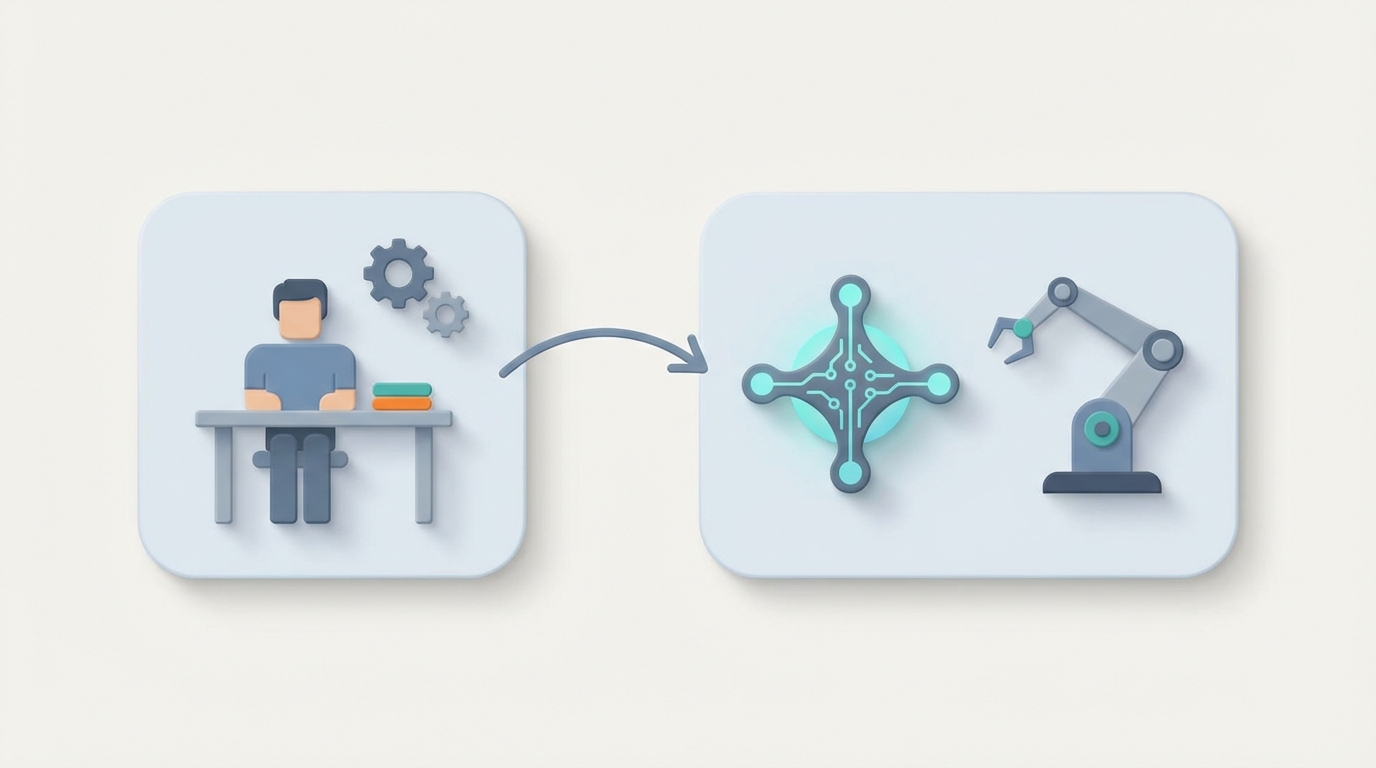
Most warranty administrators spend their days doing something that looks a lot like this: open email, download attachment, squint at a blurry photo of a serial number, cross-reference it against a policy spreadsheet, type data into an ERP, send a follow-up email asking for the missing invoice, wait three days, get the invoice, re-enter the data, approve the claim, move on to the next one.
Repeat that 200 times a week.
It's not that warranty administration is unskilled work. It's that the bulk of it — the data extraction, the validation checks, the status updates, the back-and-forth emails — is repetitive pattern matching. And repetitive pattern matching is exactly what AI agents are good at.
This isn't a hypothetical. Ford cut warranty claim processing from 10 days to 2 using AI. Cox Automotive processes over a million claims a year with computer vision and ML, reducing admin workload by 65%. Whirlpool sped up resolutions by 40% with AI-driven routing and OCR.
You don't need to be a Fortune 500 company to do the same thing. You need the right agent architecture. Here's how to build an AI warranty administrator on OpenClaw — and where the humans still matter.
What a Warranty Administrator Actually Does All Day
If you've never worked in warranty administration, the role is more complex than it sounds. It's not just "approve or deny." Here's the real breakdown of a typical day:
Claim intake and triage (30-40% of time). Claims come in through email, web portals, phone calls, dealer submissions, and sometimes literal fax machines. Each one needs to be logged, categorized, and matched to the right product and warranty policy. This means extracting serial numbers, purchase dates, defect descriptions, and customer information from a mess of PDFs, photos, and free-text emails.
Verification and review (15-25%). Once a claim is logged, the admin checks it against warranty terms. Is the product still in warranty? Does the defect description match a covered failure mode? Are the supporting documents complete — invoice, repair report, photos? Roughly 25% of initial submissions are incomplete or inaccurate, which means rework before anything moves forward.
Communication (20-30%). This is the part that eats time silently. Emailing a dealer for a missing receipt. Calling a customer to clarify a defect description. Coordinating with a service center on repair authorization. Following up on submissions that have gone cold. Each claim might generate 3-5 touchpoints before resolution.
Approval, denial, and payment processing (10%). The actual decision is often the quickest part. Most claims are straightforward — either they meet the policy criteria or they don't. But the documentation trail leading to that decision is what takes hours.
Reporting and compliance (10-15%). Compiling metrics on claim trends, costs, failure rates, and supplier performance. Ensuring everything complies with regulations like the Magnuson-Moss Warranty Act. Handling audits. Flagging potential fraud patterns.
Process improvement and escalations (5-10%). Updating procedures, training new hires, working with engineering on root-cause analysis for recurring defects.
A single warranty admin handles anywhere from 100 to 500 claims per day depending on industry and complexity. The auto and consumer goods sectors are at the high end. Peak periods — end-of-warranty rushes, product recalls — create backlogs that can take weeks to clear.
The Real Cost of This Hire
Let's talk numbers, because this is where the math starts to matter.
A mid-level warranty administrator in the US earns $50,000 to $65,000 base salary. Add 25-30% for benefits, payroll taxes, and overhead, and you're looking at $63,000 to $85,000 total cost to company. In high-cost markets like California or New York, add another 15-25%.
Senior admins or those in automotive and tech push $75,000 to $104,000 fully loaded. Contractors run $25-40 per hour.
But salary is only part of the story. The hidden costs are what really add up:
Training. Warranty administration is domain-specific. A new hire needs 2-4 months to learn your product lines, warranty policies, ERP systems, and escalation procedures. During that ramp-up, they're operating at maybe 50% productivity while consuming a senior admin's time for mentoring.
Turnover. This is the killer. SHRM data puts turnover in administrative roles at 20-30% annually. Glassdoor reviews for warranty admin positions consistently cite "tedious data entry" as a top complaint. Every time someone leaves, you're back to square one on training — plus recruiting costs (typically 50-75% of annual salary for replacement).
Error costs. Human error rate on manual data entry runs 5-10%. In warranty administration, errors mean incorrect payments, compliance violations, or fraudulent claims slipping through. The industry fraud rate is estimated at 5-15% of total claims, and manual processes catch a fraction of it.
Scale constraints. When claim volume spikes, you can't just flip a switch. You either eat the backlog (40% of claims take 2+ weeks to resolve during peak periods, per PwC benchmarks) or scramble to hire temps who are even less trained.
So the real question isn't "can I afford an AI agent?" It's "can I afford to keep doing this with humans alone?"
What AI Handles Right Now
Not everything in warranty administration needs a human. Here's what an AI agent built on OpenClaw can handle today, with high reliability:
Document Extraction and Data Entry
This is the single biggest time-saver. OCR and NLP models can extract serial numbers, purchase dates, defect codes, and customer information from PDFs, photos, scanned invoices, and free-text emails at 95%+ accuracy. What takes a human 5-10 minutes per claim takes an agent seconds.
On OpenClaw, you'd set up a document processing node that ingests incoming claim attachments, extracts structured data, and populates your CRM or ERP automatically. No more manual re-keying.
Initial Validation and Rule-Based Checks
Is the product still under warranty? Has this serial number already been claimed? Does the defect description match a covered failure mode? Are all required documents attached?
These are rule-based checks that an OpenClaw agent can execute instantly against your warranty policy database. Roughly 80% of claims can be triaged as "straight-through" — clearly valid, clearly invalid, or clearly incomplete — without any human judgment.
Automated Approvals for Low-Risk Claims
For claims that pass all validation checks and fall below a certain dollar threshold, the agent can auto-approve and trigger payment or repair authorization. This alone can handle 40-50% of total claim volume. The human only sees the exceptions.
Fraud Detection
ML models are significantly better than humans at spotting fraud patterns across large datasets. Unusual claim frequencies from a single dealer, serial number anomalies, suspiciously similar defect descriptions across unrelated claims — an OpenClaw agent can flag these in real time with around 85% precision, compared to the much lower catch rate of manual review.
Customer and Dealer Communication
An OpenClaw agent can handle the bulk of routine communications: sending acknowledgment emails, requesting missing documents with specific instructions about what's needed, providing status updates, and answering FAQs about warranty coverage. This eliminates the 20-30% of time admins spend on back-and-forth messaging for straightforward cases.
Reporting and Analytics
Real-time dashboards showing claim trends, costs by product line, failure rate predictions, and supplier performance metrics. No more spending Friday afternoons compiling spreadsheets. The agent generates these continuously.
What Still Needs a Human
Here's where I want to be honest, because overselling AI capabilities is a fast way to end up with a system nobody trusts.
Complex disputes and negotiations. When a high-value dealer is threatening to switch suppliers over a denied claim, that's a relationship conversation. It requires empathy, judgment about the long-term business value, and the ability to negotiate a resolution that isn't strictly by-the-book. AI can surface the relevant data and history, but the human makes the call.
Edge cases and deep fraud investigations. The AI flags anomalies. But investigating whether a pattern of claims represents a staged failure scheme or just a genuinely defective batch requires contextual reasoning, phone calls, and sometimes legal coordination. Humans are still better at this.
Policy interpretation in ambiguous situations. Warranty terms aren't always clear-cut. When a failure could plausibly fall under two different coverage categories, or when regional regulations create conflicting obligations, you need someone who understands the legal and business implications of the interpretation.
Root-cause collaboration. When claim data reveals a systemic defect, the warranty team needs to work with engineering, quality, and supply chain to identify the root cause and implement corrections. This is cross-functional, creative problem-solving that AI can inform but not drive.
Escalations with emotional weight. Some customers are angry. Some situations are genuinely unfair. Handling these with appropriate empathy and authority is a human skill.
The realistic picture: an AI agent handles 70-80% of the volume and 60-70% of the total time. Your human administrators shift from data entry clerks to exception handlers and strategic analysts. You might go from three full-time admins to one, supported by an agent that never sleeps and never misses a validation check.
How to Build One with OpenClaw
Here's the practical part. OpenClaw gives you the framework to build this as a multi-node agent workflow. Let me walk through the architecture.
Step 1: Claim Ingestion Node
Set up an intake node that monitors your claim submission channels — email inbox, web portal API, dealer portal. The node parses incoming submissions and routes them into the processing pipeline.
node: claim_ingestion
triggers:
  - email_inbox: warranty-claims@yourcompany.com
  - webhook: /api/claims/submit
  - scheduled_poll: dealer_portal_api
actions:
  - extract_attachments
  - classify_claim_type
  - route_to: document_processing
Step 2: Document Processing and Data Extraction
This node handles OCR on photos and PDFs, NLP extraction on free-text descriptions, and structured data parsing from form submissions. It outputs a standardized claim record.
node: document_processing
model: openclaw/document-extract
inputs:
  - claim_attachments
  - claim_text
outputs:
  - serial_number
  - purchase_date
  - defect_description
  - product_category
  - supporting_docs_checklist
validation:
  confidence_threshold: 0.92
  fallback: human_review_queue
The confidence threshold is important. When the model isn't sure about a serial number extraction, it routes to a human rather than guessing. This is how you maintain data quality.
Step 3: Policy Validation Node
Cross-references the extracted claim data against your warranty policy database. Checks eligibility, coverage terms, duplicate claims, and document completeness.
node: policy_validation
inputs:
  - extracted_claim_data
  - warranty_policies_db
  - claims_history_db
checks:
  - warranty_active: purchase_date + coverage_period > today
  - no_duplicate: serial_number NOT IN recent_claims
  - docs_complete: all required_docs present
  - covered_defect: defect_code IN policy.covered_failures
outputs:
  - validation_status: [approved, denied, incomplete, review_needed]
  - missing_items: []
  - risk_score: float
Step 4: Fraud Detection Node
Runs the claim against ML models trained on your historical fraud patterns. Looks for anomalies in claim frequency, geographic clustering, defect description similarity, and timing patterns.
node: fraud_detection
model: openclaw/anomaly-detect
inputs:
  - extracted_claim_data
  - dealer_history
  - regional_claim_patterns
outputs:
  - fraud_risk_score: float
  - flags: []
threshold:
  auto_flag: 0.75
  auto_block: 0.92
Step 5: Decision and Routing Node
This is the orchestration layer. Based on validation status and fraud score, it either auto-approves, auto-denies with explanation, requests missing info, or escalates to a human.
node: decision_routing
rules:
  - if: validation_status == approved AND fraud_risk < 0.3 AND claim_value < $500
    action: auto_approve
    trigger: payment_processing
  - if: validation_status == denied
    action: auto_deny
    trigger: denial_notification
  - if: validation_status == incomplete
    action: request_docs
    trigger: communication_node
  - if: fraud_risk > 0.75 OR claim_value > $2000 OR validation_status == review_needed
    action: escalate
    trigger: human_review_queue
Step 6: Communication Node
Handles all outbound messaging — approval confirmations, denial explanations, document requests, and status updates. Uses templated responses personalized with claim details.
node: communication
model: openclaw/compose
channels:
  - email
  - dealer_portal_message
  - sms (if opted in)
templates:
  - approval_confirmation
  - denial_with_explanation
  - missing_docs_request
  - status_update
tone: professional, clear, specific
personalization:
  - customer_name
  - claim_reference
  - specific_missing_items
  - next_steps
Step 7: Reporting Node
Continuously aggregates claim data into dashboards. Tracks processing times, approval rates, cost trends, fraud detection rates, and agent performance metrics.
node: reporting
schedule: continuous
outputs:
  - dashboard: claim_volume_by_product
  - dashboard: avg_processing_time
  - dashboard: cost_by_category
  - dashboard: fraud_detection_rate
  - alert: if avg_processing_time > 24h
  - alert: if fraud_rate_spike > 2x_baseline
  - weekly_report: management_summary
Putting It Together
The full pipeline runs as a single OpenClaw agent. Claims flow in, get processed, validated, scored, decided, communicated, and reported — all without a human touching the straightforward ones.
Your human admin gets a clean queue of only the claims that need judgment: high-value cases, flagged fraud, ambiguous policy interpretations, and angry customers. Instead of processing 200 claims a day, they're reviewing 30-40 that actually need their expertise.
The implementation timeline is realistic: 2-4 weeks for a basic pipeline with your existing warranty policies and claim data, another 2-4 weeks to train the fraud detection model on your historical patterns, and ongoing refinement as the agent learns from human decisions on escalated cases.
The Math
Let's run it. Three warranty administrators at $75,000 fully loaded each = $225,000/year. Plus turnover costs (let's say one leaves annually) = another $40,000-$55,000 in recruiting and training. Total: roughly $270,000-$280,000/year.
An OpenClaw agent handling 70% of volume means you need one administrator instead of three. Cost: $75,000 for the human + OpenClaw platform costs. Even accounting for setup and ongoing model refinement, you're looking at $100,000-$130,000/year total — a 50%+ reduction.
But the cost savings aren't even the best part. Processing time drops from days to hours. Error rates plummet. Fraud detection improves dramatically. Your remaining human admin is doing interesting, high-judgment work instead of burning out on data entry. And the system scales linearly — a 3x spike in claims doesn't require a hiring scramble, just more compute.
Next Steps
You've got two options.
Build it yourself. OpenClaw gives you everything you need to architect this agent. Start with the claim ingestion and document extraction nodes — that's where you'll see the fastest ROI. Add validation and auto-approval next. Layer in fraud detection once you have a baseline. The YAML configurations above are a real starting framework, not pseudocode.
Or let us build it for you. If you'd rather skip the implementation curve and have a production-ready AI warranty administrator deployed into your existing systems, that's exactly what Clawsourcing does. We'll map your warranty policies, integrate with your CRM/ERP, train the models on your historical claims data, and hand you a working agent. You focus on the exceptions. The agent handles everything else.
Either way, the days of paying humans to squint at blurry serial number photos and re-type data into SAP are numbered. The technology is here. The economics are obvious. The only question is how fast you move.