AI Health Information Technician: Automate Medical Records Management
Replace Your Health Information Technician with an AI Health Information Technician Agent
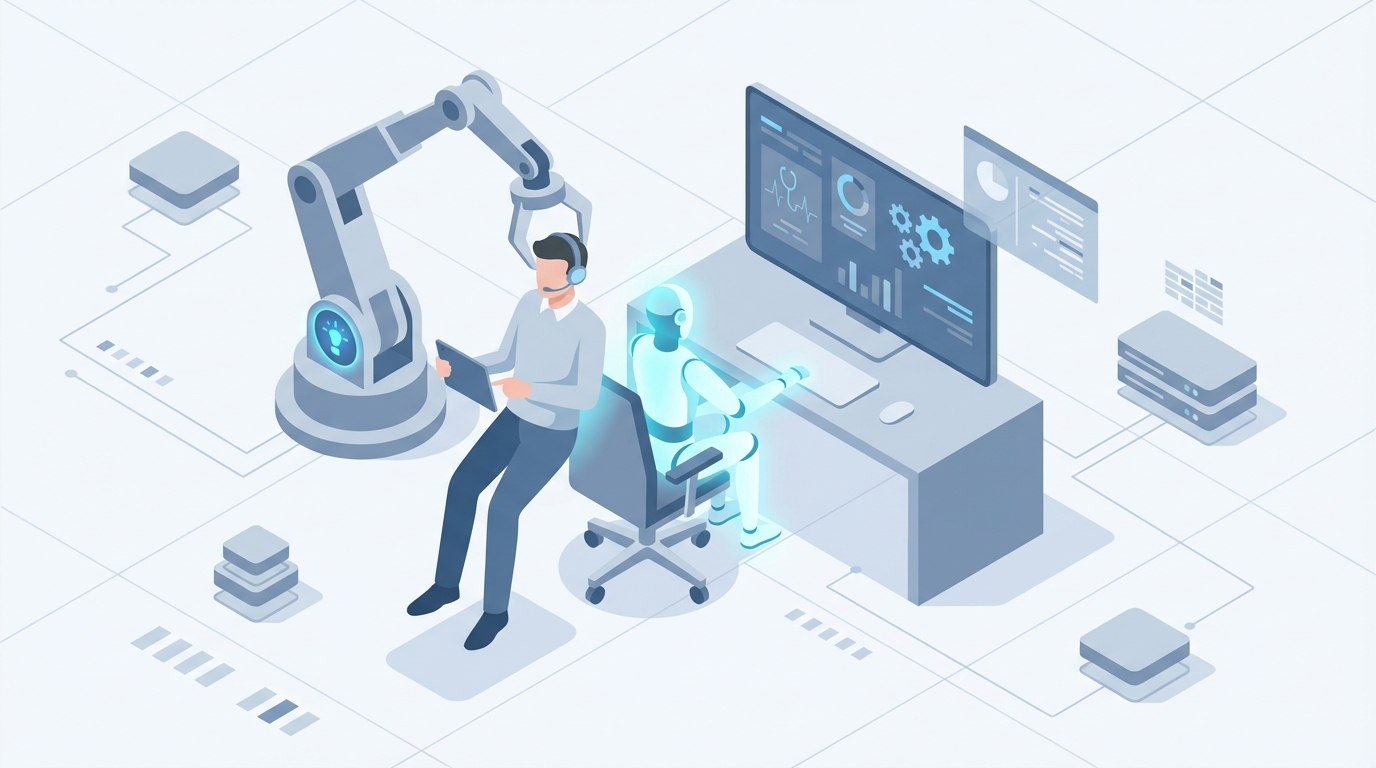
Let's talk about what a Health Information Technician actually does all day, because most people outside healthcare have no idea — and that's exactly why this role is ripe for AI replacement.
A Health Information Technician (HIT) sits at a desk for 60-70% of their workday, staring at an EHR system like Epic or Cerner, doing work that is simultaneously critical and mind-numbingly repetitive. They review patient records for completeness. They assign ICD-10 and CPT/HCPCS codes to diagnoses and procedures so hospitals can get paid. They extract data for quality reporting. They audit records for HIPAA compliance. They merge duplicate patient files, fix data entry errors, and generate reports that nobody reads until a regulator shows up.
The average HIT processes 100 to 200 records per day. Roughly 40-50% of their time goes to medical coding and abstracting alone — reviewing clinical notes, deciphering a physician's documentation, querying providers when something's ambiguous, and applying the correct standardized codes. Another 20-30% goes to data entry and reconciliation. The rest splits between auditing, compliance checks, and reporting.
It's essential work. It's also the kind of work that AI handles extremely well right now.
The Real Cost of a Health Information Technician
Before we talk about replacing the role, let's be honest about what it costs.
The U.S. Bureau of Labor Statistics puts the median salary for Medical Records Specialists at $48,780 per year. Entry-level positions start around $37,000; senior or certified roles (RHIT/RHIA credentials via AHIMA) push past $72,000. In California, the average is $62,000. In rural areas, you might get away with $40,000.
But salary is just the start. Add 25-40% for benefits, payroll taxes, workers' comp, and overhead. That's $60,000 to $70,000 per full-time equivalent, minimum.
Now factor in what doesn't show up on a budget line:
Training costs. ICD-10 updates added over 200 new codes in 2026 alone. Every update means retraining. Every new compliance mandate means more education hours. AHIMA certification maintenance requires ongoing continuing education.
Turnover costs. Annual turnover in HIT roles runs 15-20%. Every departure means recruiting, onboarding, and months of reduced productivity while the replacement gets up to speed. Conservative estimates put the cost of replacing a single HIT at 50-75% of their annual salary.
Error costs. Manual coding produces error rates that lead to 20-30% of claims being denied on first submission. Denied claims mean delayed reimbursement, rework, and potential compliance exposure. HIPAA fines average $1.5 million per breach.
Backlog costs. Post-COVID telehealth surges overwhelmed HIT departments. Coding backlogs can delay reimbursements by weeks, directly impacting cash flow.
A single HIT costs $60,000-$70,000 per year in direct compensation. The indirect costs — errors, turnover, backlogs, training — can easily double that figure. And you probably need more than one.
What AI Can Handle Right Now
This isn't speculative. Major health systems are already using AI for HIT tasks, and the results are concrete.
Automated Medical Coding: AI models using NLP can scan clinical notes and suggest ICD-10 and CPT codes with 80-95% accuracy on routine cases. CodaMetrix deployed their AI coding platform at Mass General Brigham and WakeMed, achieving 90%+ accuracy and reducing reimbursement delays from 30 days to 5. 3M's 360 Encompass CAC automates 70-80% of coding at institutions like Mayo Clinic and Cleveland Clinic, cutting manual coding time in half and error rates by 30%.
Data Extraction and Entry: AI with OCR and NLP capabilities pulls structured and unstructured data from clinical documents at 90%+ accuracy. Vitals, diagnoses, procedure details, medication lists — all extractable without a human touching the record. Humans only need to validate edge cases.
Anomaly Detection and Duplicate Resolution: AI flags duplicate patient records, missing consent forms, incomplete documentation, and compliance risks with roughly 85% detection rates. This is pattern matching at scale — exactly what machines are built for.
Abstraction and Reporting: Generating HEDIS measures, quality metrics, and regulatory reports from aggregated data is largely automatable. The AI pulls the numbers; a human confirms clinical relevance.
Auditing and Compliance Screening: Rule-based AI checks can scan records against HIPAA requirements, flag potential violations, and identify documentation gaps before an auditor does.
The consensus from Gartner and HIMSS is that AI can automate 40-60% of routine HIT tasks today, with potential to reduce headcount needs by 20-30%. That's not a future projection — that's current capability.
What Still Needs a Human
Here's where I'm going to be honest, because overpromising is how AI projects fail.
Complex coding judgment. When a patient presents with multiple comorbidities, social determinants of health, or ambiguous clinical documentation, AI struggles. It can suggest codes, but a human needs to make the final call on cases where context matters — and in healthcare, context always matters for the hard cases.
Provider communication. When clinical notes are incomplete or contradictory, someone has to pick up the phone (or send a message) and query the physician. AI can draft the query. AI cannot navigate the politics of telling a surgeon their documentation is insufficient.
Legal and regulatory interpretation. AI can flag potential HIPAA issues. It cannot interpret novel legal situations, respond to regulatory inquiries, or make judgment calls about data release requests that fall in gray areas. The 21st Century Cures Act interoperability mandates are a moving target that requires human interpretation.
Quality improvement design. AI can identify patterns — this department has a 25% higher denial rate, this physician's documentation triggers more queries. But designing the intervention, getting buy-in from stakeholders, and implementing process changes? That's human work.
Ethical oversight. Healthcare data is sensitive. Someone needs to own the ethical implications of how data is used, shared, and protected. That's not delegable to a machine.
The realistic model is this: AI handles 60-70% of the volume (the routine, repetitive, high-volume work), and a smaller team of experienced HITs handles the remaining 30-40% (the complex, judgment-heavy, interpersonal work). You don't eliminate humans — you eliminate the need for a full department of humans doing work that doesn't require human intelligence.
How to Build an AI Health Information Technician with OpenClaw
Here's where it gets practical. OpenClaw lets you build AI agents that can handle the automatable portions of the HIT role without requiring you to stitch together five different enterprise products.
Step 1: Define Your Agent's Scope
Don't try to automate everything at once. Start with the highest-volume, most time-consuming task: medical coding and data extraction.
In OpenClaw, you create an agent with a clear system prompt that defines its role, constraints, and output format:
You are a Health Information Technician AI agent. Your primary responsibilities are:

1. Review clinical documentation and extract relevant diagnoses, procedures, and patient data
2. Assign appropriate ICD-10-CM diagnosis codes and CPT/HCPCS procedure codes
3. Flag records that require human review due to ambiguity, complexity, or missing information
4. Ensure all output complies with current coding guidelines and HIPAA requirements

Constraints:
- Never fabricate codes. If uncertain, flag for human review with confidence score
- Always cite the specific clinical documentation supporting each code assignment
- Flag any record with fewer than 3 data points as incomplete
- Output structured JSON for downstream system integration
Step 2: Build Your Knowledge Base
OpenClaw's knowledge base system is where this gets powerful. Upload your coding references, compliance documents, and institutional guidelines:
- Current ICD-10-CM code tables and guidelines
- CPT/HCPCS code sets relevant to your facility's specialties
- Your organization's coding policies and query templates
- HIPAA compliance checklists
- Payer-specific documentation requirements
- Historical coding data (anonymized) to help the agent learn your patterns
# OpenClaw Knowledge Base Configuration

knowledge_sources:
  - name: "ICD-10-CM 2026"
    type: reference_document
    update_frequency: annual
    priority: high
  - name: "Internal Coding Policies"
    type: institutional_guidelines
    update_frequency: quarterly
    priority: high
  - name: "Payer Requirements"
    type: reference_document
    update_frequency: monthly
    priority: medium
  - name: "Historical Coding Patterns"
    type: training_data
    update_frequency: weekly
    priority: medium
Step 3: Set Up Your Workflow Pipelines
The agent needs to handle multiple tasks in sequence. OpenClaw's workflow builder lets you chain these together:
Pipeline 1: Intake and Extraction Clinical document comes in → Agent extracts patient demographics, diagnoses, procedures, medications → Outputs structured data → Flags incomplete records
Pipeline 2: Code Assignment Structured data from Pipeline 1 → Agent assigns ICD-10 and CPT codes → Assigns confidence score to each code → Routes high-confidence codes (>90%) to auto-approval → Routes low-confidence codes to human review queue
Pipeline 3: Compliance Check Coded record → Agent scans against HIPAA requirements, payer rules, and internal policies → Flags violations → Generates audit trail
Pipeline 4: Reporting Approved records → Agent aggregates data → Generates quality metrics, HEDIS measures, and management reports
# OpenClaw Workflow Configuration

workflows:
  medical_coding_pipeline:
    trigger: new_clinical_document
    steps:
      - action: extract_clinical_data
        agent: hit_extraction_agent
        output: structured_patient_data

      - action: assign_codes
        agent: hit_coding_agent
        input: structured_patient_data
        output: coded_record
        confidence_threshold: 0.90

      - action: route_for_review
        condition: confidence < 0.90
        destination: human_review_queue

      - action: compliance_check
        agent: hit_compliance_agent
        input: coded_record
        output: validated_record

      - action: generate_audit_trail
        agent: hit_audit_agent
        input: validated_record
        output: audit_log
Step 4: Integration Points
Your AI HIT agent needs to talk to your existing systems. OpenClaw supports API integrations with major EHR platforms. The key connections:
- EHR System (Epic, Cerner, etc.): Pull clinical documents, push coded data back
- Billing/Revenue Cycle Management: Send approved codes for claim generation
- Compliance Dashboard: Feed audit trails and flagged issues
- Human Review Interface: Queue ambiguous cases for your remaining HIT staff
Step 5: Implement Human-in-the-Loop
This is non-negotiable for healthcare. Configure your OpenClaw agent to require human approval for:
- Any code assignment with confidence below your threshold (start at 90%, adjust based on results)
- Records involving complex multi-comorbidity cases
- Any potential HIPAA compliance flag
- First-time code applications for newly added ICD-10 codes
- All data release requests
# Human-in-the-Loop Configuration

human_review:
  required_conditions:
    - confidence_score < 0.90
    - complexity_flag: true
    - compliance_flag: true
    - new_code_flag: true
    - data_release_request: true

  escalation:
    timeout: 4_hours
    escalate_to: senior_hit_supervisor

  feedback_loop:
    enabled: true
    retrain_frequency: weekly
The feedback loop is critical. Every time a human reviewer corrects or confirms the agent's output, that data flows back into the system. Your agent gets more accurate over time, specific to your institution's patterns and preferences.
Step 6: Monitor and Measure
Track the metrics that matter:
- Coding accuracy rate (target: 90%+ for auto-approved, trending toward 95%)
- Records processed per hour (compare against human baseline of 12-25/hour)
- Denial rate on AI-coded claims vs. previously human-coded claims
- Time from documentation to coded record
- Human review queue volume (should decrease over time as agent improves)
- Compliance flag accuracy (false positive rate)
OpenClaw's analytics dashboard gives you these out of the box. Set up alerts for accuracy drops or unusual patterns.
The Math
Let's run the numbers on a mid-size clinic with 3 HITs:
Current cost: 3 HITs × $65,000 (fully loaded) = $195,000/year. Plus indirect costs from errors, turnover, and backlogs — conservatively another $50,000-$100,000.
With an OpenClaw AI agent: Keep 1 experienced HIT for oversight, complex cases, and provider communication. Cost: $65,000. OpenClaw platform: a fraction of the two salaries you just eliminated.
Net savings: $100,000-$150,000 per year, with faster reimbursement cycles, lower denial rates, and consistent 24/7 processing capacity.
The AI doesn't call in sick. It doesn't need two weeks of retraining when ICD-10 updates drop. It doesn't burn out from processing its 150th record of the day. And it doesn't leave for a competitor, taking institutional knowledge with it.
Start Here
If you want to build this yourself, start with OpenClaw. Define a single pipeline — I'd recommend starting with automated coding for your highest-volume, most straightforward record type. Run it in shadow mode alongside your human team for 30 days. Compare accuracy. Adjust. Then expand.
If you don't want to build it yourself — or if you want it done right the first time with healthcare-specific expertise — hire us to build it through Clawsourcing. We'll scope the project, build the agent, integrate it with your EHR, and hand you a system that's actually working before you write the second check.
Either way, the technology is here. The ROI is clear. The only question is whether you deploy it now or wait until your competitors do it first.