Fleet Coordination on Autopilot: AI Agent for Vehicle Management
Replace Your Fleet Coordinator with an AI Fleet Coordinator Agent
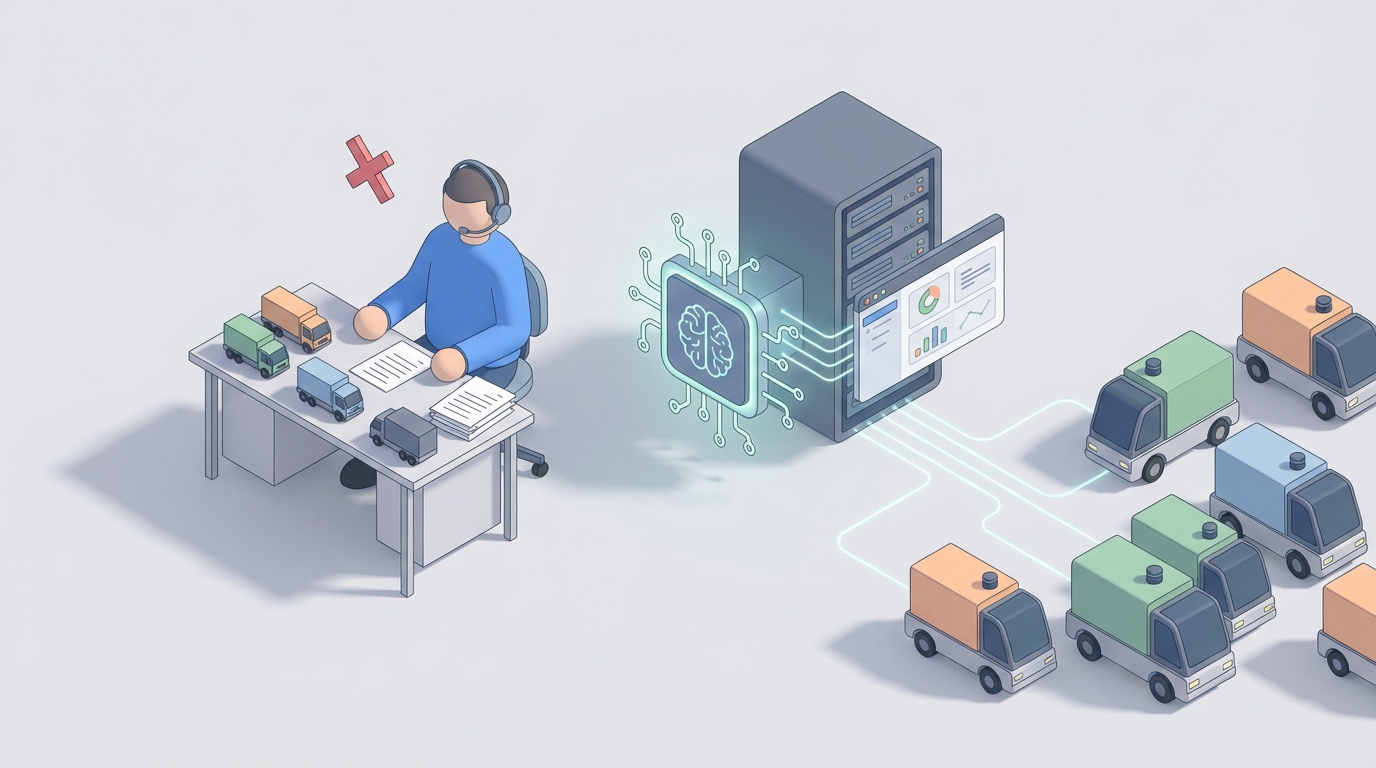
Fleet coordinators are the people who keep vehicles moving, drivers legal, and maintenance from turning into a five-alarm fire. They're essential — until you realize that most of what they do all day is react to dashboards, update spreadsheets, and chase vendors over the phone. That's not strategy. That's process. And process is exactly what AI agents are built to handle.
I'm not going to tell you that AI can replace every aspect of fleet coordination tomorrow. It can't. But it can handle 60-70% of the work that currently eats a coordinator's week — and it can do it faster, cheaper, and without calling in sick. Let me walk you through what this actually looks like, what it costs, and how to build it on OpenClaw.
What a Fleet Coordinator Actually Does All Day
If you've never worked alongside a fleet coordinator, here's the reality. Their day breaks down roughly like this:
40-50% desk work: Data entry, emails, phone calls. Logging maintenance issues in one system, cross-referencing driver availability in another, emailing a vendor about a brake job, calling a driver about an expired CDL. It's unglamorous admin work spread across 4-7 different software tools that don't talk to each other.
30% monitoring dashboards: GPS and telematics platforms (Samsara, Geotab, Verizon Connect) spit out real-time data — vehicle locations, idle times, fuel consumption, fault codes. The coordinator watches these, waiting for something to go wrong so they can react.
20% fieldwork and vendor coordination: On-site inspections, meeting with mechanics, negotiating with tire suppliers, handling the aftermath of a breakdown or accident.
The specific tasks that eat the most time:
- Maintenance scheduling and tracking (25-35% of their week): Logging issues, scheduling service windows, following up with shops, tracking parts on backorder, analyzing downtime patterns.
- Manual reporting and data entry (20-30%): Pulling numbers from telematics, compiling fuel reports, building compliance spreadsheets for audits, duplicating data across systems because nothing integrates cleanly.
- Driver and vehicle dispatching (15-25%): Matching available drivers to vehicles to jobs, adjusting assignments in real time when someone calls out or a truck breaks down.
- Compliance documentation (10-20%): FMCSA hours-of-service logs, DVIR records, emissions paperwork, CDL renewal tracking, DOT inspection prep.
Notice the pattern? Most of this is monitoring, logging, scheduling, and reacting. It's rules-based work with some judgment calls sprinkled in. A human can do it, but a human doing it is expensive, slow, and prone to the kind of errors that come from toggling between seven browser tabs at 3 PM on a Friday.
The Real Cost of This Hire
Let's talk numbers, because this is where the decision actually gets made.
The average US fleet coordinator salary lands between $48,000 and $68,000 per year, with a median around $57,000 according to BLS data. Experienced coordinators managing large fleets (50+ vehicles) in high-cost markets like California or New York can push $85,000.
But salary is never the real number. The real number is total cost to employer, which SHRM estimates at 1.25-1.4x base salary once you factor in:
- Health insurance and benefits: $8,000-$15,000/year
- Payroll taxes: ~7.65% (FICA)
- Training and onboarding: $3,000-$5,000 for a new hire
- Software licenses they need: $2,000-$5,000/year
- PTO and sick time: 15-20 days average
- Turnover costs when they leave (and transportation roles turn over at 25-30% annually): $15,000-$25,000 per replacement
All in, you're looking at $65,000 to $90,000 per year for one fleet coordinator. For a mid-size operation running 50-100 vehicles, you probably need two or three of them to cover shifts and workload peaks.
That's $130,000 to $270,000 per year in coordinator costs before anyone optimizes a single route.
An AI agent running on OpenClaw costs a fraction of that. We're talking hundreds to low thousands per month depending on complexity, not tens of thousands. And it doesn't need health insurance, doesn't take PTO, and doesn't quit after 18 months to go coordinate someone else's fleet.
What AI Handles Right Now (With OpenClaw)
This isn't theoretical. These are tasks that AI agents handle today, reliably, in production environments. Companies like UPS, FedEx, PepsiCo, and Schneider National have already proven the models at scale. UPS's ORION system optimizes over 100 million delivery stops per day and saves them $400 million annually in fuel alone. FedEx's predictive maintenance AI reduced breakdowns by 25% across 100,000+ vehicles.
You don't need to be UPS to get these benefits. OpenClaw lets you build the same types of agents for your fleet, scaled to your operation.
Here's what an OpenClaw-powered fleet coordinator agent can do:
Real-Time Vehicle Tracking and Alerts
An OpenClaw agent connects to your telematics API (Samsara, Geotab, whatever you're running) and monitors your entire fleet continuously. Not a human glancing at a dashboard between emails — continuous, 24/7 monitoring.
The agent flags anomalies automatically: excessive idle time, route deviations, geofence breaches, fault codes that indicate impending mechanical issues. Instead of a coordinator noticing a check-engine light during their morning dashboard review, the agent catches it at 2 AM and creates a maintenance ticket before the driver even starts their next shift.
trigger: vehicle_fault_code_detected
conditions:
  - fault_severity: >= warning
  - vehicle_status: active
actions:
  - create_maintenance_ticket:
      priority: based_on_fault_code_severity
      assign_to: nearest_preferred_vendor
      notify: driver, ops_manager
  - check_vehicle_schedule:
      if_assigned_next_24h: flag_for_reassignment
  - log_event: compliance_database
Predictive Maintenance Scheduling
This is the single highest-ROI application. Unplanned vehicle downtime costs fleets an average of $500-$1,000 per vehicle per day in lost productivity. ML models trained on your telematics data — mileage patterns, engine hours, historical repair data, fault code frequency — can predict failures before they happen.
An OpenClaw agent doesn't just predict the failure. It handles the entire workflow: identifies the predicted issue, checks the vehicle's schedule, finds an open service window that minimizes operational impact, contacts your preferred vendor through their API or via automated email, and reschedules the driver to a backup vehicle. The coordinator used to spend 25-35% of their week on this. The agent does it in seconds.
Automated Dispatching and Vehicle Assignment
When a job request comes in, the agent evaluates:
- Which vehicles are available and closest to the pickup point
- Which drivers are legal to drive (HOS remaining, CDL status, required endorsements)
- Vehicle capacity and type match for the job
- Fuel levels and range
- Maintenance windows that might conflict
It makes the assignment, notifies the driver, and updates all relevant systems. When a driver calls out sick, the agent automatically reassigns their vehicle and routes to the next best available driver — something that used to mean 45 minutes of phone calls and spreadsheet juggling.
Compliance Monitoring and Reporting
FMCSA hours-of-service violations cost $1,000+ per incident. CDL expirations can ground a driver instantly. Emissions paperwork filed late means fines.
An OpenClaw agent tracks every compliance deadline across your fleet — every driver's HOS status in real time, every CDL renewal date, every vehicle inspection due date, every emissions test window. It doesn't track them in a spreadsheet that someone has to remember to check. It actively monitors and acts: sending renewal reminders 60, 30, and 7 days out; preventing dispatch of drivers approaching HOS limits; auto-generating DVIR reports from telematics data; compiling audit-ready compliance packages on demand.
agent: compliance_monitor
schedule: continuous
monitors:
  - driver_hos_status:
      warning_threshold: 2_hours_remaining
      action: restrict_new_assignments, notify_driver
  - cdl_expiration:
      warning_days: [60, 30, 7]
      action: notify_driver, notify_manager, block_dispatch_if_expired
  - vehicle_inspection_due:
      warning_days: [30, 14, 3]
      action: schedule_inspection, notify_coordinator
  - emissions_certification:
      warning_days: [45, 14]
      action: schedule_test, create_reminder
Cost Analysis and Route Optimization
The agent continuously analyzes fuel consumption patterns, toll costs, and route efficiency across your fleet. It identifies which vehicles are burning more fuel than expected (potential maintenance issue or driver behavior problem), which routes consistently underperform, and where consolidation opportunities exist.
Dynamic route optimization alone — adjusting for real-time traffic, weather, and delivery windows — typically yields 5-15% fuel savings. On a 50-vehicle fleet spending $500,000 annually on fuel, that's $25,000-$75,000 back in your pocket.
What Still Needs a Human
Here's where I'm going to be honest, because overselling AI is how you end up with expensive software that disappoints everyone.
Vendor negotiations: AI can identify that you need a brake job and find available shops. It cannot negotiate a better labor rate with your preferred mechanic or evaluate whether a shop's quote is fair based on your relationship history and local market. Humans are still better at the relational, leverage-based parts of vendor management.
High-stakes decisions: Should you approve a $12,000 engine rebuild or replace the vehicle? That requires judgment about fleet strategy, capital allocation, resale values, and business direction that AI can inform but shouldn't make alone.
Crisis management with empathy: When a driver is involved in an accident, they need a human being on the other end of the phone. AI can handle the initial triage — alerting emergency services, notifying insurance, dispatching a replacement vehicle — but the human element of supporting your people in stressful situations isn't something you automate away.
Union and labor relations: If your drivers are unionized, assignment rules can be byzantine and politically sensitive. AI can learn the rules, but navigating grievances and shop steward conversations requires a human.
Insurance claims and legal disputes: Anything that might end up in a courtroom needs human oversight. AI can compile the documentation, but a person needs to own the process.
Integration with truly legacy systems: If part of your operation still runs on paper forms or a 2003-era ERP that has no API, the AI agent hits a wall. It can't interface with what doesn't have a digital interface. (Though this is a temporary limitation — digitize that stuff and the agent can handle it.)
The realistic picture: an AI fleet coordinator agent handles 60-70% of the work, and your remaining human coordinator (you probably only need one now, not three) focuses on vendor relationships, strategic decisions, driver support, and the edge cases the agent flags for human review.
That's not eliminating jobs for the sake of it. That's letting your best coordinator do the work that actually requires human judgment instead of spending half their day copying numbers between spreadsheets.
How to Build This on OpenClaw
Here's the practical part. Building an AI fleet coordinator agent on OpenClaw involves connecting your existing data sources, defining your workflows, and letting the platform handle the orchestration.
Step 1: Map Your Data Sources
List every system your fleet operation touches:
- Telematics/GPS: Samsara, Geotab, Motive, Verizon Connect
- Maintenance management: Fleetio, Whip Around, RTA Fleet
- HR/Driver records: Your HRIS or even a structured spreadsheet
- Fuel cards: WEX, Comdata, Fuelman
- ERP/Accounting: QuickBooks, NetSuite, SAP
- Communication: Email, Slack, SMS
OpenClaw connects to these via APIs or, for systems without clean APIs, through structured data imports. The goal is a unified data layer that your agent can read from and write to.
Step 2: Define Your Agent's Core Workflows
Don't try to automate everything at once. Start with the highest-ROI workflows:
Priority 1 — Maintenance automation: Connect telematics fault codes → maintenance ticket creation → vendor scheduling → driver notification → vehicle reassignment. This alone saves 10-15 hours per week for a typical coordinator.
Priority 2 — Compliance monitoring: Connect driver records and telematics → continuous HOS tracking → CDL/certification expiration monitoring → automated alerts and dispatch restrictions.
Priority 3 — Dispatch optimization: Connect job requests → vehicle/driver availability → automated assignment → route optimization → real-time adjustment.
# Example: OpenClaw Fleet Coordinator Agent - Core Config
agent_name: fleet_coordinator
data_sources:
  telematics:
    provider: samsara
    api_key: ${SAMSARA_API_KEY}
    sync_interval: 5_minutes
  maintenance:
    provider: fleetio
    api_key: ${FLEETIO_API_KEY}
    sync_interval: 15_minutes
  fuel:
    provider: wex
    import_method: daily_csv
  driver_records:
    source: google_sheets  # or your HRIS API
    sync_interval: daily

workflows:
  - maintenance_automation:
      trigger: fault_code OR mileage_threshold OR time_interval
      steps:
        - evaluate_severity
        - check_vehicle_schedule
        - create_maintenance_ticket
        - find_available_vendor
        - schedule_service
        - reassign_vehicle_if_needed
        - notify_stakeholders
      escalate_to_human_if:
        - estimated_cost > $5000
        - safety_critical_fault
        - no_backup_vehicle_available

  - compliance_monitor:
      trigger: continuous
      checks:
        - hos_remaining < 2_hours
        - cdl_expiration < 60_days
        - vehicle_inspection_due < 30_days
      actions:
        - alert_appropriate_parties
        - restrict_dispatch_if_violation_imminent
        - generate_compliance_report_weekly

  - smart_dispatch:
      trigger: new_job_request
      logic:
        - match_vehicle_type_to_job
        - check_driver_availability_and_compliance
        - optimize_route
        - assign_and_notify
      fallback: escalate_to_human_coordinator
Step 3: Set Escalation Rules
This is critical. Your agent needs clear rules for when to handle something autonomously and when to flag a human. Good escalation rules are what separate a useful agent from a liability.
Define thresholds for:
- Cost: Any repair or purchase over $X gets human approval
- Safety: Any safety-critical fault code goes to a human immediately, even if the agent creates the ticket
- Exceptions: Anything that doesn't match a known pattern gets flagged rather than guessed at
- Driver issues: Behavioral alerts (harsh braking patterns, HOS patterns suggesting fatigue) go to a human for the conversation
Step 4: Test With a Subset
Don't roll this out across your entire fleet on day one. Pick 10-15 vehicles and run the agent alongside your existing coordinator for 2-4 weeks. Compare:
- Did the agent catch maintenance issues the coordinator missed (or vice versa)?
- Were dispatch assignments comparable or better?
- Did compliance alerts fire accurately?
- How many false positives needed human dismissal?
Tune the agent based on what you learn, then expand gradually.
Step 5: Measure and Iterate
After 90 days of full deployment, you should be tracking:
- Vehicle downtime %: Should decrease 20-30%
- Coordinator hours spent on automated tasks: Should drop 60%+
- Compliance violations: Should approach zero for preventable issues
- Fuel costs per mile: Should decrease 5-15% from route optimization
- Response time to fault codes: Should drop from hours to minutes
These aren't aspirational numbers. They're consistent with what companies running AI fleet tools are already seeing in production.
The Bottom Line
A fleet coordinator costs you $65,000-$90,000 per year all-in. An AI fleet coordinator agent on OpenClaw costs a fraction of that and handles the majority of the work — the repetitive, reactive, rules-based work that burns out good coordinators and creates bottlenecks when they're out sick or leave for another job.
You don't eliminate the human entirely. You reduce your coordinator headcount, upskill the ones you keep into strategic roles (vendor management, fleet planning, driver development), and let the agent handle the 60-70% of tasks that never required human judgment in the first place.
The companies that have already done this — UPS saving $400M annually, FedEx cutting breakdowns by 25%, Schneider slashing dispatch time in half — they didn't get there by waiting. They started automating the obvious stuff and expanded from there.
You can build this yourself on OpenClaw. The platform, the integrations, and the workflow engine are all there. Start with maintenance automation, add compliance monitoring, layer in smart dispatch, and iterate.
Or, if you'd rather have someone build it for you, that's what Clawsourcing is for. We'll scope your fleet operation, build the agent, connect your systems, and hand you a working AI fleet coordinator tuned to your specific vehicles, drivers, and workflows. You focus on running the business. We'll build the agent that keeps the fleet moving.