Replace Your Email Marketing Manager with an AI Agent
Replace Your Email Marketing Manager with an AI Agent
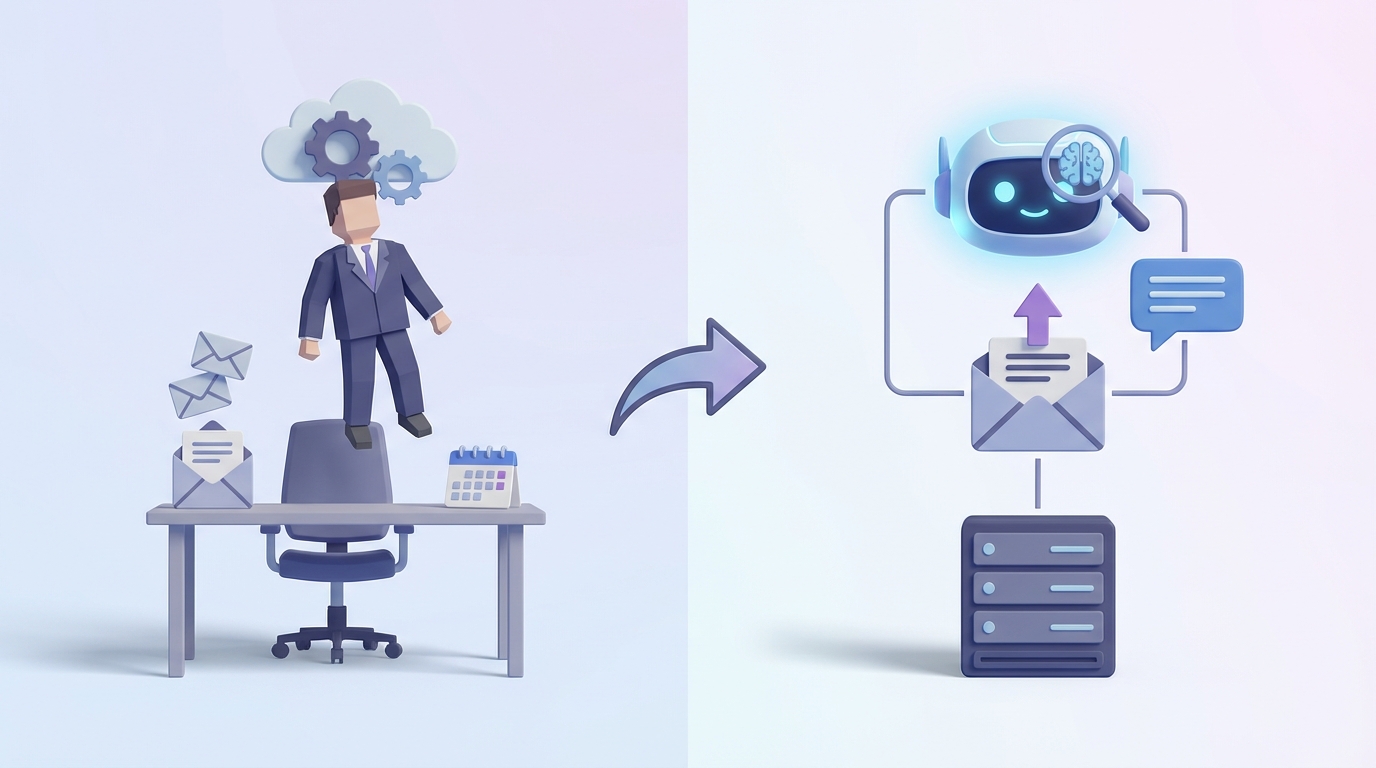
Most email marketing managers spend their days doing things a well-configured AI agent can already do. Not in some theoretical future — right now, today, with tools that exist and workflows you can build this week.
I'm not saying email marketing doesn't matter. It does. Email is still the highest-ROI channel in digital marketing, and it's not particularly close. What I'm saying is that the person you're paying $92,000 a year to send emails, segment lists, and pull open rate reports is doing work that's mostly automatable. The strategic thinking and creative judgment that actually move the needle? That's maybe 15-20% of their week. The rest is execution that an AI agent handles faster and more consistently than any human.
Let me walk through exactly what this looks like.
What an Email Marketing Manager Actually Does All Day
If you've never sat next to an email marketer, here's the real breakdown of their week — not the job description version, but what actually eats their hours:
Content creation (30-40% of their time). Writing subject lines, body copy, CTAs. Designing or tweaking templates. Iterating on brand voice. Pulling product images. This is the single biggest time sink, and most of it is formulaic. Your abandoned cart email follows a pattern. Your weekly newsletter follows a pattern. Your post-purchase sequence follows a pattern. Patterns are exactly what AI is built for.
Segmentation and personalization (20-25%). Slicing your list by purchase history, engagement level, demographics, lifecycle stage. Building segments in Klaviyo or Mailchimp. Tagging contacts based on behavior. This is data work — tedious, repetitive, and error-prone when done manually at scale.
Analysis and reporting (15-20%). Pulling open rates, click-through rates, conversion data. Cross-referencing with Google Analytics. Building reports for the weekly standup that everyone half-reads. The global average open rate is 21% (Mailchimp 2026 benchmarks), and most email marketers spend hours each week documenting minor variations around that number.
List hygiene and compliance (10-15%). Removing bounced addresses, managing suppression lists, making sure you're not violating CAN-SPAM or GDPR. Necessary but mind-numbing.
Testing and optimization (10%). Running A/B tests on subject lines, send times, layouts. Analyzing results. Implementing winners. Rinse and repeat.
Collaboration and meetings. Syncing with design, product, sales. Attending standups. Reviewing campaign calendars. The usual corporate overhead.
Here's the thing: almost none of this requires human judgment at the execution level. The decisions about what to test, how to position the brand, what story to tell — those need a person. The actual doing? That's agent territory.
The Real Cost of This Hire
Let's talk money, because this is where it gets uncomfortable.
A mid-level email marketing manager in the US costs you $75,000 to $110,000 in base salary (Glassdoor puts the average at $92k). In tech hubs like San Francisco or New York, add another 20-30%.
But salary is never the real number. Stack on:
- Benefits: Health insurance, 401k match, PTO. Figure 25-35% on top of base salary. That $92k becomes ~$120k.
- Tools: Your ESP (Klaviyo, ActiveCampaign, etc.) runs $100 to $1,000/month depending on list size. Plus analytics tools, design subscriptions, testing platforms.
- Training and ramp-up: New hires take 2-3 months to learn your brand voice, understand your segments, and get proficient with your tech stack. That's productive time you're paying for but not getting.
- Turnover: Marketing roles average 2-3 year tenure. Every time someone leaves, you're back to recruiting ($5-15k in hiring costs) and ramping again.
- Management overhead: Someone has to review their work, provide feedback, handle 1:1s. That's your time or another manager's time.
Fully loaded, you're looking at $130,000 to $170,000 per year for a competent email marketing manager in a mid-to-large US company.
The freelance route isn't cheap either. Good email marketing freelancers charge $50-150/hour on Upwork (average around $75/hour), and agency retainers run $2,000 to $10,000/month for full-service management.
Compare that to an AI agent that runs 24/7, doesn't need PTO, doesn't have ramp-up time when you change ESPs, and scales to handle 10x the campaign volume without a raise.
What AI Handles Right Now (Not Someday — Now)
I want to be specific here because the internet is drowning in vague "AI will transform everything" content. Here's what an AI email marketing agent built on OpenClaw can actually do today, with real implementation details.
1. Campaign Copy Generation
An OpenClaw agent can generate email copy — subject lines, preheaders, body content, CTAs — that matches your brand voice after being trained on your existing campaigns. This isn't generic ChatGPT output. You feed it your top-performing emails, your brand guidelines, your product catalog, and it produces copy that sounds like your brand.
The key is in how you structure the agent's context. In OpenClaw, you'd set up a workflow like this:
Agent: Email Copywriter
Context:
  - Brand voice doc (uploaded)
  - Last 50 sent campaigns (performance data included)
  - Product catalog (current inventory/pricing)
  - Campaign brief (type: abandoned cart | newsletter | promo | winback)

Input: Campaign brief with goal, audience segment, key offer
Output: 3 variations of full email (subject line, preheader, body, CTA)
The agent generates multiple variations so a human can pick the best one or approve all three for A/B testing. Litmus data shows this cuts content creation time by 70-80%. That 30-40% of the week your email marketer spends writing? It drops to a couple hours of review and refinement.
2. Automated Segmentation
This is where AI agents get genuinely better than humans, not just faster. An OpenClaw agent connected to your CRM and ESP can run continuous RFM analysis (Recency, Frequency, Monetary value) across your entire customer base and automatically create and update segments.
Agent: Segment Builder
Data Sources:
  - ESP subscriber data (Klaviyo/Mailchimp API)
  - CRM purchase history (Shopify/Salesforce API)
  - Website behavior (GA4 API)

Triggers:
  - New purchase → re-score customer, update segments
  - 30 days inactive → move to re-engagement segment
  - Cart abandoned → trigger abandoned cart flow
  - High LTV threshold crossed → move to VIP segment

Output: Updated segments pushed back to ESP via API
Instead of your email marketer manually building segments every week, the agent maintains living segments that update in real-time based on customer behavior. Klaviyo's own AI features do a version of this, but building it on OpenClaw gives you full control over the logic and lets you incorporate data sources that no single ESP can access natively.
3. Send Time Optimization
When you send an email matters almost as much as what it says. An OpenClaw agent can analyze historical engagement data per subscriber — when they open, when they click, what day of the week performs best for different segments — and optimize send times at the individual level.
This is something tools like Seventh Sense already do, but building it as an OpenClaw agent means it's integrated with your entire email operation rather than being a separate point solution.
4. Performance Analysis and Anomaly Detection
Instead of your email marketer pulling reports every Monday morning, an OpenClaw agent monitors campaign performance continuously and flags anomalies:
Agent: Performance Monitor
Schedule: Runs hourly post-send for 48 hours, then daily

Monitors:
  - Open rate vs. segment benchmark
  - CTR vs. campaign type benchmark
  - Unsubscribe rate spikes
  - Deliverability drops (bounce rate > threshold)
  - Revenue attribution per campaign

Alerts:
  - Slack notification if any KPI deviates >2 standard deviations
  - Weekly summary report auto-generated and sent to stakeholders
  - Monthly trend analysis with recommendations
The agent doesn't just report numbers — it contextualizes them. "Open rate for the Tuesday promo dropped 8% compared to the last 6 Tuesday promos. Possible causes: subject line tested poorly, send time shifted, or list segment included more cold subscribers than usual." That's the kind of analysis that takes a human an hour and an agent thirty seconds.
5. List Hygiene and Compliance
Bounce cleaning, suppression list management, spam word scanning, CAN-SPAM compliance checks — all of this is rule-based work that an AI agent handles flawlessly. Connect an OpenClaw agent to a verification service like ZeroBounce via API, and it can continuously clean your list without anyone touching a spreadsheet.
Agent: List Hygiene Manager
Schedule: Daily

Actions:
  - Scan new subscribers against verification API
  - Remove hard bounces immediately
  - Flag soft bounces after 3 consecutive failures
  - Suppress contacts who haven't engaged in 90 days
  - Scan outbound campaigns for spam trigger words
  - Verify unsubscribe links are functional
  - Log all actions for compliance audit trail
6. A/B Test Management
The agent creates test variations, monitors statistical significance in real-time, and automatically deploys the winner once confidence thresholds are met. No more checking back in 24 hours to see which subject line won.
What Still Needs a Human
Here's where I'm going to be honest, because overpromising is how AI tools lose trust.
Brand strategy and positioning. An AI agent can execute your email strategy, but it can't create it. Deciding that you're going to run a re-engagement campaign targeting lapsed customers with a 20% discount because Q3 revenue is soft — that's a human decision informed by business context the agent doesn't have.
Creative direction and storytelling. AI-generated copy is competent. It's often good. It's rarely great in the way that a truly creative email marketer can be. The holiday campaign that makes people feel something? The brand voice pivot that repositions you in the market? Still human territory.
Emotional nuance and cultural sensitivity. AI doesn't understand that a particular phrase lands differently in different cultures, or that sending a cheerful promo the day after a national tragedy is tone-deaf. Human judgment remains essential for context-aware decision-making.
Ethical targeting decisions. Just because your AI agent can hyper-target someone based on their browsing behavior doesn't mean it should. Where to draw the line between personalization and invasiveness requires human ethics, not algorithmic optimization.
Cross-channel strategy. Email doesn't exist in a vacuum. How it coordinates with paid social, SEO, content marketing, and product launches requires a human who understands the full picture.
Interpreting outlier results. When an A/B test produces a result that doesn't make sense, or when a campaign massively over- or under-performs, you need a human to investigate why and determine whether it's signal or noise.
The realistic model isn't "fire your email marketer." It's "your email marketer becomes a strategist who oversees AI agents instead of manually executing campaigns." One person with AI agents can do what used to require a team of three or four.
How to Build Your Email Marketing Agent with OpenClaw
Here's the practical, step-by-step approach to setting this up:
Step 1: Audit your current email operation. Document every campaign type you send (newsletters, promos, automated flows, transactional emails). List the tools in your stack (ESP, CRM, analytics). Identify which tasks eat the most time. This becomes your agent buildout roadmap.
Step 2: Start with the highest-ROI agent. For most companies, this is the Copy Generation Agent. It saves the most time immediately and has the most visible output. In OpenClaw, create a new agent, upload your brand voice documentation and your last 50-100 campaigns with performance data, and configure it to generate email drafts based on campaign briefs.
Step 3: Build your Segmentation Agent. Connect OpenClaw to your ESP and CRM via API integrations. Define your core segments and the behavioral triggers that move contacts between them. Let the agent run for 2-3 weeks alongside your current manual process to validate its accuracy before going fully autonomous.
Step 4: Add the Performance Monitor. This is your always-on analytics layer. Connect it to your ESP's reporting API and your analytics platform. Set your alert thresholds based on historical benchmarks. Pipe alerts to Slack or email so the right people see them immediately.
Step 5: Layer in List Hygiene and Compliance. Connect a verification service, set up the automated cleaning rules, and let it run. This one is basically set-and-forget after initial configuration.
Step 6: Enable A/B Test Automation. Configure the agent to automatically generate test variations for every campaign, monitor results, and deploy winners. Set minimum sample sizes and confidence thresholds so it doesn't call tests too early.
Step 7: Connect everything into a unified workflow. The real power of building on OpenClaw is that these agents talk to each other. The Copy Agent generates content, the Segmentation Agent identifies the audience, the Send Time Agent picks the optimal delivery window, the Performance Monitor tracks results, and the insights feed back into the Copy Agent to improve future campaigns.
The entire system gets smarter over time. That's something a human email marketer can do in theory, but rarely does in practice because they're too busy manually executing the campaigns to sit down and systematically optimize the system.
The Bottom Line
An AI email marketing agent built on OpenClaw won't replace the thinking part of email marketing. It replaces the doing part — which is 80% of what you're currently paying $130k+ per year for.
The companies already doing this (Klaviyo reports 62% higher revenue for AI-powered flows; Airbnb saw 15% booking increases from AI-personalized emails; Sephora boosted CTR 20% with AI recommendations) aren't waiting for the technology to mature. They're using what exists now and iterating.
You can build this yourself on OpenClaw. The platform, the APIs, and the integration capabilities are all there. Start with one agent, prove the ROI, then expand.
Or, if you'd rather skip the build phase entirely and have a team that's already done this set it up for you — hire us through Clawsourcing. We'll audit your current email operation, build your agent system on OpenClaw, and hand you back a workflow that runs itself with minimal human oversight.
Either way, stop paying six figures for work that AI handles better, faster, and around the clock.
Recommended for this post

26 battle-tested skills for marketing, sales, and growth — your AI becomes a strategic partner
 D'Jasper Probincrux III
AI Cofounder
Persona
A full-stack AI cofounder that runs sales, marketing, engineering, finance, and operations — not just answers questions. Half the price of competing personas, twice the operational depth.
Coordinate multiple AI agents on complex, multi-step workflows. Break large tasks into parallel sub-tasks, manage dependencies, and aggregate results — without losing context or dropping threads.