AI Agent for Patreon: Automate Membership Management, Content Delivery, and Patron Communication
Automate Membership Management, Content Delivery, and Patron Communication
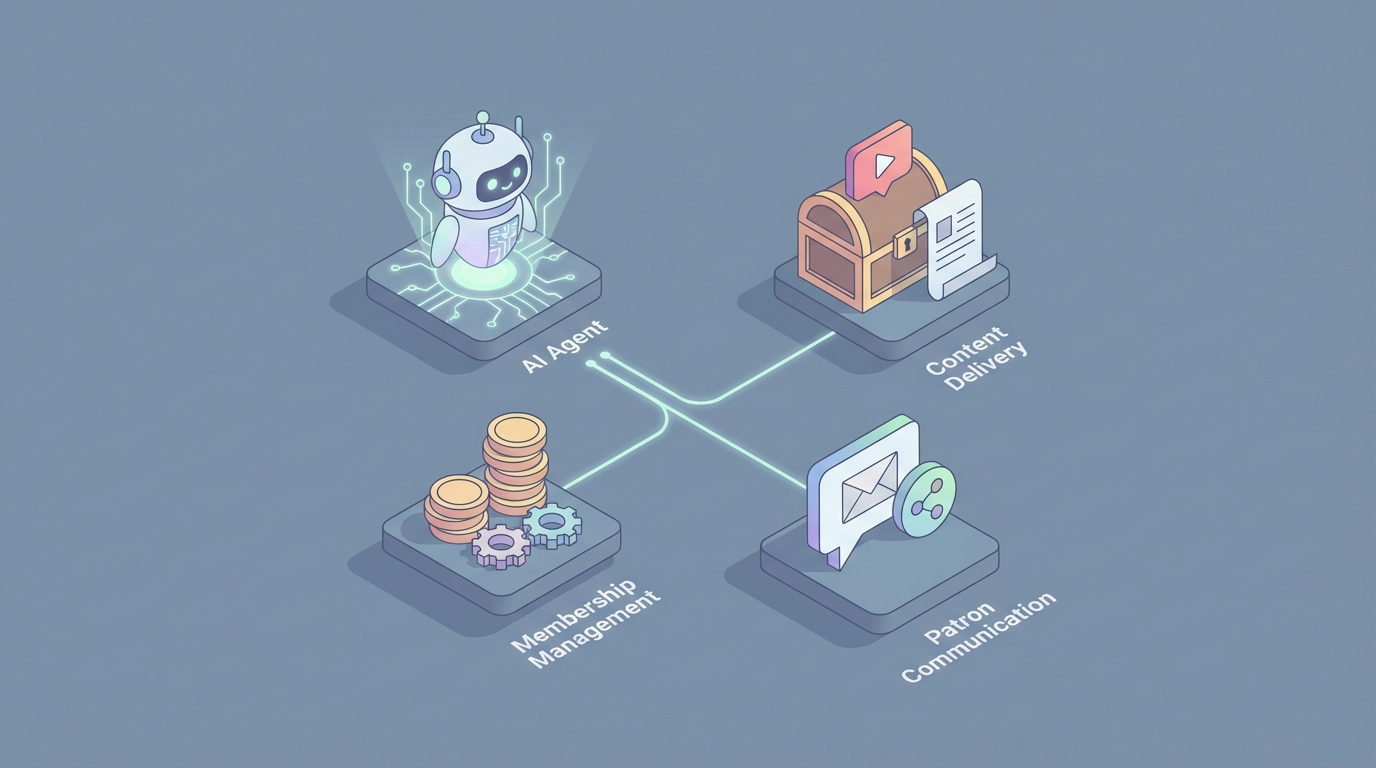
Most Patreon creators I talk to are stuck in the same loop: publish content, respond to messages, manually track who's about to churn, send a half-hearted "thanks for being a patron" DM, and wonder why 20% of their members disappear every month. The built-in tools are basically a notification system with a payment processor bolted on. That's it.
Here's what actually works: building a custom AI agent that plugs into Patreon's API, watches everything happening across your membership in real time, and takes intelligent action without you copy-pasting between six tabs. Not Patreon's AI features (which are minimal). Not a ChatGPT wrapper. A purpose-built agent running on OpenClaw that treats your Patreon like the business it actually is.
Let me walk through exactly how this works, what it can do, and how to build it.
The Real Problem With Patreon at Scale
Patreon's native automation is, to put it charitably, basic. You get:
- Welcome emails that feel like they were written by a template engine in 2014
- Tier-based Discord role assignment that breaks semi-regularly
- Post notifications
- That's essentially it
There's no conditional logic. No way to say "if a patron has been in Tier 3 for six months and hasn't opened my last four posts, send them a personalized re-engagement message." No way to combine Patreon engagement data with Discord activity or email opens. No segmentation beyond which tier someone is in.
The result is that creators end up building a Rube Goldberg machine out of Zapier, Make.com, Airtable, Notion, and prayers. It works until it doesn't — and it always stops working at the worst possible time, like when you're running a launch or taking a much-needed week off.
The deeper problem is that Patreon is a relationship business masquerading as a content platform. The creators who retain patrons for years aren't just publishing more content. They're making people feel seen, delivering personalized value, and intervening before someone clicks "cancel." That requires intelligence, not just automation.
What the Patreon API Actually Gives You
Before building anything, you need to understand what you're working with. Patreon offers an OAuth2 REST API (v2) and a set of webhooks. Here's the honest breakdown:
What you can read:
- Campaign details (your page metadata)
- Full member list with pledge amount, tier, billing info, start date, last charge date, and patron status
- Posts and post comments
- Tiers/rewards configuration
- Campaign goals
Webhooks you can listen to:
members:pledge:create— someone just pledgedmembers:pledge:update— pledge changed (upgrade, downgrade, payment issue)members:pledge:delete— someone cancelled or was removedmembers:create,members:update,members:delete- Post publish events
What you can't do (the important part):
- You cannot create or modify tiers via API
- You cannot publish posts programmatically
- You cannot send messages or emails through the API
- Rate limits are restrictive for large creators (10,000+ patrons)
- Bulk operations are mostly absent
- Shipping address access is increasingly restricted
This means your agent needs to be smart about what it does within the API and what it orchestrates outside of it — through email providers, Discord bots, or direct outreach tools. This is exactly the kind of multi-system coordination that OpenClaw is designed for.
Building the Agent on OpenClaw
OpenClaw is where this all comes together. Instead of stitching together disconnected automations, you build a single intelligent agent that understands your Patreon business holistically — patron behavior, content performance, engagement patterns, churn risk — and acts on it.
Here's the architecture:
Data Layer: Webhook Listener + API Polling
Your OpenClaw agent starts by ingesting data from two sources:
1. Webhook receiver — Set up an endpoint that Patreon sends events to in real time:
# Webhook endpoint for Patreon events
@app.route('/patreon/webhook', methods=['POST'])
def patreon_webhook():
    event = request.json
    trigger = event['data']['type']

    if trigger == 'member':
        patron_data = {
            'patron_id': event['data']['id'],
            'full_name': event['data']['attributes']['full_name'],
            'email': event['data']['attributes']['email'],
            'pledge_amount': event['data']['attributes']['currently_entitled_amount_cents'],
            'status': event['data']['attributes']['patron_status'],
            'last_charge_date': event['data']['attributes']['last_charge_date'],
            'lifetime_support': event['data']['attributes']['lifetime_support_cents']
        }
        # Pass to OpenClaw agent for processing
        openclaw_agent.process_patron_event(trigger, patron_data)

    return jsonify({'status': 'received'}), 200
2. Scheduled API polling — Because webhooks don't cover everything (like post engagement or comment activity), you also poll the API on a schedule:
# Polling for enriched patron data
def sync_patron_data():
    campaign_id = get_campaign_id()
    members = patreon_client.get_members(
        campaign_id,
        fields={
            'member': ['full_name', 'email', 'patron_status',
                       'currently_entitled_amount_cents', 'last_charge_date',
                       'lifetime_support_cents', 'pledge_relationship_start'],
            'tier': ['title', 'amount_cents']
        }
    )

    for member in members:
        openclaw_agent.update_patron_profile(member)
Intelligence Layer: OpenClaw Agent Logic
This is the part that matters. Your OpenClaw agent isn't just moving data around — it's reasoning about patron behavior and deciding what to do. Here are the core capabilities you should build:
Workflow 1: Smart Churn Prediction and Intervention
This is the single highest-value thing an AI agent can do for your Patreon. Average patron lifetime is 3–8 months. If you can extend that by even one month across your base, the revenue impact is significant.
Your OpenClaw agent builds a risk profile for every patron based on:
- Engagement decay: Are they opening fewer posts? Commenting less?
- Payment patterns: Any declined charges? Downgrade from a higher tier?
- Tenure: Patrons in months 2–4 are statistically most likely to churn
- Content match: Are they in a tier whose recent content doesn't match what they originally signed up for?
When the agent flags a patron as high-risk, it triggers an intervention sequence — not a generic "we miss you" email, but a personalized message based on their actual behavior:
Agent reasoning:
- Patron "Sarah M." has been in Tier 2 ($10/mo) for 4 months
- She engaged with 8/10 posts in months 1-2, but only 1/6 in months 3-4
- Her highest engagement was with video content (3 comments on video posts)
- Last 6 posts were text-only
- Risk score: 78/100

Action: Send personalized email via ConvertKit:
"Hey Sarah — I noticed I've been heavy on written posts lately, but
I know you've loved the video deep-dives. Good news: I'm dropping a
new video breakdown this Thursday that I think you'll really dig.
Wanted to give you a heads up before it goes live."
This isn't a template. The OpenClaw agent generated it based on Sarah's specific engagement history. That's the difference between automation and intelligence.
Workflow 2: Automated Onboarding Sequences
The first 48 hours after someone pledges determine whether they stick around. Patreon's default welcome email is... fine. It exists. But it doesn't orient a new patron, show them what to engage with first, or make them feel like joining was the right call.
Your OpenClaw agent handles this:
-
Webhook fires →
members:pledge:create -
Agent checks tier and pulls the patron's available info
-
Generates a personalized welcome sequence delivered over 3–5 days via email or Discord DM:
- Day 0: Welcome + "start here" guide tailored to their tier
- Day 1: Curated "best of" content picks based on what high-retention patrons in the same tier engaged with most
- Day 3: Check-in asking what they're most interested in (poll or reply-based)
- Day 5: Introduction to the community + how to get the most value
-
Agent logs all of this to the patron's profile for future reference
The content of each message is generated by the OpenClaw agent based on your content library and the patron's tier. You write the framework once. The agent personalizes it forever.
Workflow 3: Cross-Platform Patron Intelligence
Here's where the data silo problem gets solved. Your patrons don't just live on Patreon. They're in your Discord, on your email list, visiting your website, maybe buying merch. But Patreon knows nothing about any of that.
Your OpenClaw agent acts as the central nervous system:
- Patreon → pledge status, tier, billing, content engagement
- Discord (via bot) → message frequency, channels active in, reactions, voice chat participation
- Email (ConvertKit/Beehiiv) → open rates, click rates, reply rates
- Website (analytics pixel) → page visits, time on site, specific content consumed
- Merch/Shopify → purchase history, wishlist activity
The agent combines all of this into a unified patron profile. Now you can do things that are impossible with Patreon alone:
- Identify your true VIPs (high engagement across all platforms, not just highest pledge)
- Find patrons who are super active in Discord but have never opened an email (fix your channel strategy)
- Spot someone who visits your merch store repeatedly but hasn't purchased (trigger a discount code)
- Recognize that a patron's Discord activity dropped off two weeks before they typically cancel (intervene early)
# OpenClaw agent patron scoring
def calculate_patron_health_score(patron_id):
    patreon_data = get_patreon_engagement(patron_id)
    discord_data = get_discord_activity(patron_id)
    email_data = get_email_engagement(patron_id)

    score = openclaw_agent.evaluate(
        prompt=f"""
        Calculate a 0-100 health score for this patron based on:
        - Patreon: {patreon_data}
        - Discord: {discord_data}
        - Email: {email_data}

        Weight recent activity (last 30 days) 3x vs older activity.
        Flag any sharp declines in any channel.
        Return score, risk_factors, and recommended_action.
        """
    )
    return score
Workflow 4: Content Strategy Intelligence
Your OpenClaw agent doesn't just manage patrons — it helps you make better content decisions. By analyzing engagement patterns across your entire post history and patron base, it can surface insights like:
- "Your video posts get 3.2x more comments than text posts, but you've published 80% text in the last two months"
- "Tier 3 patrons engage most with behind-the-scenes content. Tier 1 patrons engage most with tutorials. You're publishing the same content to both."
- "Posts published on Tuesday mornings get 40% more engagement than Friday afternoons"
- "Your top 10% of patrons by lifetime value all joined during months when you published at least 2 video posts"
This is the kind of analysis that would take hours to do manually by exporting CSVs and building pivot tables. Your OpenClaw agent does it on demand when you ask a natural language question: "What content should I prioritize this month to reduce churn in Tier 2?"
Workflow 5: Intelligent Upsell and Expansion
Most creators leave money on the table because they never ask patrons to upgrade — or they ask everyone the same way at the same time. Your OpenClaw agent identifies the right moment and the right message:
- A Tier 1 patron who has engaged with every single post for three consecutive months gets a personalized nudge: "You're getting so much value from the basics — Tier 2 unlocks [specific thing they'd care about based on their engagement pattern]"
- A patron who just hit their one-year anniversary gets a "thank you" message that casually mentions the annual billing option (which saves them money and dramatically reduces your churn)
- A patron who has been very active in community discussions gets invited to a higher tier that includes direct access or AMAs
The agent handles the timing, the personalization, and the delivery. You set the strategy. It executes.
What You're Not Building
To be clear about scope: this agent doesn't replace Patreon. It doesn't try to do things the API won't allow (like programmatically publishing posts — you still do that on platform). What it does is fill every gap that Patreon leaves open:
- Patreon handles: payments, content hosting, basic tier management
- Your OpenClaw agent handles: intelligence, personalization, cross-platform coordination, proactive retention, and analytics
The agent is the brain. Patreon is one of several hands.
The Bottom Line on Impact
Creators who implement this kind of intelligent automation typically see:
- 15–30% reduction in monthly churn through proactive intervention (this alone pays for everything)
- 10–20% increase in average revenue per patron via well-timed upsells and tier optimization
- 5–10 hours per week saved on manual community management, message responses, and data analysis
- Better content decisions driven by actual engagement data instead of gut feel
The math isn't complicated. If you have 500 patrons at $10/month average and you reduce churn by 20%, that's roughly $12,000 in additional annual revenue from people who would have otherwise left. Plus the time you get back to actually create.
Next Steps
If you're running a Patreon with more than a few hundred patrons (or you're scaling toward that), this is the kind of system that pays for itself almost immediately. The combination of Patreon's webhooks, the API's read capabilities, and OpenClaw's agent intelligence gives you something that didn't exist even two years ago: a membership business that gets smarter about every patron, every day, without you doing the work manually.
We build these exact systems through Clawsourcing — our done-with-you service where we architect and deploy custom OpenClaw agents for your specific Patreon setup, content strategy, and tech stack. No cookie-cutter templates. We look at your actual patron data, your churn patterns, your content mix, and build the agent around the workflows that will move the needle most for your specific business.
If you're tired of the Zapier-Airtable-prayers stack and want something that actually thinks, get in touch through Clawsourcing and let's talk about what your Patreon agent should look like.
Recommended for this post
Your SEO specialist that builds content strategies, optimizes pages, and tracks rankings -- own the search results.
 SpookyJuice.ai
Your Claude API expert that optimizes prompts, manages tokens, and builds production AI applications.
SpookyJuice.ai
Scott — Autonomous Prospect Research Agent
Prospect Research Agent
Finds ICP-qualified leads from YC, Product Hunt, IndieHackers, and Twitter. Qualifies every one. Automatically.
 Marco
Marco