How to Automate Daily Safety Compliance Checks with AI
How to Automate Daily Safety Compliance Checks with AI
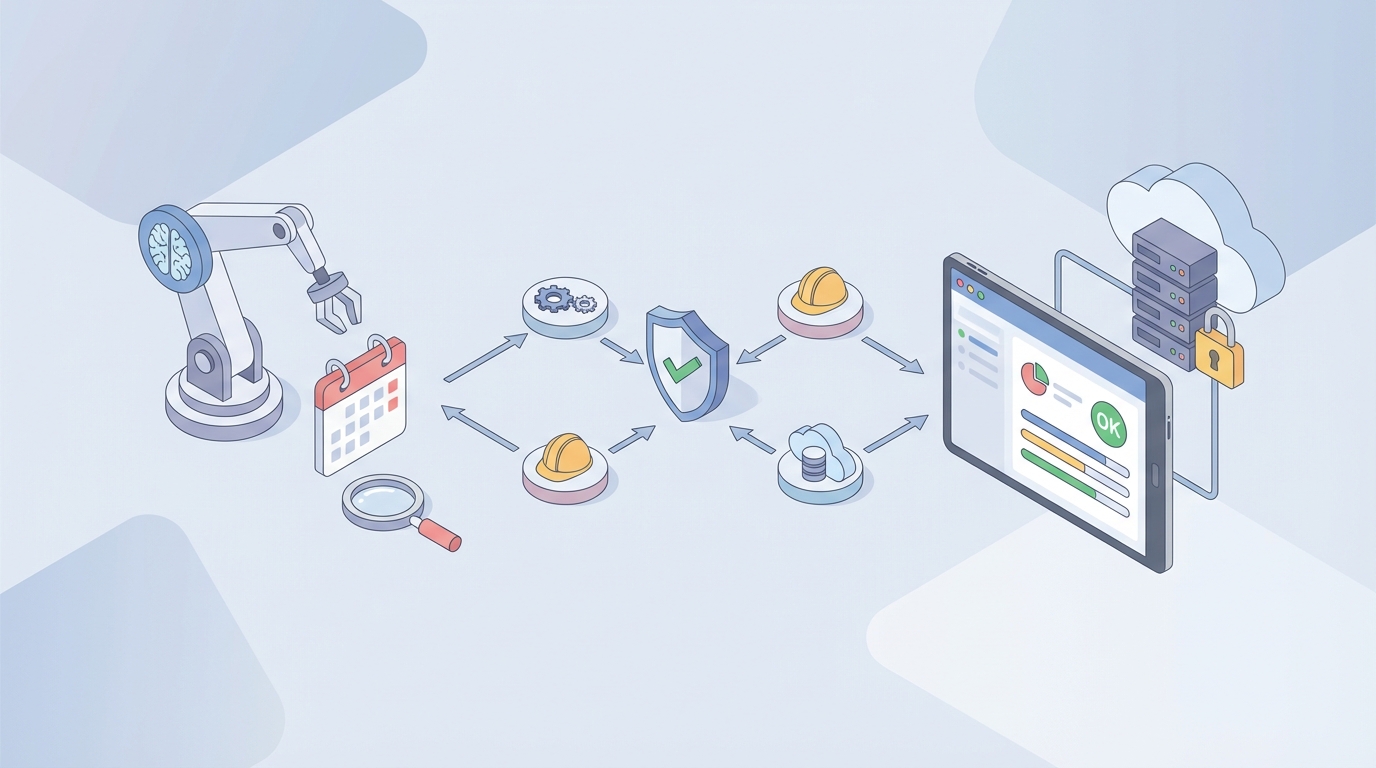
Every safety manager I've talked to in construction says some version of the same thing: "I spend half my week filling out forms and the other half wishing I had time to actually prevent incidents." That ratio is broken. And it's been broken for a long time.
The construction industry accounts for roughly 20% of all U.S. worker fatalities despite representing only about 5% of the workforce. In 2022, the Bureau of Labor Statistics recorded 1,069 fatal injuries on construction sites. Falls remain the leading killer, and fall protection remains OSHA's number-one cited standard — year after year after year.
You'd think with numbers like these, the industry would have airtight compliance processes. Instead, most firms are running safety on spreadsheets, paper checklists, and whatever mobile app their last project owner required. The administrative overhead is enormous. The actual hazard prevention? Inconsistent at best.
Here's where things get interesting: AI is now mature enough to take over the repetitive observation and reporting layers of safety compliance — the parts that eat 30 to 50 percent of a safety professional's week. Not with some speculative future technology. Right now, with tools you can build and deploy on a platform like OpenClaw.
Let me walk through exactly how this works.
The Manual Workflow Today (And Why It Bleeds Time)
If you've worked in or around construction safety, this sequence will be painfully familiar:
Step 1: Pre-job planning. Before work begins, someone develops a site-specific safety plan, Job Hazard Analyses for each major task, and whatever permits are required. This involves reviewing blueprints, schedules, and subcontractor safety programs. Much of this is done in Word documents, emailed around, and stored in folders that nobody opens again until an audit.
Step 2: Daily and weekly inspections. A safety manager or competent person walks the site with a checklist — sometimes on a tablet, sometimes on paper. They visually check guardrails, harnesses, trench shoring, housekeeping, signage, and worker behaviors. They watch for PPE compliance, proper ladder use, barricade placement. On a mid-sized project, a single thorough inspection takes two to three hours. Documentation and follow-up add another one to two hours on top of that.
Step 3: Incident and near-miss reporting. When something goes wrong — or almost goes wrong — workers fill out forms. Supervisors investigate. Root cause analysis gets done using 5-Why templates or similar frameworks. The entire loop from event to documented corrective action can take days.
Step 4: Documentation and record-keeping. Inspection logs, training records, equipment certifications, Safety Data Sheets — all of this has to be compiled, organized, and made accessible for OSHA audits, client audits, and insurance reviews.
Step 5: Training. Toolbox talks, orientation sessions, annual refreshers. Attendance and comprehension are tracked manually in most cases.
Step 6: Audits and corrective actions. Internal audits, third-party audits, follow-up on deficiencies. Reports submitted to owners, insurers, regulators. Each with their own format requirements.
Here's the number that should jump out at you: the Construction Industry Institute estimated in 2022 that manual safety processes consume 8 to 15 hours per week per safety professional on a typical mid-sized project. A large U.S. general contractor profiled in ENR found their safety teams averaged 4.5 hours per site inspection on documentation and follow-up alone. Across 50-plus active sites, that's multiple full-time positions doing nothing but paperwork.
Meanwhile, only 5 to 20 percent of near misses actually get reported. Not because people don't care. Because the process is so cumbersome that workers just skip it.
What Makes This Painful (Beyond the Obvious)
The time cost is the most visible problem, but there are compounding issues that make the whole system fragile:
Inconsistency across sites. Every project owner, every client, every region has slightly different requirements and formats. Your safety manager on Site A is documenting things differently than the one on Site B. When you try to aggregate data to find trends, you're comparing apples to filing cabinets.
Reactive posture. By the time you find a hazard during a scheduled inspection, it's already existed for hours or days. The current workflow is designed to document what went wrong, not to prevent it from happening in the first place.
Poor data quality. When humans manually enter observations under time pressure, data quality suffers. Fields get skipped. Descriptions are vague. Photos are missing or poorly labeled. This makes trend analysis nearly impossible.
Cost of failure. The Liberty Mutual Workplace Safety Index puts the direct and indirect costs of serious construction injuries above $15 billion annually in the U.S. OSHA citations in construction routinely exceed 25,000 per year. A single serious violation can cost over $16,000. A willful violation? Over $160,000.
Scaling is brutal. Adding a new job site means adding more safety personnel or stretching existing staff thinner. Neither option is cheap or sustainable.
The bottom line: companies are spending enormous resources on compliance administration while leaving preventable hazards in place. That's not a people problem. It's a systems problem. And systems problems are exactly what AI is good at solving.
What AI Can Handle Right Now
Let's be clear about what's realistic. I'm not talking about some futuristic robot safety manager. I'm talking about what's demonstrably working in production environments today, and what you can build with OpenClaw's agent platform.
Computer vision monitoring. Real-time detection of PPE compliance — hard hats, high-visibility vests, safety glasses, harnesses — from fixed cameras, drone footage, or 360-degree site captures. Current accuracy exceeds 90 to 95 percent in good conditions. Several Tier-1 contractors (Skanska, DPR Construction) have deployed this and reported 70 to 80 percent reductions in time spent on certain compliance checks.
Automated inspection report generation. Feed an AI agent walkthrough video or a set of site photos, and it produces structured inspection reports with flagged exceptions, timestamps, and locations. No more spending two hours writing up what you saw during a one-hour walk.
Trend analysis and predictive risk scoring. Historical inspection data, weather forecasts, schedule pressure indicators, and workforce factors get crunched to flag high-risk periods, high-risk trades, and high-risk activities before incidents happen.
Document management and compliance tracking. Automatically track training certifications, equipment inspection dates, permit expirations. Flag anything missing or expired without a human having to dig through files.
Incident classification and initial reporting. Natural language processing to categorize incoming reports, suggest standard corrective actions, and route them to the right people.
Real-time alerting. Immediate notifications when a violation is detected — a worker in an exclusion zone, someone at height without a harness, a guardrail missing from an open edge.
These aren't hypothetical capabilities. They're shipping products. And with OpenClaw, you can build agents that tie these capabilities together into a cohesive workflow instead of juggling six different point solutions.
Step-by-Step: Building Your Automated Safety Compliance Agent on OpenClaw
Here's how to actually set this up. I'll walk through the architecture of an AI agent that handles daily safety compliance checks — from data ingestion through reporting and escalation.
Step 1: Define Your Data Sources
Your agent needs inputs. In construction safety, those typically include:
- Camera feeds: Fixed jobsite cameras, drone footage, body-worn cameras, or 360-degree capture devices (like Ricoh Theta or Insta360).
- Existing inspection data: Historical reports from iAuditor, Procore, or even scanned paper checklists.
- Project schedules: From Procore, Primavera P6, or Microsoft Project — so the agent knows what work is happening where.
- Weather data: Via API (OpenWeatherMap, NOAA) to factor conditions into risk scoring.
- Training and certification databases: Employee records with cert dates, expiration dates, and competency levels.
In OpenClaw, you configure these as data connectors in your agent's workspace. OpenClaw supports direct API integrations, file uploads, and webhook listeners, so you can pull from your existing stack without ripping anything out.
Step 2: Build the Observation Layer
This is the core of your daily compliance check automation. You're essentially creating a digital "competent person" that watches the site continuously.
Configure your OpenClaw agent with a vision analysis module pointed at your camera feeds. The agent should be instructed to detect and log:
- Workers without required PPE (hard hats, vests, glasses, gloves, harnesses)
- Unprotected edges, floor openings, or missing guardrails
- Improper ladder positioning or use
- Housekeeping violations (debris in walkways, unsecured materials)
- Exclusion zone breaches
- Unauthorized equipment operation
In your OpenClaw agent configuration, the prompt structure might look something like this:
Agent Role: Construction Site Safety Compliance Monitor

Data Sources:
- Site camera feeds (Cameras 1-12, refreshed every 60 seconds)
- Today's work schedule from Procore API
- Current weather conditions from OpenWeatherMap API
- Active permits and JHAs for today's tasks

Instructions:
1. Analyze each camera frame for PPE compliance violations, fall hazards,
   housekeeping issues, and exclusion zone breaches.
2. Cross-reference detected activities against today's scheduled work
   and active permits. Flag any work occurring without a corresponding permit.
3. For each detected issue, classify severity as:
   - CRITICAL: Imminent danger (unprotected fall hazard, no harness at height)
   - HIGH: Serious violation (missing hard hat, improper scaffolding)
   - MEDIUM: Non-compliance (housekeeping, signage missing)
   - LOW: Observation for trend tracking
4. CRITICAL issues: Trigger immediate alert to site superintendent
   and safety manager via SMS and app notification.
5. HIGH/MEDIUM issues: Log to daily inspection report with
   timestamp, camera ID, location, photo capture, and suggested corrective action.
6. Generate end-of-day compliance summary by 4:00 PM local time.
Step 3: Build the Reporting Layer
Your agent should produce two types of output:
Real-time alerts for critical and high-severity issues. OpenClaw lets you configure notification channels — SMS, email, Slack, Microsoft Teams, or push notifications through a custom app. The alert includes the violation type, location, photo evidence, and recommended immediate action.
Daily compliance reports that mirror the format your clients and regulators expect. This is where OpenClaw's document generation capabilities shine. You can template your reports to match OSHA 300 log formats, client-specific inspection forms, or your company's internal standard.
Here's an example of the output structure you'd configure:
Daily Safety Compliance Report Template:

## Site: [Project Name]
## Date: [Auto-generated]
## Weather Conditions: [From API]
## Active Work Areas: [From schedule]

### Violations Detected
| Time | Location | Camera | Type | Severity | Photo | Status |
|------|----------|--------|------|----------|-------|--------|

### Compliance Score: [Percentage based on observations vs. violations]

### Trend Summary
- PPE compliance rate: [X]% (vs. [Y]% 7-day average)
- Open corrective actions from previous days: [List]
- High-risk areas for tomorrow based on scheduled work: [List]

### Recommended Actions
[AI-generated based on violation patterns and historical data]
Step 4: Build the Corrective Action Tracker
When a violation is flagged, it shouldn't just sit in a report. Your OpenClaw agent can manage the corrective action loop:
- Issue is detected and logged.
- Corrective action is assigned to the responsible party (foreman, subcontractor superintendent) with a deadline.
- Agent monitors whether the condition has been corrected by re-checking the relevant camera feed or prompting for a follow-up photo upload.
- If the deadline passes without resolution, the agent escalates — first to the site safety manager, then to the project manager.
- Closed items are logged with before/after documentation for audit readiness.
This replaces what is normally a multi-day email chain or a whiteboard in the site trailer that nobody updates.
Step 5: Connect Predictive Risk Scoring
This is where the automation moves from reactive to proactive — and it's where the real safety improvements come from.
Your OpenClaw agent can analyze patterns across all your data:
- Weather + schedule: Tomorrow has high winds forecast and steel erection is scheduled. Agent flags elevated fall risk and recommends pre-task briefing emphasis on wind procedures.
- Historical patterns: PPE violations spike on Fridays and in the third week of a new subcontractor's mobilization. Agent prompts additional safety presence during those periods.
- Leading indicators: Near-miss reports have increased 40% over the past two weeks on the south tower. Agent flags this as a potential precursor and recommends a stand-down meeting.
Configure this as a scheduled analysis task in OpenClaw that runs every evening and produces a "risk briefing" for the next day's pre-task meetings.
Step 6: Set Up the Training and Certification Monitor
This one's straightforward but saves enormous administrative time. Your agent continuously monitors:
- Worker certifications (OSHA 10/30, equipment operator licenses, first aid/CPR)
- Equipment inspection dates (cranes, forklifts, scaffolding tags)
- Permit expirations (hot work, confined space, excavation)
When anything is within 30 days of expiration, the agent notifies the responsible party. When anything has expired, it flags the worker or equipment as non-compliant and alerts supervision.
No more spreadsheet reviews. No more surprise audit findings because someone's forklift cert lapsed two months ago.
What Still Needs a Human
I want to be direct about this because overpromising on AI is how you get burned.
Human judgment is non-negotiable for:
- Contextual risk assessment. Is this temporary scaffold configuration safe given this specific wind load, these soil conditions, and this sequence of work? AI can flag the scaffold. A competent person has to evaluate it.
- Root cause investigation. AI can classify an incident and suggest likely contributing factors. A human has to interview witnesses, understand the social dynamics, and determine what actually happened.
- Legal accountability and sign-off. You cannot delegate regulatory responsibility to an AI. A qualified person must review and accept corrective action plans, close out violations, and sign inspection reports.
- Safety culture. Coaching workers, building trust, understanding why someone bypassed a procedure — this is inherently human work. It's also the most important safety work on any project.
- Complex regulatory interpretation. When OSHA shows up or when you're negotiating a variance, you need experienced safety professionals, not algorithms.
- Ethics and privacy. Deploying cameras and AI monitoring on a construction site involves real workforce privacy considerations. These decisions require thoughtful human governance.
The right mental model: AI is a copilot for your safety managers, not a replacement. It handles the observation, documentation, and pattern recognition so your people can focus on the judgment calls, the coaching, and the culture-building that actually prevent fatalities.
Expected Time and Cost Savings
Let's do the math based on the real numbers from the research:
Current state: A safety professional on a mid-sized project spends 8 to 15 hours per week on manual compliance processes. At a fully loaded cost of $75 to $120 per hour for experienced safety personnel, that's $600 to $1,800 per week per project in compliance administration alone.
With an OpenClaw-powered safety compliance agent:
- Automated observation and reporting cuts inspection documentation time by 50 to 80 percent. That's 4 to 12 hours per week reclaimed per safety professional.
- Automated certification and permit tracking eliminates 2 to 3 hours per week of administrative review.
- Predictive risk scoring is net new capability — it doesn't replace existing time, it prevents incidents that would have consumed 20 to 40 hours each in investigation, reporting, and corrective action.
- Corrective action tracking cuts follow-up time by roughly 60 percent.
Conservative estimate: 8 to 15 hours per week saved per project. Across 10 active projects, that's 80 to 150 hours per week — the equivalent of 2 to 4 full-time safety positions redeployed from paperwork to actual hazard prevention.
On the cost avoidance side: Firms aggressively adopting safety technology report 20 to 35 percent improvements in Total Recordable Incident Rate (TRIR), according to a 2026 FMI and Oxford Economics report. Given that the average cost of a serious construction injury runs well into six figures when you factor in direct costs, indirect costs, schedule impact, and insurance premium increases, even one prevented serious injury per year more than pays for the technology.
Real payback period: For most mid-sized contractors, the payback period on this kind of automation is 2 to 4 months.
Getting Started
You don't have to automate everything at once. The highest-impact, lowest-effort starting point is usually this:
- Pick one active job site with existing camera coverage.
- Build a basic PPE compliance monitoring agent on OpenClaw using the camera feeds.
- Configure daily reporting to match your current inspection format.
- Run it alongside your manual process for two weeks and compare.
You'll see the gaps your manual process has been missing. You'll see the time savings on documentation. And you'll have a concrete business case for rolling it out across your projects.
If you want to skip the build-from-scratch phase, check out the Claw Mart marketplace. There are pre-built safety compliance agents and templates that you can deploy on OpenClaw and customize to your specific requirements — your clients' reporting formats, your company's severity classifications, your notification preferences. It's significantly faster than building from zero, and you can modify anything that doesn't fit your workflow.
If you'd rather have someone build and configure the entire system for you, Clawsource it. Post your safety compliance automation project on Claw Mart's Clawsourcing board and get matched with builders who've already deployed this kind of agent for other contractors. You describe what you need — your camera setup, your reporting requirements, your existing tools — and a vetted builder delivers a working agent configured for your operation.
Construction safety is too important to run on spreadsheets and memory. The technology to automate the tedious parts exists today. The people freed up by that automation can go do the work that actually saves lives.
Recommended for this post

Your orchestrator that coordinates agent swarms with task decomposition and consensus protocols -- agents working together.
 SpookyJuice.ai
Your memory engineer that builds persistent context, tiered storage, and retrieval systems -- agents that remember.
SpookyJuice.ai
Helios
Persona
The Elite Agent Architect. Your complete professional partner for building world-class AI agents.
 Just Dan