How to Automate Monthly Rent Collection and Late Fee Reminders
How to Automate Monthly Rent Collection and Late Fee Reminders
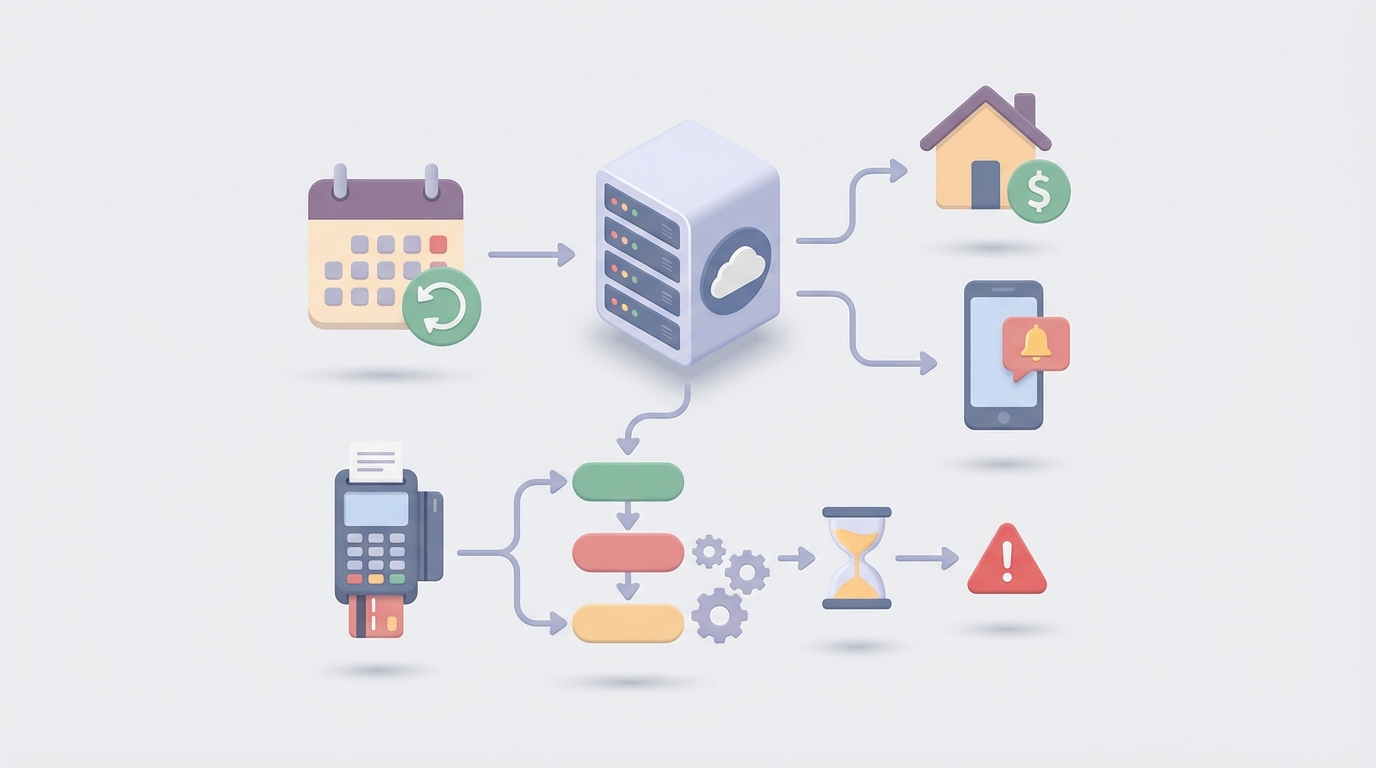
If you manage rental properties, you already know the drill. The first of the month rolls around, and instead of focusing on anything that actually grows your business, you're staring at a spreadsheet trying to figure out who paid, who didn't, who sent a partial payment to the wrong Zelle handle, and who's about to hit day five of their grace period. Then you're writing emails, sending texts, logging into three different platforms, and mentally preparing for the phone call where someone tells you their dog ate their checkbook.
This is the reality for most landlords and property managers. And it's largely unnecessary in 2026.
I'm going to walk you through exactly how to automate monthly rent collection and late fee reminders using an AI agent built on OpenClaw. Not the "wave your hands and everything is magical" version — the real version, where I tell you what the agent handles, what it doesn't, and what the actual time savings look like.
The Manual Workflow Today (And Why It's Eating Your Life)
Let's be honest about what rent collection actually looks like for most operators. Whether you have 5 units or 500, some version of this process repeats every single month:
Step 1: Generate invoices or statements (30–90 minutes) If all your tenants pay the same flat rent, this is simple. But most portfolios have variable charges — utilities, parking, pet fees, storage. Someone has to compile these, review them, and either send them out or post them to a portal. For a 20-unit portfolio, this can easily eat 30–60 minutes. For 100+ units with add-ons, you're looking at a couple of hours even with software doing some of the lifting.
Step 2: Wait, then chase (2–6 hours/month) This is the time vampire. Rent is due on the 1st. Grace period ends on the 5th. By the 6th, you're checking who hasn't paid and starting the outreach cycle: first a friendly reminder email, then a text, then a phone call, then a firmer email. For a portfolio of 100 units with a typical 6–8% delinquency rate, that's 6–8 tenants per month who need individual follow-up. Each one might require 2–4 touchpoints before they either pay or you escalate.
Property managers report spending 15–25 hours per month on AR tasks per 100 units. Small landlords with 5–20 units burn 4–12 hours monthly. That's not managing property — that's being an unpaid collections agent.
Step 3: Process payments (1–3 hours) If everyone pays via ACH through your property management portal, great. But reality is messier. You've got tenants paying via Zelle, Venmo, physical checks, money orders, and occasionally cash. Each payment method requires manual processing, matching to the correct unit, and entry into your accounting system.
Step 4: Reconciliation (1–2 hours) Did unit 4B pay $1,200 or $1,150? Was that $50 short intentional (partial payment) or an error? The Zelle payment from "Mike S." — is that the tenant in 7A or the one in 12C? Partial payments, duplicate payments, and misapplied funds create detective work that scales linearly with your unit count.
Step 5: Apply late fees and generate notices (30–60 minutes) After the grace period, you need to calculate and apply late fees per the lease terms, then generate the appropriate notices. In some jurisdictions, this means a formal 3-day or 5-day pay-or-quit notice with specific legal language. Get the timing or wording wrong, and you've potentially invalidated your right to evict, costing you months.
Step 6: Escalation and reporting (variable) For the tenants who still haven't paid after notices, you're into negotiation territory — payment plans, final warnings, attorney coordination. Plus monthly reporting: AR aging reports, cash flow summaries, owner distributions.
Total realistic time cost per month:
- 5–20 units: 4–12 hours
- 100 units: 15–25 hours (often requiring 1–2 dedicated staff)
- 500+ units: Multiple full-time AR staff
A 2023 proptech study found that property managers spend roughly 22% of their total operational time on rent collection and tenant accounting. That's more than a full day per week for many operators.
What Makes This Painful (Beyond Just the Hours)
The time cost is obvious. But the hidden costs are what really compound:
Cash flow unpredictability. When you can't predict who will pay late — or at all — you can't plan owner distributions, maintenance budgets, or debt service with confidence. Late payments from 6% of tenants can delay distributions for 100% of owners.
Error-driven liability. A late fee applied one day too early. A pay-or-quit notice with the wrong date or amount. A payment misapplied to the wrong unit. These aren't just inconveniences — they're potential legal landmines. In tenant-friendly jurisdictions like California or New York, a procedural error on a notice can reset your eviction timeline by months.
Emotional drain. This is the one nobody puts in the spreadsheet. Calling tenants about late rent is unpleasant. It erodes the landlord-tenant relationship. It's the task that gets procrastinated, which means fees pile up, conversations get harder, and small problems become big ones.
Scaling ceiling. Every unit you add increases the manual burden roughly linearly. This means your margins compress as you grow unless you hire — and good AR staff aren't cheap. You end up in a paradox where growth makes you busier but not proportionally wealthier.
What AI Can Handle Right Now
Here's where I want to be specific, because the AI hype cycle has trained everyone to either believe it can do everything or nothing. The truth for rent collection is somewhere in the middle — but the "somewhere" is genuinely useful.
An AI agent built on OpenClaw can reliably handle the following today:
1. Automated invoice generation with variable charges The agent pulls lease data, utility charges, and any recurring add-ons, compiles the statement, and sends it to each tenant via their preferred channel (email, SMS, portal notification) on a schedule you define. No manual review needed for standard invoices.
2. Intelligent dunning sequences This is the biggest win. Instead of you manually texting tenants on day 6, the agent runs an escalating communication sequence:
- Day 1: Payment confirmation or friendly reminder
- Day 3 (grace period warning): Nudge with specific amount and payment link
- Day 5 (grace period expiration): Formal notice that late fee will be applied
- Day 6: Late fee applied, notification sent with updated balance
- Day 10: Firmer follow-up with payment plan option
- Day 15: Pre-escalation notice
The agent can adjust timing and tone based on tenant history. A tenant who's paid on time for 18 months and is late for the first time gets a different message than a tenant who's been late 4 of the last 6 months.
3. Payment reconciliation Using banking integrations, the agent matches incoming payments to tenants and units, flags discrepancies (partial payments, overpayments, unidentified deposits), and updates your ledger automatically. It handles the 85–90% of payments that are straightforward and surfaces only the exceptions for your review.
4. Late fee calculation and application Per your lease terms and local regulations, the agent calculates and applies late fees automatically. You configure the rules once — flat fee vs. percentage, grace period length, maximum fee caps — and it executes consistently every month.
5. Notice generation The agent drafts legally appropriate notices (pay-or-quit, late payment, lease violation) using templates you've approved with your attorney. It populates tenant-specific details, correct dates, and accurate amounts.
6. Real-time reporting AR aging reports, collection rate dashboards, cash flow projections, and delinquency trend analysis — generated daily or on-demand without anyone pulling data from three systems into a spreadsheet.
7. Tenant self-service The agent can field routine tenant inquiries: "Did my payment go through?" "What's my current balance?" "Can I get a receipt?" These questions, which make up 60–70% of tenant accounting communications, get answered instantly without human involvement.
Step-by-Step: Building Your Rent Collection Agent on OpenClaw
Here's how to actually build this. I'm assuming you have a portfolio of at least 10 units (the ROI gets better as you scale) and that you're using some form of electronic record-keeping, even if it's just a spreadsheet.
Step 1: Define Your Data Sources
Your agent needs access to:
- Lease data: Tenant names, unit numbers, rent amounts, lease terms, grace periods, late fee structures
- Payment data: Bank account or payment processor feeds showing incoming payments
- Communication channels: Email, SMS, or portal messaging capability
- Tenant contact info: Phone numbers, email addresses, preferred communication method
If you're using property management software like AppFolio, Buildium, or Rent Manager, most of this is already centralized. If you're running on spreadsheets, you'll need to structure your data first.
In OpenClaw, you configure these as data connections. The platform supports direct integrations with major property management systems, banking APIs via Plaid, and communication services like Twilio for SMS and SendGrid for email.
Step 2: Build the Monthly Cycle Workflow
In OpenClaw, you define the workflow as a series of triggered actions:
Trigger: 1st of month (or your rent due date) → Pull all active leases → Calculate total amount due per tenant (base rent + variable charges) → Generate invoice/statement → Send via tenant's preferred channel → Log to ledger
Trigger: Grace period – 2 days → Check payment status for all tenants → For unpaid: send reminder with payment link and grace period deadline → For paid: send confirmation receipt
Trigger: Grace period expiration → Check payment status → For unpaid: calculate late fee per lease terms → apply to ledger → send late notice → Log all actions for compliance trail
Trigger: Grace period + 5 days → For still-unpaid: escalate communication → send formal notice draft for human review → Flag account in dashboard
You can configure these workflows visually in OpenClaw's builder or define them programmatically. Here's a simplified example of how the late fee logic might look:
def process_late_fees(tenant, lease, payment_status, current_date):
    grace_period_end = lease.due_date + timedelta(days=lease.grace_period_days)

    if current_date > grace_period_end and not payment_status.is_paid:
        late_fee = calculate_late_fee(lease)

        # Apply fee to tenant ledger
        ledger.add_charge(
            tenant_id=tenant.id,
            charge_type="late_fee",
            amount=late_fee,
            description=f"Late fee for {lease.current_period}"
        )

        # Send notification
        notification.send(
            tenant=tenant,
            template="late_fee_applied",
            variables={
                "amount_due": payment_status.balance + late_fee,
                "late_fee": late_fee,
                "payment_link": tenant.payment_url
            },
            channel=tenant.preferred_contact
        )

        # Log for compliance
        compliance_log.record(
            action="late_fee_applied",
            tenant_id=tenant.id,
            amount=late_fee,
            date=current_date,
            notice_sent=True
        )
Step 3: Configure the Dunning Sequence
This is where the AI layer in OpenClaw adds real value beyond simple rule-based automation. The agent doesn't just send the same generic message to everyone — it adapts.
Configure your escalation tiers:
- Tier 1 (Friendly): For tenants with strong payment history. Light touch, assumes it's an oversight.
- Tier 2 (Direct): For tenants with mixed history. Clear about consequences, offers payment link prominently.
- Tier 3 (Firm): For chronically late tenants. References lease terms, late fee amount, and next steps if unpaid.
- Tier 4 (Formal): Pre-legal notice language. Drafted for human review before sending.
The agent assigns tiers based on each tenant's payment pattern, then generates contextually appropriate messages. You review and approve the Tier 4 messages; Tiers 1–3 run autonomously.
Step 4: Set Up Payment Reconciliation
Connect your bank feeds via OpenClaw's Plaid integration. The agent monitors incoming deposits and matches them against expected payments using:
- Amount matching (exact or within tolerance for partial payments)
- Sender identification (name matching, account number matching)
- Timing correlation
For matched payments, it updates the ledger automatically and sends a receipt. For unmatched or partial payments, it creates a review queue with its best guess and supporting data. You spend 5 minutes reviewing exceptions instead of an hour reconciling everything.
Step 5: Build the Reporting Dashboard
Configure automated reports that the agent generates and delivers:
- Daily: Quick summary of payments received, outstanding balances
- Weekly: AR aging report, collection rate trends
- Monthly: Full financial summary, delinquency analysis, owner distribution calculations
These pull directly from the agent's ledger data, so there's no manual compilation.
Step 6: Deploy and Monitor
Start with a single month running the agent in "shadow mode" — it processes everything and shows you what it would do, but doesn't actually send communications or apply charges. Compare its outputs against your manual process. Fix any configuration issues. Then go live.
For the first 2–3 months live, review the agent's actions weekly. After that, shift to exception-only review.
What Still Needs a Human
I want to be direct about this because overselling automation is how you end up with angry tenants and legal problems.
Payment plan negotiations. When a tenant loses their job or has a medical emergency, they need to talk to a person. The agent can flag these situations early (a tenant who's always on time suddenly goes silent is a signal), but the actual conversation — assessing their situation, structuring a plan, deciding how much flexibility to offer — requires human judgment and empathy.
Legal escalation decisions. The agent can tell you that unit 8C is 30 days past due and has been unresponsive to all automated outreach. It can draft the pay-or-quit notice. But the decision to actually serve it? That's yours. Every jurisdiction has different rules, every situation has context the data doesn't capture, and every eviction has costs (financial and otherwise) that require human weighing.
Dispute resolution. "I already paid via Zelle." "You're charging me for utilities during a period when my heat didn't work." "My lease says the late fee is $25, not $50." These require investigation, judgment, and sometimes difficult conversations. The agent can pull relevant records to speed up the investigation, but it can't resolve the dispute.
Edge cases. Bankruptcy filings, domestic violence situations, government subsidy complexities (Section 8 payment timing, for example), deceased tenants, co-signer enforcement — these are all situations where the wrong automated action could create serious legal exposure.
Relationship management. Especially for smaller portfolios, tenant retention matters. Sometimes the right move is to waive a late fee for a good long-term tenant who had a rough month. That kind of judgment — balancing policy enforcement with relationship preservation — is inherently human.
Expected Time and Cost Savings
Based on real-world data from property managers using automated rent collection (from AppFolio case studies, Baselane user reports, and NMHC survey data), here's what you can realistically expect:
Time savings:
- 5–20 units: From 4–12 hours/month down to 1–3 hours/month (70–75% reduction)
- 100 units: From 15–25 hours/month down to 4–8 hours/month (60–70% reduction)
- The remaining hours are spent on exceptions, disputes, and escalation decisions — the human-judgment work
Financial impact:
- Properties with automated rent collection show 18% lower delinquency rates (NMHC 2023)
- Institutional landlords using predictive analytics report 15–25% reduction in delinquency through early intervention
- Faster collection means better cash flow predictability for owner distributions
- Fewer procedural errors on notices reduces legal costs and eviction timeline delays
Error reduction:
- Automated late fee calculation eliminates miscalculation (a common source of tenant disputes)
- Consistent notice timing and language reduces compliance risk
- Automated audit trails make legal proceedings smoother when escalation is necessary
Cost comparison for a 100-unit portfolio:
- Manual/semi-manual: 1–2 part-time AR staff (~$25,000–$45,000/year)
- Automated with AI agent: OpenClaw platform costs + 5–8 hours/month of human oversight (~$3,000–$8,000/year in staff time, plus platform fees)
- Net savings: Significant enough that the automation pays for itself within the first 2–3 months for most portfolios
Getting Started
If you're managing rental properties and still running rent collection manually — or using software that automates the easy parts but leaves you stuck with the painful 40–60% — an AI agent built on OpenClaw can realistically cut your monthly time investment by 60–75% while reducing delinquency and errors.
The key insight is this: you're not replacing yourself. You're replacing the mechanical, repetitive, soul-crushing parts of the process so that the hours you do spend are on decisions that actually require your brain — negotiations, relationships, strategy.
You can browse pre-built rent collection and property management agent templates on Claw Mart, where other property managers have already published workflows you can adapt to your portfolio. If you've built something that works well, consider Clawsourcing it — publish your agent on Claw Mart and let other landlords and property managers benefit from what you've figured out (and earn from it while you're at it).
The 22% of your time currently consumed by rent collection admin could be spent on acquisitions, maintenance optimization, tenant experience, or literally anything more valuable than sending the same "your rent is late" text for the fourth month in a row.
Start building on OpenClaw. Start browsing on Claw Mart. Stop being an unpaid collections agent.