How to Automate Contract Renewal Reminders and Negotiations Prep
How to Automate Contract Renewal Reminders and Negotiations Prep
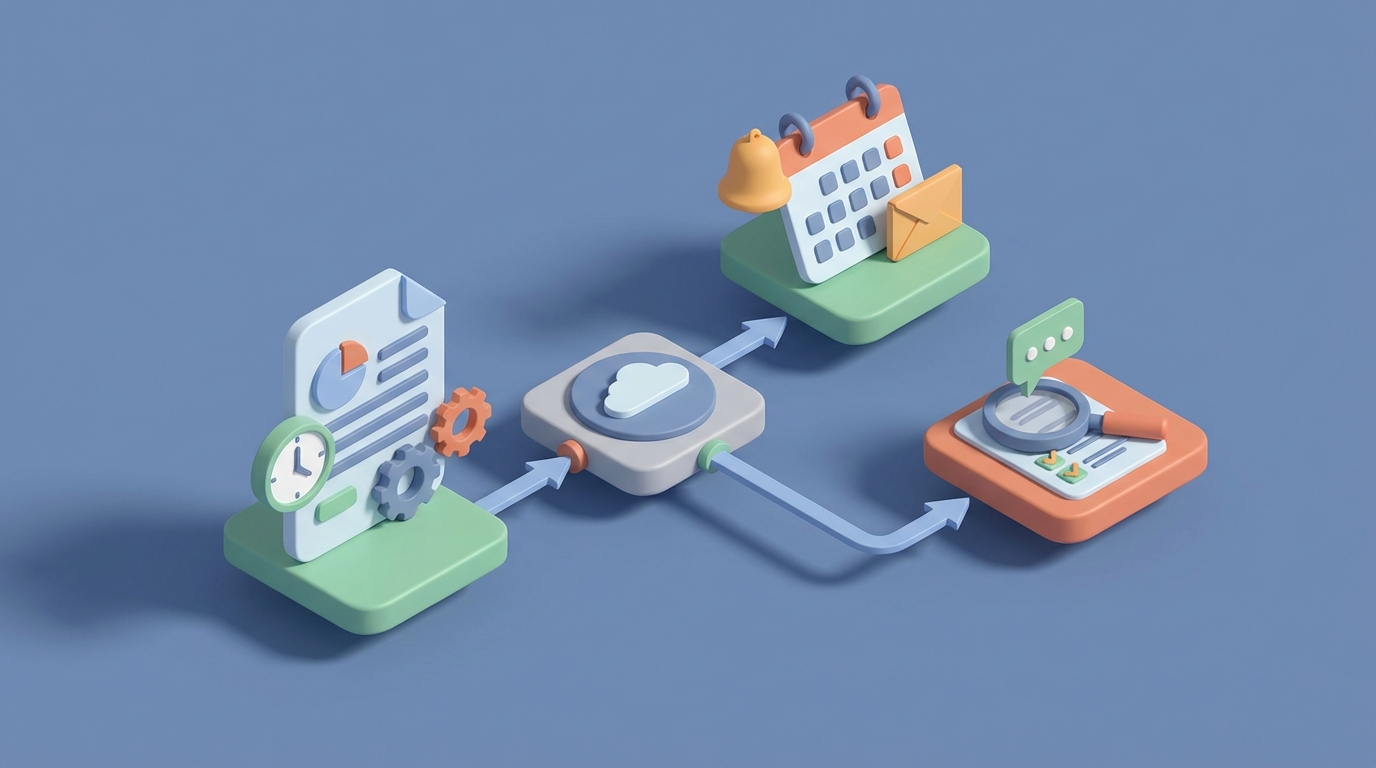
Every company has a graveyard of contracts that auto-renewed because someone forgot to check a spreadsheet. That $48,000/year analytics tool nobody uses anymore? Renewed for another 12 months because the calendar reminder was set on an intern's account and the intern left in March. The office supply vendor charging 22% above market rate? Nobody reviewed the pricing escalation clause buried on page 14.
This isn't a theoretical problem. PwC found that 43% of companies experienced financial loss from missed contract deadlines in a single 12-month period. WorldCC research consistently shows organizations hemorrhage 5–9% of annual contract value through poor contract management. For a company spending $5M annually on vendor contracts, that's $250K to $450K walking out the door because of broken processes.
The fix isn't hiring more people to stare at spreadsheets. It's building an AI agent that handles the tedious extraction, tracking, and notification work while keeping humans in the loop for the decisions that actually matter.
Here's exactly how to do it with OpenClaw.
The Manual Workflow Today (And Why It's Broken)
Let's be honest about what contract renewal management actually looks like at most companies. Not the aspirational version. The real one.
Step 1: Contract Storage & Tracking Someone saves the signed PDF to a shared drive. Maybe Google Drive, maybe SharePoint, maybe their desktop. Key dates — renewal deadlines, notice periods, termination windows — get manually extracted and typed into a spreadsheet. If you're lucky, there's a single master spreadsheet. More often, there are three competing versions across legal, procurement, and finance.
Time: 20–30 minutes per contract for initial data entry.
Step 2: Calendar Reminders The person responsible (which is itself often unclear) creates a calendar event 60–90 days before renewal. This is usually a single reminder with a vague subject line like "Review Acme Corp contract."
Time: 5 minutes per contract. But this step gets skipped entirely for roughly 30% of contracts based on industry surveys.
Step 3: Stakeholder Notification When the reminder fires, someone sends emails to the business owner, finance, and legal asking: Should we renew, renegotiate, or terminate? This kicks off a chain of "who's responsible for this?" emails that can last weeks.
Time: 1–3 hours of cumulative back-and-forth per contract.
Step 4: Contract Review The responsible party digs out the actual contract — often discovering the version on the shared drive is outdated — and reviews pricing, terms, SLAs, and auto-renewal clauses. They try to find the original negotiation notes. Those are usually gone.
Time: 1–3 hours per contract, depending on complexity.
Step 5: Decision Making & Negotiation A business case gets built (maybe), quotes are requested from the vendor or competitors, and negotiations happen via email. Often, this step gets compressed into a few frantic days because the notice period is almost up.
Time: 2–5 hours per contract for straightforward renewals. Weeks for complex ones.
Step 6: Documentation & Execution New terms are recorded, the contract is countersigned, and records are updated in multiple systems. Or, more realistically, the signed copy gets saved somewhere and nobody updates the spreadsheet.
Time: 30–60 minutes per contract.
Total time per contract renewal: 4–12 hours of human effort, spread across multiple people.
For a company managing 300 active contracts, that's 1,200–3,600 hours per year. That is one to two full-time employees doing nothing but chasing renewals. And they're still missing 15–20% of them.
What Makes This Painful (Beyond the Obvious)
The time cost is bad. But the real damage is subtler.
Silent auto-renewals are the default outcome. When the process depends on individuals remembering things, the path of least resistance is always "it just renewed automatically." A mid-sized manufacturer discovered they were auto-renewing 67% of their software licenses without any review whatsoever. They found $840K in potential savings in a single renewal cycle once they actually started looking.
Negotiation leverage evaporates. You can't negotiate effectively when you discover the renewal deadline is next Tuesday. Vendors know this. The companies that negotiate 90 days out get meaningfully better terms than those scrambling at the last minute.
Institutional knowledge walks out the door. The person who negotiated the original deal, who knows why clause 7.3 matters, who has the relationship with the vendor's account manager — when they leave, all of that context disappears. The next person inherits a PDF and a spreadsheet row.
Compounding costs are invisible. A 3% annual price escalation clause doesn't feel painful in year one. By year five, you're paying 16% more than the original price. Multiply that across dozens of contracts and you're bleeding cash in ways that never show up in any single line item review.
What AI Can Handle Right Now
Not everything in contract management needs AI. And AI can't do everything. But there's a fat middle ground of tedious, high-volume, pattern-matching work where AI agents genuinely excel. Here's what's realistic today — not theoretical, not "coming soon" — with an agent built on OpenClaw.
Obligation and date extraction. Modern NLP can scan contracts and extract renewal dates, notice periods, auto-renewal clauses, price escalation terms, and key obligations with greater than 90% accuracy on well-structured contracts. This is the single highest-ROI automation because it eliminates the manual data entry that's both slow and error-prone.
Centralized renewal dashboard. An OpenClaw agent can maintain a living database of all contracts with 30/60/90-day renewal views, automatically updated as new contracts are added or terms change. No more competing spreadsheets.
Automated, contextual reminders. Not just "hey, this contract is up for renewal" — but reminders that include relevant contract excerpts, historical spend data, vendor performance notes, and suggested action items. Sent to the right stakeholders via email, Slack, or Teams based on the contract type and value.
Risk flagging. Contracts with unfavorable auto-renewal terms, price increases above a threshold, SLA violations, or patterns that suggest the vendor has been underperforming can be automatically flagged for priority review.
Negotiation prep packages. This is where it gets interesting. An OpenClaw agent can compile market rate benchmarks, historical pricing from your own contracts, vendor performance data, and key leverage points into a prep document that gives your negotiator a real starting position instead of going in blind.
First-draft generation. Renewal notices, amendment templates, and termination letters can be auto-generated from templates populated with contract-specific data.
Step-by-Step: Building the Automation With OpenClaw
Here's a practical implementation plan. This isn't a weekend project, but it's also not a six-month enterprise deployment. A competent team can have the core system running in two to four weeks.
Phase 1: Contract Ingestion and Data Extraction (Week 1)
First, you need to get your contracts into a structured format.
Build an OpenClaw agent that ingests contract documents (PDF, DOCX, scanned images with OCR) and extracts key fields. Configure it with a structured extraction schema:
extraction_schema:
  - field: vendor_name
    type: string
  - field: contract_start_date
    type: date
  - field: contract_end_date
    type: date
  - field: auto_renewal
    type: boolean
  - field: auto_renewal_term
    type: string
  - field: notice_period_days
    type: integer
  - field: annual_value
    type: currency
  - field: price_escalation_clause
    type: string
  - field: termination_for_convenience
    type: boolean
  - field: key_sla_terms
    type: list[string]
  - field: primary_business_owner
    type: string
Your OpenClaw agent processes each document, extracts these fields, and writes them to your database (Airtable, Notion, PostgreSQL — whatever you're already using). For contracts where extraction confidence is below your threshold, the agent flags them for human review rather than guessing.
Start with your highest-value contracts. Upload the top 50 by annual spend first. Validate the extraction accuracy. Tune the agent's prompts based on what it gets wrong. Then batch-process the rest.
Phase 2: Reminder Engine and Workflow Triggers (Week 2)
Now build the notification layer. Your OpenClaw agent calculates key dates for each contract:
reminder_rules:
  - trigger: notice_period_days + 30  # Extra buffer
    action: send_initial_review_request
    recipients: [business_owner, procurement_lead]
  - trigger: notice_period_days + 14
    action: send_negotiation_prep_package
    recipients: [business_owner, procurement_lead, finance]
  - trigger: notice_period_days + 7
    action: send_escalation_if_no_decision
    recipients: [business_owner, procurement_lead, department_head]
  - trigger: notice_period_days
    action: send_final_deadline_warning
    recipients: [all_stakeholders, legal]
Each reminder isn't just a ping. The OpenClaw agent compiles a contextual briefing: the contract summary, historical spend trend, any flagged risks, and a clear call to action ("Decide by [date] or this auto-renews for 12 months at $X").
Connect the agent to your communication tools. Slack and Teams integrations are straightforward through OpenClaw's tooling capabilities. Email works too. The key is meeting people where they already are, not asking them to log into another dashboard.
Phase 3: Negotiation Prep Automation (Week 3)
This is where the real value compounds. When a contract enters the review window, your OpenClaw agent automatically builds a negotiation prep package that includes:
- Contract summary: Key terms, pricing, SLA commitments
- Spend analysis: Actual spend vs. contracted amounts over the contract period
- Price benchmarking: Market rates for comparable services (pulled from your historical data and any benchmarking databases you have access to)
- Performance scorecard: SLA adherence, support ticket history, user satisfaction data if available
- Leverage points: Competing vendors, contracts with better terms you've negotiated elsewhere, market trends
- Recommended negotiation position: Based on the data, a suggested starting point for the renewal conversation
negotiation_prep:
  contract_id: "ACM-2026-0147"
  vendor: "Acme Analytics Inc."
  current_annual_value: "$48,000"
  market_benchmark_range: "$32,000 - $41,000"
  utilization_rate: "34% of licensed seats"
  sla_compliance: "91% (below 99% target)"
  auto_renewal_date: "2026-03-15"
  notice_deadline: "2026-01-15"
  recommended_action: "Renegotiate - reduce seat count, request 15-20% rate reduction based on underutilization and SLA gaps"
  alternative_vendors: ["DataViz Pro", "InsightEngine"]
This package gets delivered automatically to the right people at the right time. Your negotiator walks into the conversation with ammunition instead of assumptions.
Phase 4: Decision Tracking and Execution (Week 4)
Close the loop. When a stakeholder makes a decision (renew, renegotiate, terminate), that decision gets captured and the agent triggers the next workflow:
- Renew as-is: Agent generates confirmation, updates the contract database with new dates, and sets up the next renewal cycle's reminders.
- Renegotiate: Agent generates a first draft of the negotiation letter or amendment request, pre-populated with the agreed-upon ask. Tracks the negotiation status.
- Terminate: Agent generates the termination notice per the contract's required format and notice period, flags it for legal review, and initiates vendor replacement workflow.
Every action is logged. Every decision has a paper trail. Next year, when this contract comes up again, the agent has full context on what happened this time.
What Still Needs a Human
AI agents are not a replacement for judgment. Here's where humans remain essential and where you should not try to automate:
Business value assessment. Is this tool still worth what we're paying? Does it align with our strategy for next year? AI can tell you utilization is at 34%. It cannot tell you whether the remaining 34% of users are your executive team and losing the tool would cause a revolt.
Relationship decisions. Sometimes you renew at a slightly higher price because the vendor is a strategic partner, or because switching costs would be catastrophic. These are judgment calls that require organizational context AI doesn't have.
Legal interpretation in edge cases. Well-structured contracts are easy for AI to parse. Heavily negotiated agreements with ambiguous language, side letters, and verbal amendments need a human lawyer.
Final negotiation execution. AI can prepare the brief. A human needs to have the conversation, read the room, and make real-time concessions.
Regulatory and compliance decisions. Industry-specific rules change in ways that require human expertise to interpret and apply.
The pattern is clear: let AI handle data extraction, tracking, reminders, and preparation. Keep humans in the loop for interpretation, strategy, and execution.
Expected Time and Cost Savings
Let's be conservative with the math.
Time savings per contract renewal: 60–75%. The 4–12 hours of manual effort drops to 1–3 hours, primarily for review and decision-making. The extraction, tracking, reminder, and prep work is handled by your OpenClaw agent.
For a company with 300 contracts:
- Manual process: 1,200–3,600 hours/year → ~$60K–$180K in labor costs (at $50/hr fully loaded)
- With OpenClaw automation: 300–900 hours/year → ~$15K–$45K in labor costs
- Labor savings: $45K–$135K/year
Missed renewal reduction: Moving from 15–20% missed renewals to under 3% means every contract gets reviewed. Even if only 30% of those newly reviewed contracts yield savings through negotiation, the impact is significant. A tech company with 400 vendor contracts reduced missed renewals to under 2% and saved $1.2M in the first year through better negotiation timing.
Negotiation improvement: Companies using AI-enhanced contract management report 2.8x more contracts being actively negotiated rather than auto-renewed. When you actually negotiate — armed with data — you save money. Typical negotiation savings range from 5–15% of contract value.
For a company spending $5M annually on vendor contracts:
- 5% improvement from better negotiation timing and preparation = $250K/year
- Reduced missed renewals preventing unfavorable auto-renewals = $100K–$200K/year
- Labor savings = $45K–$135K/year
- Total estimated annual impact: $395K–$585K
These aren't aspirational numbers. They're in line with what companies implementing contract automation consistently report.
Getting Started
You don't need to automate everything at once. Start with the highest-value contracts — the top 50 by annual spend. Get them into your OpenClaw agent, validate the extraction, and set up the reminder workflows. That alone will likely pay for the entire implementation within the first renewal cycle.
If you want pre-built agent templates for contract renewal management, browse the Claw Mart marketplace. There are ready-made agents and components for document extraction, notification workflows, and negotiation prep that you can customize rather than building from scratch. It's the fastest way to get from "we track renewals in a spreadsheet" to "we have an AI agent handling this" without reinventing every piece.
The contracts are sitting there. The money is leaking out. The only question is whether you fix the process now or discover another silent auto-renewal next quarter.
Ready to stop leaving money on the table? Explore contract management agents on Claw Mart →