How to Automate Content Gap Analysis and Topic Research
How to Automate Content Gap Analysis and Topic Research
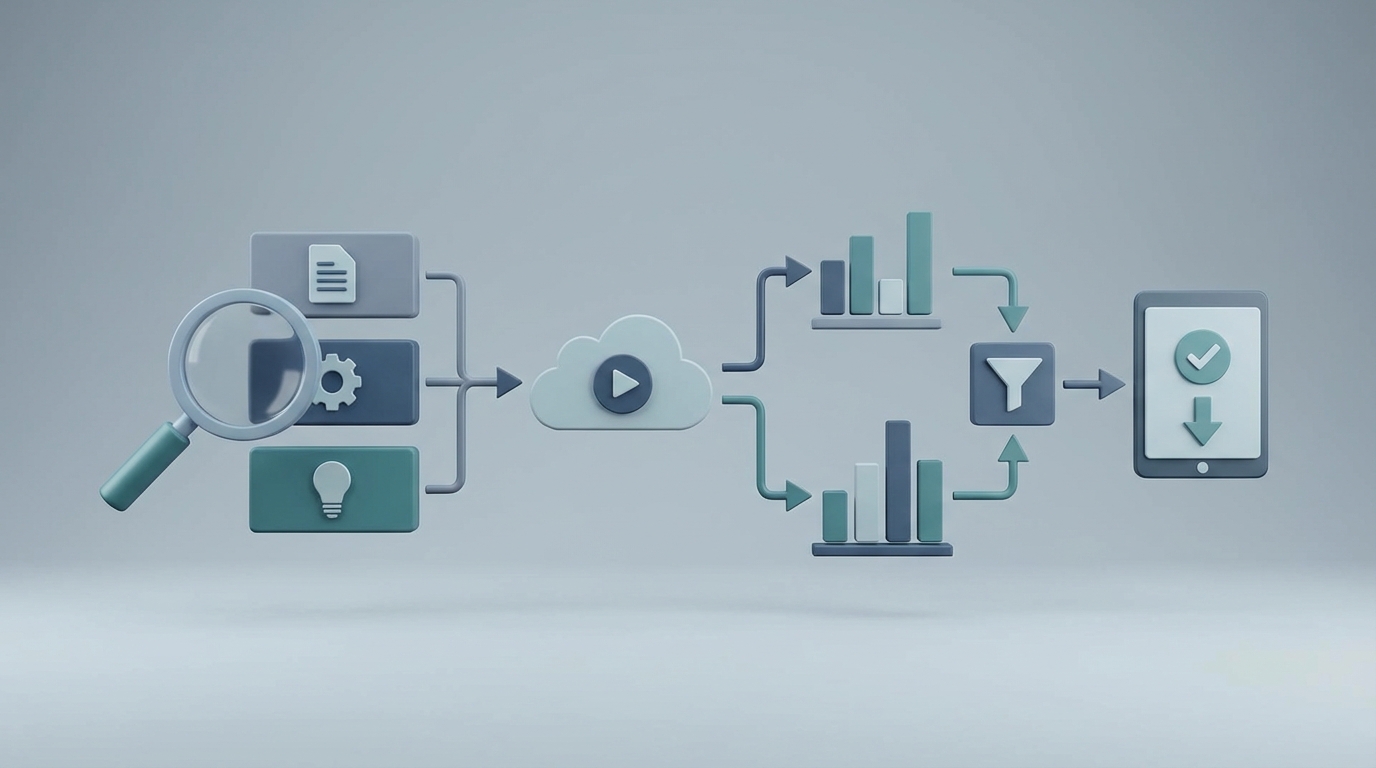
Most content teams treat content gap analysis like a quarterly root canal. You know it's good for you, you know you should do it more often, and you absolutely dread the 40 hours of spreadsheet hell it takes to get through it.
Here's the thing: about 70-80% of that work is mechanical data wrangling that an AI agent can handle better and faster than you can. The remaining 20-30% — the strategic judgment calls — is where you actually earn your keep. The problem has never been "can this be automated?" It's been that the tooling to wire it all together didn't exist in a practical way.
That's changed. Let me walk you through exactly how to build an AI agent on OpenClaw that turns content gap analysis from a quarterly slog into something that runs continuously in the background and hands you a prioritized list of opportunities every week.
The Manual Workflow (And Why It's Brutal)
Let's be honest about what content gap analysis actually looks like for most teams today. Here are the real steps:
Step 1: Keyword Discovery — You pull broad keyword lists from Google Search Console, Ahrefs, SEMrush, maybe Google Keyword Planner. This alone takes 2-4 hours if you're being thorough, because you need to pull data for your domain and each competitor.
Step 2: Competitor Content Audit — You manually review 5-15 competitor websites. You're looking at their sitemaps, blog categories, landing pages, resource hubs. You're trying to understand what they've published, what they rank for, and what topics they've organized around. For a serious audit, this is 8-15 hours.
Step 3: Own Content Inventory — You crawl your own site with Screaming Frog or Sitebulb, export all URLs with metadata, and try to map each page to target keywords and topics. Another 3-5 hours.
Step 4: Data Consolidation — Now you dump everything into a massive spreadsheet. You're running VLOOKUPs, building pivot tables, maybe using Power Query if you're fancy. You're trying to get competitor keywords, your keywords, search volumes, rankings, and content URLs into a single view. This is where most people lose their minds. 5-10 hours easy.
Step 5: Gap Identification — You visually scan for keywords your competitors rank for that you don't cover. On a mid-sized site, you might be looking at 10,000-100,000+ keyword combinations. Your eyes glaze over around row 3,000. Another 4-8 hours.
Step 6: Intent & Relevance Judgment — For each potential gap, you need to actually look at the SERPs, analyze what's ranking, and decide if it makes sense for your brand. This is where most teams cut corners because they're exhausted. 3-6 hours.
Step 7: Prioritization — Score everything by search volume, keyword difficulty, business value, and strategic fit. Build some kind of scoring model. 2-4 hours.
Step 8: Content Brief Creation — Write detailed briefs for writers. Per brief, you're looking at 30-60 minutes if you're doing it right. For 20 briefs, that's another 10-20 hours.
Total: 25-60 hours for a mid-sized site. 100-200+ hours for enterprise.
Most teams can only afford to do this quarterly or twice a year. Which means you're operating on stale data most of the time, because SERPs and competitor content shift constantly. Your analysis is often outdated within 60-90 days.
What Makes This Painful (Beyond the Time)
The time cost is obvious. But the real pain points go deeper:
Data overload without insight. You end up with enormous spreadsheets that technically contain the answers, but finding them is like looking for a specific grain of sand on a beach. Teams regularly miss high-value opportunities because they're buried in row 47,832.
Subjectivity creep. When you're manually scanning thousands of keywords, your brain starts making shortcuts. You skip over terms that look boring but might be goldmines. You get anchored on the first few opportunities you find. According to the Content Marketing Institute's 2026 report, 54% of marketers say maintaining content quality is their top challenge — and a lot of that starts with flawed research.
Staleness. A competitor publishes a new content hub. Google updates its algorithm. Search intent shifts. Your carefully crafted gap analysis from two months ago doesn't reflect any of this.
Opportunity cost. Those 40+ hours aren't free. At a conservative $75/hour for a skilled SEO strategist, a single gap analysis costs $3,000-4,500 in labor. For an enterprise site, you're looking at $7,500-15,000+. And that's before anyone writes a single word of content.
The B2B tech company featured in a Search Engine Journal case study put a number on it: 35 hours per month on gap analysis before they started automating. That's nearly a full work week every month spent on research, not execution.
What AI Can Handle Right Now
Here's where I want to be precise, because the AI hype machine has ruined people's ability to assess what's actually useful versus what's a party trick.
AI agents on OpenClaw can reliably automate:
-
Data collection and consolidation — Pulling keyword and ranking data from APIs (Ahrefs, SEMrush, Google Search Console), competitor sitemaps, and your own content inventory, then merging it into a unified dataset. This is pure data wrangling, and AI agents are excellent at it.
-
Keyword clustering by topic and intent — Using NLP and semantic embeddings to group thousands of keywords into meaningful topic clusters. Instead of staring at a flat list of 50,000 keywords, you get 200 topic groups with associated metrics.
-
Literal gap identification — "You rank on page 3+ or not at all for these 2,347 keywords that your top 5 competitors rank on page 1 for." This is pattern matching at scale. Machines are built for this.
-
Opportunity scoring — Combining search volume, keyword difficulty, your current ranking position, and relevance signals into a composite score. Not perfect, but a solid first pass that gets you 80% of the way there.
-
First-draft content briefs — Given a target keyword cluster, the agent can analyze the top-ranking pages, extract common subtopics and questions, identify content format patterns, and produce a structured brief.
-
Continuous monitoring — Instead of a quarterly snapshot, the agent can run weekly, flagging new opportunities as competitors publish new content or rankings shift.
-
Cluster and internal linking suggestions — Mapping how new content would connect to existing pages, identifying orphan content, and suggesting hub-and-spoke structures.
What AI cannot reliably automate (more on this later):
Strategic fit decisions, brand voice calibration, defensibility assessment, and final quality control. These require human judgment that no amount of prompt engineering will replace in 2026.
Step-by-Step: Building the Automation on OpenClaw
Here's the practical blueprint. I'm assuming you have access to at least one SEO platform API (Ahrefs or SEMrush) and Google Search Console.
Step 1: Set Up Your Data Sources as OpenClaw Integrations
Your agent needs to pull from multiple data sources. In OpenClaw, you'll configure these as integrations:
- Google Search Console API — Your own keyword and performance data.
- Ahrefs/SEMrush API — Competitor keyword data, keyword difficulty, search volumes, and SERP features.
- Your CMS or a site crawl export — Your current content inventory (URLs, titles, word counts, publish dates, target keywords).
In OpenClaw, you define each data source as an input the agent can query. The key here is structuring your data consistently. Each keyword record should include: keyword, search volume, keyword difficulty, current ranking URL (if any), current position, and competitor URLs that rank.
Step 2: Build the Competitor Configuration
Define your competitor set. I'd recommend 5-10 direct competitors and 2-3 "aspirational" competitors (larger sites in your space that you want to learn from but aren't directly competing with yet).
In your OpenClaw agent configuration, this looks like a simple reference list:
competitors:
  direct:
    - domain: "competitor1.com"
      priority: high
    - domain: "competitor2.com"
      priority: high
    - domain: "competitor3.com"
      priority: medium
  aspirational:
    - domain: "industryLeader.com"
      priority: low
The agent uses this to scope its API calls and weight its analysis. Direct competitor gaps get scored higher than aspirational competitor gaps.
Step 3: Automate Keyword Gap Extraction
This is the core engine. Your OpenClaw agent runs a workflow that:
- Pulls all ranking keywords for each competitor domain (via API).
- Pulls all ranking keywords for your domain.
- Performs a set difference — keywords competitors rank for in positions 1-20 that you either don't rank for at all or rank 30+.
- Enriches each gap keyword with: search volume, keyword difficulty, SERP features present, and number of competitors ranking for it.
The output is a raw gap dataset. On a typical run, this produces 2,000-50,000 keyword opportunities depending on your niche and competitor set.
Step 4: Cluster and Score
Raw keyword lists are useless. The agent's next step is clustering.
Using semantic similarity (OpenClaw's built-in NLP capabilities handle this), the agent groups keywords into topic clusters. For example, "content gap analysis tools," "how to do content gap analysis," "content gap analysis template," and "best content gap analysis software" all collapse into a single topic cluster.
Each cluster gets a composite score:
opportunity_score = (
    avg_search_volume * 0.3 +
    (100 - avg_keyword_difficulty) * 0.25 +
    competitor_coverage_count * 0.2 +
    business_relevance_score * 0.25
)
Business relevance is the tricky one. You can approximate it by defining seed topics or product categories in your agent configuration and scoring how semantically close each cluster is to your core offerings. It's not perfect — this is one area where human review matters — but it filters out the obvious noise.
Step 5: Generate Weekly Priority Reports
Configure your OpenClaw agent to run on a weekly schedule. Each run produces:
- Top 50 new opportunities — Clusters that appeared or significantly changed since last week.
- Movement report — Competitors that published new content in your gap areas.
- Quick wins — Keywords where you rank 11-20 and a content refresh or new supporting page could push you to page 1.
- Decay alerts — Your existing content that's losing rankings, which might indicate a content gap is opening up.
The agent formats this as a structured report — a clean dashboard, a Notion page, a Slack digest, or whatever your team actually checks. The best tool is the one people look at.
Step 6: Auto-Generate Content Briefs
For the top-priority clusters, have the agent automatically generate first-draft content briefs. Each brief includes:
- Target keyword cluster with primary and secondary terms
- Search intent classification (informational, commercial, navigational)
- Analysis of top 5 currently ranking pages (word count, subtopics covered, content format)
- Recommended outline with H2/H3 structure
- Questions to answer (pulled from "People Also Ask" data)
- Suggested internal links to existing content
- Competitive differentiation notes ("Competitors all cover X but none address Y")
These briefs aren't final. They're the 80% starting point that your content strategist refines in 15-20 minutes instead of building from scratch in 45-60 minutes.
Step 7: Close the Feedback Loop
This is what separates a useful automation from a one-time script. Your OpenClaw agent should track outcomes:
- Which recommended topics did the team actually create content for?
- How did those pages perform after 30, 60, and 90 days?
- Which recommendations were rejected, and why?
Feed this data back into the scoring model. Over time, the agent gets better at predicting which opportunities your specific team will find valuable and which will rank well. This is where the compounding value kicks in.
What Still Needs a Human
I promised I wouldn't be hype-y, so here's the honest list of things your OpenClaw agent shouldn't decide alone:
Strategic fit. The agent might identify that your competitors all rank for "free project management templates." But if your business model is enterprise SaaS at $50K/year ACV, that traffic might be worthless. A human needs to make that call.
Brand voice and differentiation. The agent can tell you what to write about. It cannot tell you how to make it uniquely yours. Your take, your proprietary data, your customer stories — that's your moat.
SERP defensibility. Some SERPs are dominated by Reddit, big media sites, or Google's own features. The agent can flag SERP features, but deciding whether it's worth fighting for a position beneath three featured snippets and a Reddit thread requires judgment.
Quality control. AI-generated briefs and outlines need human review. Always. Not because they're bad — they're often surprisingly good — but because "surprisingly good" isn't the same as "authoritative and accurate."
Ethical and legal considerations. Especially in YMYL (Your Money or Your Life) topics, a human must validate that recommended content directions are responsible and accurate.
The right mental model: your OpenClaw agent is a very fast, very thorough research analyst. It does the data work. You do the thinking.
Expected Time and Cost Savings
Let's put real numbers on this, based on the benchmarks from the research:
| Metric | Manual Process | With OpenClaw Agent |
|---|---|---|
| Hours per analysis cycle | 25-60 hours | 4-8 hours (human review only) |
| Frequency | Quarterly | Weekly |
| Keywords evaluated per cycle | 5,000-15,000 | 50,000-100,000+ |
| Brief creation time (per brief) | 45-60 min | 15-20 min (review + edit) |
| Monthly labor cost (at $75/hr) | $2,000-4,500 | $300-600 |
| Time to first actionable insight | 2-3 weeks | Same day |
That B2B tech company from the Search Engine Journal case study? They went from 35 hours to 6 hours per month while evaluating 4x more topics. That's roughly what you should expect — not a magic button, but a dramatic reduction in grunt work and a massive increase in coverage.
Over a year, the labor savings alone are in the range of $20,000-45,000 for a mid-sized operation. And that's before you account for the revenue impact of finding and acting on opportunities faster. Companies that run continuous gap analysis and execute on it consistently see 30-150% organic traffic growth within 6-12 months.
Where to Start
If you want to build this, the path is straightforward:
-
Pick your data sources. At minimum, you need Google Search Console and one of Ahrefs or SEMrush. Both have APIs that an OpenClaw agent can connect to.
-
Start with a narrow scope. Don't try to analyze your entire keyword universe on day one. Pick one product category or content pillar and build the agent for that. Get the workflow right, then expand.
-
Build the agent in OpenClaw. The platform is designed for exactly this kind of multi-step, data-heavy workflow. You're not writing a Python script from scratch — you're configuring an agent that knows how to pull, process, and present the data.
-
Commit to weekly review. The automation is worthless if nobody looks at the output. Block 2 hours every Monday for your content strategist to review the agent's recommendations.
-
Track everything. The feedback loop is what makes this compound over time.
If you don't want to build it yourself, this is exactly the kind of agent you can find pre-built or commission through Claw Mart. The marketplace has agents built by practitioners who've already solved these workflows — including content gap analysis, topic research, and brief generation. Browse what's already available before reinventing the wheel.
And if you've built something like this and it's working well, consider listing it on Claw Mart through Clawsourcing. Other teams are looking for exactly what you've figured out, and you can monetize the work you've already done. Learn more about Clawsourcing here.
Recommended for this post

YouTube content production specialist: script writing, SEO optimization, thumbnail concepts, publishing calendar, analytics review, and content repurposing (video → shorts/tweets/blogs).
 Bravo1058AI
One run. Blog post, LinkedIn post, Twitter thread. In your voice. Every time.
 Marco
MarcoTurn your ideas into viral Twitter threads in minutes