Automate Vacation Rental Turnover Cleaning and Restocking Coordination
Automate Vacation Rental Turnover Cleaning and Restocking Coordination
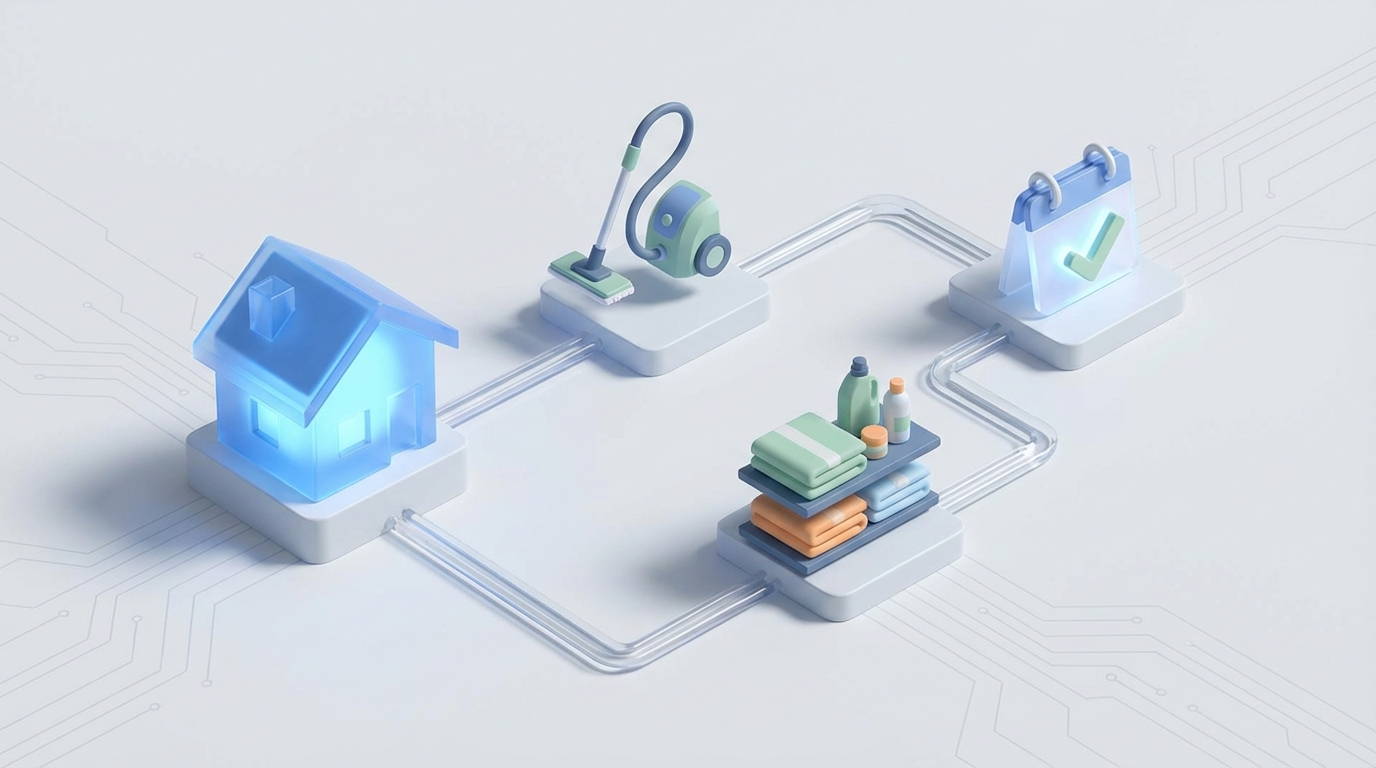
If you manage vacation rentals, you already know the drill. A guest checks out at 10am. The next one arrives at 4pm. In that six-hour window, you need to coordinate a cleaner, verify the property isn't trashed, restock everything from coffee pods to toilet paper, check that nothing's broken, stage the space so it looks magazine-ready, and upload documentation proving it all happened. Now multiply that by 15 or 30 properties and do it every day of the week.
Turnover coordination is the operational backbone of every short-term rental business, and it's also the thing most likely to break. Not because any single step is hard, but because the orchestration across people, tools, and tight timelines is genuinely brutal at scale.
Most of the administrative overhead — the texting, the scheduling, the chasing, the inventory tracking — doesn't require a human brain. It requires a system that watches calendars, talks to people, makes decisions based on rules, and escalates when something goes wrong. That's exactly what an AI agent does.
Here's how to build one with OpenClaw that handles the coordination layer of vacation rental turnover, so your team can focus on the parts that actually require human hands and judgment.
The Manual Workflow Today (And Why It Eats Your Life)
Let's be specific about what a single turnover looks like for a property manager running 20+ units:
Step 1: Detect the checkout. You check your PMS (Guesty, Hostaway, OwnerRez, whatever) to confirm the guest has departed. Maybe your smart lock confirms the last exit. Maybe you're just watching for a checkout message. Time: 2–5 minutes per property, but multiplied across your portfolio daily.
Step 2: Assign a cleaner. You text or call your cleaning crew. You check who's available. You factor in drive times, property size, and whether this is a same-day turn (checkout 10am, check-in 4pm) that needs priority. Time: 5–15 minutes per property, more if someone cancels.
Step 3: The cleaner does the work. Deep clean bathrooms, kitchen, floors, surfaces. Strip and remake beds. Run laundry. This is 2–5 hours of physical labor depending on property size and condition.
Step 4: Restocking. Check toiletries, paper goods, coffee, kitchen basics, garbage bags, welcome amenities. Replace what's missing. Time: 15–30 minutes, plus a supply run if you're out of something.
Step 5: Damage and maintenance check. Look for broken items, missing inventory (wine glasses, remotes, towels), burned-out bulbs, HVAC issues, hot tub chemistry. Time: 10–20 minutes.
Step 6: Documentation. Cleaner uploads photos proving each room is done. Manager reviews them. Any damages get logged for potential guest charges. Time: 5–15 minutes per property for the manager to review.
Step 7: Final sign-off. Manager approves the property as guest-ready, or flags issues that need a second pass. Lock codes get reset. Thermostat gets set. Listing calendar updates. Time: 5–10 minutes.
Total manager time per turnover: 30–60 minutes of coordination work — not counting the physical cleaning. Across 20 properties with daily turns, that's 10–20 hours per week just on turnover admin. A 2026 VRMA study confirmed professional managers spend 15–25 hours weekly on turnover tasks when managing 20+ units.
This is why so many operators hit a ceiling around 8–15 properties. The coordination overhead scales linearly while revenue doesn't.
What Makes This Painful
It's not just time. It's the specific ways this workflow fails:
Unreliable cleaners. This is the #1 complaint on every host forum. Someone no-shows, and you're scrambling two hours before check-in. The cascading failure from one missed cleaning can tank a review and cost you hundreds in future bookings.
Tight turn windows. Same-day turnovers leave zero buffer. If a guest checks out late, if the cleaner hits traffic, if the property needs extra work because someone threw a party — you're in crisis mode with no margin.
Inconsistent quality. Different cleaners interpret "clean" differently. What one person considers spotless, a guest rates three stars. Without standardized verification, you're gambling on every turn.
Inventory shrinkage. Guests walk off with towels, break wine glasses, lose remotes. You don't notice until the next guest complains. Tracking consumable inventory across 20+ properties with spreadsheets is a losing game.
Communication overhead. The average property manager sends 30–50 messages per day just coordinating cleaners. Confirmations, reminders, photo requests, follow-ups on issues. It's a full-time job that produces no direct revenue.
Financial weight. Cleaning and labor represent 35–50% of total operating expenses for most vacation rental businesses. The average turnover costs $120–$280 in cleaning alone. Inefficiency here directly erodes margins.
What AI Can Handle Right Now
Let's be honest about what an AI agent can and can't do. It can't scrub a toilet. It can't smell whether a property feels fresh. It can't make a nuanced judgment call about whether a stain on the couch is guest damage or normal wear.
But it can handle the entire coordination and administrative layer — which is where most of your time goes. Here's what's realistic today with an agent built on OpenClaw:
Calendar monitoring and trigger detection. An OpenClaw agent connects to your PMS via API, watches for confirmed checkouts, and automatically initiates the turnover workflow the moment a departure is confirmed. No manual checking.
Intelligent cleaner assignment. Based on rules you define — cleaner availability, proximity to the property, property size, whether it's a same-day turn — the agent assigns the right person and sends them a notification with the address, access codes, and a property-specific checklist. If the cleaner doesn't confirm within 30 minutes, the agent escalates to a backup.
Real-time status tracking and escalation. The agent monitors whether the cleaner has started (via check-in confirmation or smart lock access), whether photos are being uploaded on schedule, and whether the job is completed within the expected window. If something's off — late start, missing photos, no completion signal — it escalates to you immediately rather than letting it slide.
Inventory management. The agent tracks restocking reports from each turnover, maintains running counts of supplies per property, and generates restock orders when items fall below thresholds. Connect it to a supplier or Amazon Business account and it can place orders automatically.
Photo review triage. While full AI-powered cleanliness scoring is still emerging, an OpenClaw agent can organize incoming photos by room, flag any that are missing from the required checklist, and route the complete set to you for quick review — cutting your review time from 15 minutes to 2 minutes per property.
Guest communication. The agent can send pre-arrival messages with check-in instructions, WiFi passwords, and house rules — automatically timed based on the turnover completion signal. No guest gets early check-in info for a property that isn't ready yet.
Damage documentation and logging. When a cleaner flags damage, the agent collects photos, logs the issue against the departing guest's reservation, and drafts a damage report you can review before submitting a claim.
Step-by-Step: Building the Turnover Agent on OpenClaw
Here's a practical blueprint for building this system. You don't need to implement everything at once — start with the highest-pain automation and layer on from there.
Step 1: Define Your Data Sources
Your agent needs to watch and interact with several systems:
- PMS calendar (Guesty, Hostaway, OwnerRez, etc.) — for checkout/check-in times and reservation details.
- Smart lock system (August, Yale, Schlage, RemoteLock) — for access code management and departure confirmation.
- Communication channel (SMS via Twilio, WhatsApp Business, or email) — for cleaner notifications.
- Photo storage (Google Drive, Dropbox, or your PMS's built-in media) — for documentation.
- Inventory tracker (Airtable, Google Sheets, or a dedicated database) — for supply levels.
In OpenClaw, you set these up as connected integrations. Most PMS platforms offer REST APIs or Zapier-compatible webhooks. Smart locks almost universally have API access. The agent acts as the central nervous system connecting all of them.
Step 2: Build the Trigger Workflow
The core logic starts here. In pseudocode, your primary automation looks like this:
WHEN reservation.checkout is confirmed (via PMS webhook or calendar poll):
  1. Identify property_id and checkout_time
  2. Check next reservation check-in time for this property
  3. Calculate turn_window (hours between checkout and next check-in)
  4. IF turn_window < 6 hours → flag as PRIORITY
  5. Query cleaner_roster for available cleaners matching:
     - property_zone (geographic proximity)
     - property_size_certification (trained for this unit)
     - current_schedule (not already booked)
  6. Assign top-ranked cleaner
  7. Send assignment notification via SMS/WhatsApp:
     - Property address
     - Access code (generated fresh via smart lock API)
     - Estimated cleaning time
     - Link to property-specific checklist
     - Photo upload instructions
  8. Set timer: IF cleaner doesn't confirm within 30 min → assign backup
  9. Set timer: IF cleaner doesn't check in within 60 min of checkout → alert manager
In OpenClaw, this translates to a structured agent workflow where each step is a discrete action node. The agent handles conditional logic, API calls, message composition, and timer-based escalations natively — you're defining the rules and letting the agent execute them.
Step 3: Build the Monitoring Layer
Once a cleaner is assigned and confirmed, the agent shifts to monitoring mode:
WHEN cleaner.check_in is detected (smart lock access or manual confirmation):
  1. Start turn_timer
  2. Monitor photo_uploads against required_checklist:
     - Kitchen (3 angles minimum)
     - Each bathroom (2 angles minimum)
     - Each bedroom (bed made, closet, surfaces)
     - Living areas
     - Exterior/entry
  3. IF required photos not uploaded within expected_cleaning_time + 30min:
     → Send reminder to cleaner
  4. IF still incomplete after reminder + 30min:
     → Alert manager with current status

WHEN cleaner.marks_complete:
  1. Verify all checklist items marked done
  2. Verify all required photos uploaded
  3. IF inventory_flags exist (e.g., "low on shampoo", "missing remote"):
     → Log to inventory_tracker
     → IF critical item → alert manager immediately
  4. IF damage_flags exist:
     → Collect damage photos
     → Log against departing guest reservation
     → Draft damage report for manager review
  5. Generate turn_summary for manager review
  6. IF all clear → mark property as GUEST_READY
  7. Trigger guest pre-arrival message sequence
  8. Reset smart lock code for incoming guest
Step 4: Build the Inventory Automation
This runs as a background process alongside individual turnovers:
AFTER each turnover.complete:
  1. Update inventory counts for property based on cleaner's restocking report
  2. FOR each supply_item:
     - IF current_count < reorder_threshold:
       → Add to weekly_restock_order
       → IF critical (toilet paper, towels, linens) AND count = 0:
         → Trigger emergency restock alert
  3. Weekly: Generate consolidated restock order across all properties
  4. Route order for manager approval or auto-submit to supplier
Step 5: Build the Reporting Dashboard
Your OpenClaw agent can compile performance data that would take hours to gather manually:
- Average turn time per property and per cleaner
- Photo compliance rates (are cleaners actually documenting everything?)
- Inventory burn rates by property (which units chew through supplies fastest?)
- Escalation frequency (which properties or cleaners cause the most issues?)
- Turn window utilization (how tight are your same-day turns actually running?)
This data feeds back into better scheduling, cleaner performance reviews, and inventory purchasing decisions.
What Still Needs a Human
Being realistic about boundaries is what separates a useful system from an expensive toy. Here's what your agent shouldn't try to fully automate:
Quality judgment. Photos can confirm that a bed is made. They can't confirm that the sheets smell fresh, that there's no hair in the shower drain, or that the property has that intangible "this place is cared for" feeling. For high-value properties or after new cleaners, human spot-checks remain essential.
Damage liability decisions. An agent can document damage and draft a report. But deciding whether to charge a guest $50 or $500, how to word the message diplomatically, and whether to involve Airbnb resolution — that's human territory. The stakes are too high and the nuance too significant.
Cleaner relationship management. Your cleaning team is the backbone of your operation. Training them on brand standards, handling disputes fairly, building loyalty so they don't leave for a competitor — no agent replaces that.
Edge cases. Guest left a suitcase behind. There's an unidentifiable smell. The neighbor's tree fell on the deck. A pipe burst. These require on-the-ground judgment that no workflow can fully anticipate.
Final guest-ready approval on premium properties. Many experienced managers still do a personal walkthrough on their highest-revenue units. The agent can handle 80% of your portfolio autonomously; the top 20% might still get your personal eyes.
The goal isn't full automation. It's automating the 70–80% of coordination work that's purely administrative, so your human attention goes to the 20–30% that actually benefits from it.
Expected Time and Cost Savings
Based on the operational benchmarks from Breezeway, VRMA, and real operator case studies, here's what you can realistically expect after implementing this type of agent:
Manager time per turnover: Drops from 30–60 minutes to 5–10 minutes (primarily photo review and exception handling). For a 20-property portfolio, that's saving 12–18 hours per week.
Cleaner no-show impact: Reduced from "crisis requiring 30+ minutes of frantic calling" to "agent already assigned backup within 30 minutes, you get a notification." Maybe 2 minutes of your attention instead of 30.
Inventory waste: Running counts and automated reordering typically reduce emergency supply runs by 60–80%. Fewer Walmart trips at 9pm the night before a check-in.
Guest review impact: Properties with consistent, timely turnovers achieve 15–20% higher review scores for cleanliness. That directly drives occupancy and pricing power.
Scalability: The most meaningful impact. An agent like this is what takes you from a 15-property ceiling to 30, 40, or 50 units without proportionally increasing your admin staff. The coordination layer scales with the software, not with headcount.
One mid-size Florida management company using automated turnover workflows reported reducing per-turn manager involvement by roughly 65% while maintaining quality scores. A solo operator with 6 properties eliminated 10–12 hours per week of texting alone. These numbers are real, not theoretical.
Getting Started
You don't need to build the entire system on day one. Start with the highest-impact piece: automated cleaner assignment and escalation triggered by PMS checkout events. That single workflow eliminates the most painful daily task for most property managers.
Once that's running reliably, layer on photo compliance monitoring, then inventory tracking, then reporting.
If you want to skip the build-from-scratch approach, check out Claw Mart — there are pre-built agent templates and components for property management workflows that you can customize for your specific setup. Faster than wiring everything yourself, and built by people who've already solved the integration headaches.
And if you've already built turnover automation that works well — or you've solved a piece of this puzzle in a clever way — consider listing it on Claw Mart through Clawsourcing. Other property managers will pay for workflows that save them 15 hours a week. Your operational expertise becomes a product.
The vacation rental operators who win over the next few years won't be the ones who clean better. They'll be the ones who coordinate better. Build the agent, reclaim your time, and put your attention where it actually matters: the guest experience and the growth of your portfolio.