Automate TikTok Script and Caption Creation from Long-Form Content
Automate TikTok Script and Caption Creation from Long-Form Content
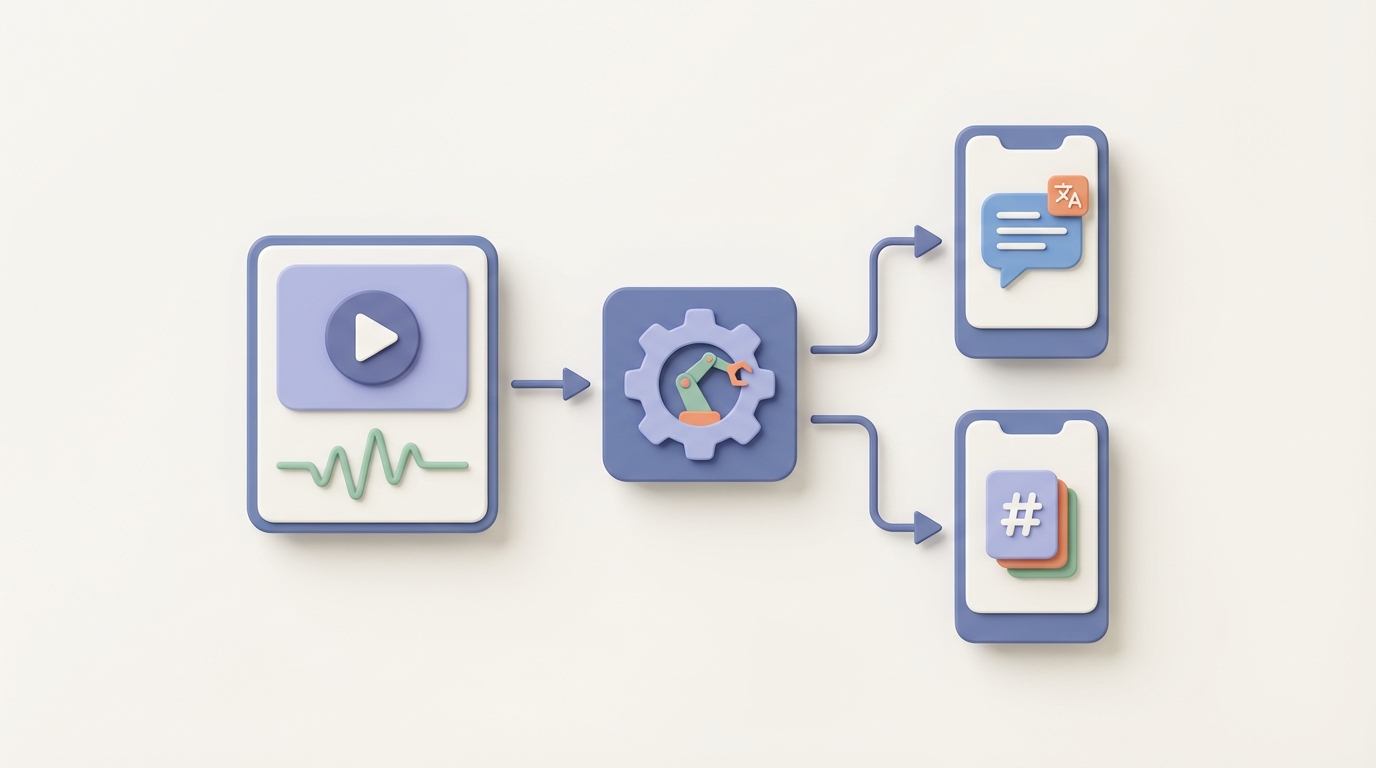
Most brands treat TikTok content creation like a craft project. Every video is a bespoke, hand-stitched ordeal: scroll for trends, brainstorm a hook, write a script, film, edit, write a caption, optimize hashtags, post, pray. Then do it again tomorrow.
If you're posting 5 times a week — which is the baseline for any brand serious about TikTok growth — you're looking at 25 to 40 hours per month just on creation. That's a part-time employee doing nothing but making short videos. And that's before you factor in the strategic work of figuring out what's actually working and why.
Here's the thing: a huge chunk of that workflow is mechanical. Trend research, script drafting, caption writing, hashtag selection — these are pattern-matching tasks that an AI agent can handle right now, today, with high reliability. Not perfectly. Not without human oversight. But well enough to cut your per-video time from 4+ hours to under an hour.
This guide walks through exactly how to build that automation using OpenClaw, what it can realistically handle, what still needs your brain, and what the actual time and cost savings look like.
The Manual Workflow (And Why It's Bleeding You Dry)
Let's get specific about what TikTok content creation actually looks like for most brands operating at a serious volume. Here's the typical per-video breakdown:
Step 1: Trend and Idea Research — 30 to 90 minutes You're scrolling your For You Page, checking TikTok Creative Center, watching competitor accounts, trying to spot formats and sounds that are gaining traction. Trends on TikTok last 3 to 7 days, so this research has a brutally short shelf life.
Step 2: Concepting and Scripting — 30 to 60 minutes You need a hook that stops the scroll in under 3 seconds (TikTok's algorithm needs 10-15% watch-through in those first moments or you get zero distribution). Then you write the actual script or dialogue, plan on-screen text, and figure out the visual structure.
Step 3: Filming — 30 minutes to 4+ hours Multiple takes, lighting, product styling, different angles. For product brands, this often involves unboxing setups or lifestyle shoots.
Step 4: Editing — 1 to 4 hours Cutting clips, transitions, effects, text animations, auto-captions, syncing to audio, color grading, speed ramps. This is the most tedious part and the one creators complain about the most.
Step 5: Optimization and Posting — 15 to 45 minutes Writing the caption, selecting hashtags, adding CTAs, choosing posting time, linking to TikTok Shop or bio link, scheduling or uploading.
Total: 2 to 8 hours per video. Agencies report an average of about 4 hours for decent quality.
At 5 videos per week, that's 20 hours of production labor. Every week. And if you're outsourcing, agencies charge $500 to $2,000 per video. Do that math over a month and it gets ugly fast.
The Hootsuite 2026 Social Media Trends report found that 68% of social media managers cite content creation burnout as their top challenge. That's not surprising when the job is essentially an infinite treadmill that speeds up every time a new trend drops.
What Makes This Particularly Painful
It's not just the time. It's the type of time.
The creative work is mixed in with the mechanical work. You need genuine creative judgment to pick the right hook, nail the brand voice, and decide which trend actually fits your audience. But that creative work is sandwiched between hours of mechanical tasks: researching trending hashtags, writing first-draft captions, structuring scripts to a proven format, and formatting content for posting.
Trends expire. A trend you spot on Monday might be dead by Thursday. If your production pipeline takes 3 days per video, you're always behind.
Volume kills quality. The algorithm rewards consistency, but producing 5+ videos per week inevitably means some of them are rushed. And rushed TikToks don't just underperform — they get zero distribution, which means the time was entirely wasted.
The feedback loop is slow. You post, wait 24-48 hours to see performance data, then try to figure out what worked. By then you've already produced the next 3 videos using the old assumptions.
The core problem is that brands are spending human creative energy on tasks that don't require human creative energy. Script structure, caption formatting, hashtag research, trend pattern-matching — these are all tasks where an AI agent can produce a solid first draft that a human then refines in minutes instead of hours.
What AI Can Actually Handle Right Now
Let's be honest about capabilities. Not hype, not "AI will replace your entire team." Here's what works reliably in 2026:
High reliability (80%+ usable output):
- Generating script drafts from a topic, product brief, or long-form content
- Writing captions with hashtags optimized for discovery
- Matching content ideas to trending formats
- Repurposing blog posts, podcasts, or YouTube videos into short-form script outlines
- Suggesting hooks based on proven scroll-stopping patterns
Medium reliability (needs human editing but saves significant time):
- Auto-captioning and basic text animation (CapCut AI handles this well)
- Clipping long-form video into short segments (Opus Clip, Munch — about 70-80% hit rate for decent clips)
- Basic video generation from product images
Low reliability (still needs heavy human involvement):
- Humor, timing, and cultural nuance
- Brand voice consistency over dozens of videos
- Understanding why a video performed well
- Anything involving on-camera talent or authentic UGC feel
The sweet spot for automation is everything between "I have a product/topic/piece of long-form content" and "I have a ready-to-film script with a caption and hashtags." That middle zone is where most of the mechanical hours live, and it's exactly what an AI agent built on OpenClaw can handle.
Step-by-Step: Building the Automation on OpenClaw
Here's how to set up an agent that takes long-form content — a blog post, a podcast transcript, a YouTube video transcript, a product brief — and outputs TikTok-ready scripts and captions. This is a practical implementation guide, not a theoretical framework.
Step 1: Define Your Input Sources
Your agent needs to know where to pull content from. Common inputs:
- Blog post URLs — The agent scrapes the content and extracts key points.
- YouTube/podcast transcripts — Feed in a transcript and the agent identifies the most clip-worthy segments.
- Product catalog data — Product names, descriptions, key features, pricing.
- Brand voice document — A reference doc that defines your tone, vocabulary, what you do and don't say.
In OpenClaw, you set these up as input nodes in your agent workflow. The brand voice document becomes a persistent context that every generation references — this is critical for consistency.
Step 2: Build the Content Extraction Layer
The first task your agent performs is extracting the "TikTok-able" moments from your long-form content. Not everything in a 2,000-word blog post works as a 30-second video. The agent needs to identify:
- Surprising statistics or counterintuitive claims (these make great hooks)
- Step-by-step instructions that can be condensed into a quick tutorial
- Strong opinions or hot takes
- Before/after scenarios
- Product demonstrations or use cases
Your OpenClaw agent prompt for this step might look something like:
You are a TikTok content strategist. Analyze the following long-form content
and extract up to 5 segments that would work as standalone TikTok videos
(15-60 seconds). For each segment, identify:

1. The core idea in one sentence
2. Why it would stop someone from scrolling (the hook angle)
3. The ideal TikTok format (talking head, text overlay, tutorial,
   story time, duet-style, etc.)
4. Estimated video length

Prioritize segments with: surprising data, strong opinions,
actionable advice, or emotional resonance.

Brand voice reference: [inserted from persistent context]
Content to analyze: [inserted from input]
Step 3: Generate Scripts
For each extracted segment, the agent generates a full TikTok script. This is where the structure matters. TikTok scripts aren't just "say these words." They need:
- Hook (0-3 seconds): The opening line or visual that stops the scroll
- Setup (3-10 seconds): Context for why the viewer should care
- Payload (10-40 seconds): The actual content, tip, story, or demonstration
- CTA (last 3-5 seconds): What you want them to do (follow, comment, visit link, etc.)
Your OpenClaw script generation prompt:
Write a TikTok script for the following concept. Follow this exact structure:

HOOK (first 3 seconds - must create curiosity or pattern interrupt):
[Write the opening line. Make it punchy. No filler words.]

SETUP (next 5-7 seconds):
[Provide brief context. Why should they care?]

BODY (15-30 seconds):
[Deliver the core content. Use short sentences.
Write for spoken delivery — conversational, not essay-style.]

CTA (final 3-5 seconds):
[Clear call to action appropriate for the brand.]

Also provide:
- On-screen text suggestions (what text overlays should appear and when)
- Suggested visual direction (what should be on screen during each section)
- Estimated total video length

Concept: [from extraction step]
Brand voice: [from persistent context]
Target audience: [from configuration]
Step 4: Generate Captions and Hashtags
A separate agent step handles the caption, because captions serve a different purpose than scripts. The caption needs to drive engagement (comments, shares, saves) and include discovery-optimized hashtags.
Write a TikTok caption for the following video script. Requirements:

- First line must create additional curiosity or add context the video doesn't cover
- Include a question or prompt that encourages comments
- 3-5 hashtags: mix of broad discovery tags and niche-specific tags
- Total caption length: 100-200 characters (short performs better on TikTok)
- Match the brand voice document provided

Video script: [from previous step]
Brand voice: [from persistent context]
Product/service being promoted (if applicable): [from configuration]
Step 5: Batch Processing and Output
The power of building this on OpenClaw is that you can run the entire pipeline in batch. Feed in 10 blog posts on Monday morning, and by Monday afternoon you have 30 to 50 script-and-caption pairs ready for human review.
Your output for each video concept should look like this:
---
VIDEO CONCEPT #1
Source: [Blog post title / URL]
Format: Talking head with text overlay
Estimated length: 28 seconds

SCRIPT:
[Hook]: "Stop paying $2,000 for TikTok videos."
[Setup]: "Most brands spend 4 hours per video because they're
doing everything manually."
[Body]: [Full script body...]
[CTA]: "Follow for more marketing automation breakdowns."

ON-SCREEN TEXT:
- 0-3s: "You're overpaying for TikTok content"
- 5-10s: "4 hours per video x 5 videos per week = 20 hours"
- [etc.]

CAPTION:
"The math on manual TikTok production doesn't add up.
Here's what we changed 👇 What's your per-video time?
#tiktokmarketing #contentautomation #socialmediatips #ecommerce"

VISUAL DIRECTION:
Direct-to-camera in office setting. Show screen recording of
workflow during body section. Quick cut pacing.
---
Step 6: Human Review and Selection
This is the critical step that doesn't get automated. A human reviews the batch output, selects the strongest concepts, tweaks scripts for brand voice accuracy, and greenlights for production. This review step takes 15-20 minutes for a batch of 10 concepts — compared to 5-10 hours if you'd done all the concepting and scripting manually.
What Still Needs a Human
Let me be direct about this because overselling AI capabilities is how you end up with a feed full of generic, soulless content that the algorithm buries.
Creative direction and taste. The agent generates options. A human decides which ones are actually good, which hooks feel authentic to the brand, and which trends are worth riding versus which ones are played out.
On-camera talent. The best-performing TikTok content in 2026 features real people. Duolingo's TikTok dominance comes from human creative instincts and personality, not automation. AI avatars still feel uncanny and underperform authentic footage.
Cultural context and humor. TikTok's highest-engagement content is culturally specific and emotionally intelligent. AI can approximate this but frequently misses the mark on timing, tone, and references.
Performance analysis. Knowing that a video got 500K views is data. Understanding why it worked and how to replicate the pattern is strategy. That's still a human job.
Final quality control. Every AI output needs a human pass. Weird phrasing, off-brand claims, potentially problematic statements — these need to be caught before they go live.
Legal and compliance. Music licensing, FTC disclosures, TikTok Shop rules, claim substantiation — these are non-negotiable human review items.
Expected Time and Cost Savings
Here's what the math looks like based on real usage patterns from brands using similar AI-assisted workflows:
| Task | Manual Time | With OpenClaw Agent | Savings |
|---|---|---|---|
| Trend/idea research | 30-90 min | 5-10 min (agent suggests based on content library) | ~80% |
| Scripting | 30-60 min | 5-10 min (review and tweak agent output) | ~80% |
| Caption + hashtags | 15-30 min | 2-5 min (review agent output) | ~85% |
| Filming | 30 min - 4 hrs | Same (still manual) | 0% |
| Editing | 1-4 hrs | Same (use CapCut AI for assistance) | ~30% |
| Posting optimization | 15-45 min | 5-10 min | ~70% |
Net result: Per-video production time drops from ~4 hours to ~1.5-2 hours. For a 5-video-per-week cadence, that's roughly 10-12 hours saved per week. Over a month, that's 40-50 hours — essentially a full-time employee's worth of labor.
If you're outsourcing at agency rates ($500-$2,000 per video), the scripting and concepting portion alone typically represents 25-35% of the cost. Automating that step saves $2,500-$14,000 per month at scale.
Small e-commerce brands using similar AI-first production pipelines have reported dropping from ~6 hours to ~45 minutes per video when combining automated scripting with tools like CapCut for editing.
Getting Started
You don't need to automate everything at once. Start with the highest-ROI automation: script and caption generation from existing content.
If you already have blog posts, podcast episodes, YouTube videos, or even just a library of product descriptions, you're sitting on dozens of TikTok scripts that an agent can extract in minutes.
Build your first OpenClaw agent with the prompt structures above. Run a batch of 10 source pieces through it. Review the output. Tweak your prompts based on what's landing well and what feels off-brand. Within a few iterations, you'll have a pipeline that consistently produces scripts your team can film in a fraction of the time.
The agents for this workflow — and others like it — are available to explore and fork on Claw Mart. If you've built a TikTok scripting agent that's working well for your brand, consider listing it. Other brands in your niche are almost certainly dealing with the exact same production bottleneck, and a well-tuned agent has real value.
The goal isn't to remove humans from TikTok content creation. The goal is to remove humans from the parts of TikTok content creation that don't require human judgment — so they can spend their time on the parts that do.
Recommended for this post

YouTube content production specialist: script writing, SEO optimization, thumbnail concepts, publishing calendar, analytics review, and content repurposing (video → shorts/tweets/blogs).
 Bravo1058AI
One run. Blog post, LinkedIn post, Twitter thread. In your voice. Every time.
 Marco
MarcoTurn your ideas into viral Twitter threads in minutes