How to Automate Scholarship Application Screening and Ranking with AI
How to Automate Scholarship Application Screening and Ranking with AI
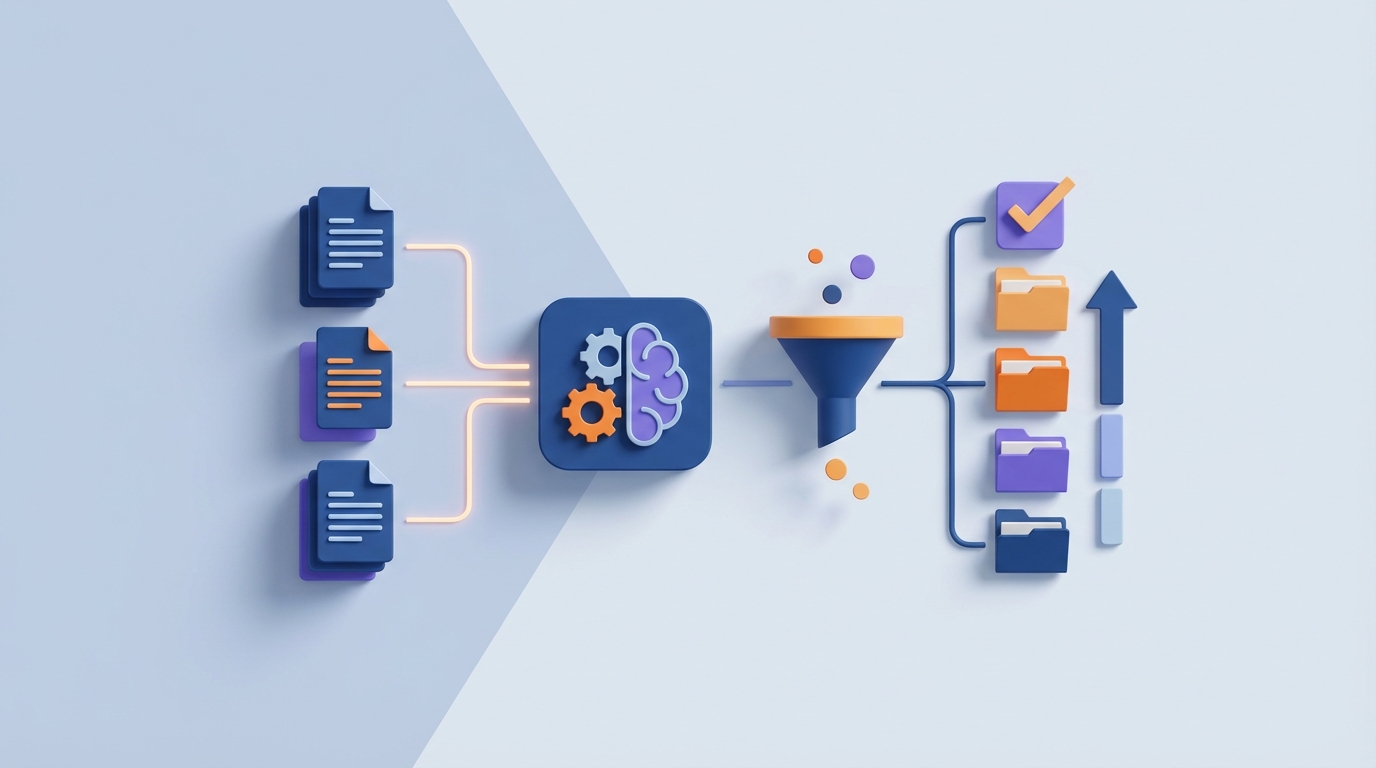
Every spring, the same ritual plays out at foundations, university offices, and community nonprofits across the country: a flood of scholarship applications lands, a handful of overworked staff and volunteer reviewers stare down a spreadsheet with 3,000 rows, and everyone quietly accepts they'll spend the next six weeks buried in essays about leadership and overcoming adversity.
It's not a glamorous problem. But it's a real one, and it's expensive. A mid-size foundation reviewing 2,000 applications at 30 minutes per app burns through 1,000 hours of reviewer time—before committee meetings, follow-ups, and final deliberation. At $50/hour (a conservative blended rate for staff time), that's $50,000 just for initial reads. And the kicker? About 40% of those applications are clearly ineligible or incomplete. Thousands of dollars spent reading essays from people who didn't meet the GPA cutoff.
This is the kind of workflow AI was made for. Not replacing human judgment on who deserves a life-changing award—but eliminating the weeks of drudgery that happen before a human even needs to think.
Here's how to build it with OpenClaw.
The Manual Workflow (And Where the Hours Go)
Let's be precise about what actually happens in a typical scholarship cycle. I've talked to program officers and reviewed process documentation from several foundations. The steps are remarkably consistent:
1. Application intake — Applicants submit through an online portal (AwardSpring, Google Forms, CommunityForce, or sometimes just email). Documents trickle in: transcripts, recommendation letters, essays, proof of enrollment, financial information. This phase alone takes 2–4 weeks because people submit incomplete packets.
2. Eligibility pre-screening — Staff manually check each application against criteria: minimum GPA, residency, enrollment status, major, demographic requirements. For a 2,000-application pool, this takes 80–160 hours. It's mind-numbing checkbox work, and mistakes happen. A 2023 NSPA survey found that roughly 15–20% of applications that make it to review committees should have been filtered out earlier.
3. Completeness verification — Is the transcript attached? Did both recommenders submit letters? Is the essay within the word count? Staff spend 40–80 hours chasing missing documents via email, waiting, following up again.
4. Essay and qualitative scoring — This is the big one. Reviewers score essays and personal statements using a rubric—usually 1–5 reviewers per application. Average time per application: 15–45 minutes for the initial read. For 1,500 eligible applications with two reviewers each, you're looking at 750–2,250 hours. And here's the dirty secret: inter-reviewer reliability is terrible. Foundation audits consistently find that different reviewers score the same essay 20–40 points apart on a 100-point scale. The signal-to-noise ratio is low.
5. Committee deliberation — Multiple rounds of meetings. Tie-breaking. Arguing about edge cases. Another 20–60 hours for the committee.
6. Final selection, interviews, notification — The last stretch. Comparatively efficient, but still time-consuming.
Total for a mid-size program: 1,000–2,500 hours per cycle. Large national programs like the Horatio Alger Association (10,000–15,000 applications) can exceed 5,000–10,000 reviewer hours.
What Makes This Painful
The time cost is obvious. But there are deeper structural problems:
Reviewer burnout destroys quality. By application #200, a volunteer reviewer is skimming. Their scores become less thoughtful, more arbitrary. The 2,001st essay about "my grandmother taught me the value of hard work" gets a lower score than the 50th one—not because it's worse, but because the reviewer is exhausted.
Inconsistency undermines fairness. When Reviewer A gives an essay 85/100 and Reviewer B gives the same essay 62/100, the average (73.5) means nothing. You're injecting noise into a decision that changes someone's life. Most programs don't have the budget or time for calibration sessions, norming exercises, or third reads.
Administrative overhead is invisible but massive. Program officers spend 30–40% of their cycle time on logistics: emailing applicants about missing documents, reformatting data between systems, building spreadsheets, scheduling reviewers. None of this is mission-critical work.
Cost scales linearly with volume. If your program grows from 1,000 to 5,000 applicants (a good problem to have), your costs 5x. There's no efficiency gain. Every new application requires the same human time.
Auditability is weak. When a donor or board member asks "why didn't this student get selected?" — good luck reconstructing the reasoning from a reviewer's "3 out of 5" score and no notes.
What AI Can Handle Right Now
Let's be honest about what works and what doesn't. AI in 2026 is excellent at structured data processing, text extraction, classification, and pattern matching. It's decent at summarization and rubric-based text evaluation. It's not reliable enough to make final award decisions on subjective, high-stakes criteria.
Here's the breakdown for scholarship screening:
Fully automatable (high confidence)
- Eligibility filtering: GPA thresholds, residency, citizenship, enrollment status, major, age, demographic criteria. Rule-based logic that an AI agent handles perfectly.
- Completeness checking: Is every required document present? Is the essay within word count? Are recommender emails valid?
- Document parsing: Extract GPA from transcripts (OCR + structured extraction), pull key data from recommendation letters, parse resumes for volunteer hours and extracurriculars.
- Plagiarism and AI-content flagging: Cross-reference against databases, check for AI-generated patterns.
- Quantitative scoring: Calculate composite scores from measurable criteria (GPA weight × 0.3 + volunteer hours × 0.2 + financial need score × 0.2, etc.).
- Keyword and topic extraction: Identify themes in essays—first-generation status, STEM focus, community service, specific hardships—for routing to the right scholarship fund.
- Applicant-to-scholarship matching: For organizations managing a portfolio of 10–50 scholarships, automatically match each applicant to every scholarship they qualify for.
Automatable with human oversight (medium confidence)
- Initial essay scoring against a rubric: AI can evaluate essays on dimensions like clarity, specificity of examples, alignment with stated criteria, and depth of reflection. It won't be perfect, but it can reliably separate the bottom 40% from the top 30%, creating a manageable shortlist.
- Ranking and shortlisting: Surface the top 15–20% of candidates based on a hybrid quantitative + qualitative score for human review.
- Anomaly detection: Flag applications that look suspicious—identical essays, mismatched data, unusual patterns.
Requires human judgment (do not automate)
- Final evaluation of essay authenticity, voice, and lived experience.
- Assessment of resilience, character, and leadership in context.
- Mission-fit judgment (does this student embody the donor's values?).
- Edge cases: GPA drops due to family crises, non-traditional academic paths, mitigating circumstances.
- DEI considerations that go beyond demographic checkboxes.
- Final selection and award decisions.
The sweet spot is clear: AI handles the first 60–80% of the funnel; humans focus on the top tier. One 2026 case study from a Midwest foundation using custom AI screening reported cutting initial review time by ~65% while maintaining 92% agreement with human reviewers on who advanced to the second round.
Step-by-Step: Building the Automation with OpenClaw
Here's how to build a scholarship screening and ranking agent on OpenClaw. This isn't theoretical—these are the actual components you'd wire together.
Step 1: Define Your Intake Schema
Before building anything, codify your eligibility criteria and scoring rubric into structured data. Your agent needs explicit rules.
eligibility_criteria:
  gpa_minimum: 3.0
  residency: ["CA", "OR", "WA"]
  enrollment_status: ["full-time undergraduate"]
  citizenship: ["US citizen", "permanent resident"]
  age_range: [17, 25]
  required_documents:
    - transcript
    - essay
    - recommendation_letter_1
    - recommendation_letter_2
    - proof_of_enrollment

scoring_rubric:
  quantitative:
    gpa: { weight: 0.25, scale: [0, 4.0] }
    volunteer_hours: { weight: 0.15, scale: [0, 500] }
    financial_need_index: { weight: 0.20, scale: [0, 100] }
  qualitative:
    essay_clarity: { weight: 0.15, scale: [1, 5] }
    essay_specificity: { weight: 0.10, scale: [1, 5] }
    essay_alignment: { weight: 0.15, scale: [1, 5] }
This schema becomes the instruction set for your OpenClaw agent. Everything downstream references it.
Step 2: Build the Eligibility Screening Agent
On OpenClaw, create an agent that ingests each application's structured data and runs it against your eligibility criteria. This is deterministic logic—no LLM ambiguity needed.
def screen_eligibility(application, criteria):
    reasons = []

    if application["gpa"] < criteria["gpa_minimum"]:
        reasons.append(f"GPA {application['gpa']} below minimum {criteria['gpa_minimum']}")

    if application["state"] not in criteria["residency"]:
        reasons.append(f"Residency {application['state']} not in eligible states")

    if application["enrollment"] not in criteria["enrollment_status"]:
        reasons.append(f"Enrollment status '{application['enrollment']}' not eligible")

    missing_docs = [
        doc for doc in criteria["required_documents"]
        if doc not in application["submitted_documents"]
    ]
    if missing_docs:
        reasons.append(f"Missing documents: {', '.join(missing_docs)}")

    return {
        "eligible": len(reasons) == 0,
        "reasons": reasons,
        "applicant_id": application["id"]
    }
For a 3,000-application pool, this step runs in seconds and typically eliminates 30–50% of applications immediately. That's 1,000+ applications your reviewers never have to open.
Step 3: Automate Document Parsing and Verification
Configure your OpenClaw agent to extract structured data from uploaded documents:
- Transcripts: Use OCR + extraction to pull cumulative GPA, credit hours, institution name, and enrollment dates. OpenClaw's document processing capabilities handle standard transcript formats. For non-standard formats, flag for human review.
- Recommendation letters: Extract recommender name, title, relationship to applicant, and key qualitative phrases (e.g., "top 5% of students I've taught," "exceptional leadership").
- Essays: Extract word count, reading level, and key topics/themes.
# Example: Parse transcript and extract GPA
agent_prompt = """
Extract the following from this transcript document:
- Cumulative GPA (on 4.0 scale)
- Total credit hours completed
- Institution name
- Most recent enrollment term
- Major/minor

Return as structured JSON. If any field is ambiguous or unreadable,
set it to null and add a note in a "flags" field.
"""
The agent processes all documents in bulk, flags incomplete or unreadable submissions, and auto-generates follow-up emails to applicants with missing materials. That 40–80 hours of document chasing? Down to near zero.
Step 4: Build the Essay Scoring Agent
This is where it gets interesting—and where you need to be disciplined about what you're asking AI to do.
You are not asking the agent to decide if an essay is "good." You're asking it to evaluate against specific, measurable rubric dimensions.
essay_scoring_prompt = """
You are evaluating a scholarship essay against a structured rubric.
Score each dimension from 1-5 based on the criteria below.
Provide a brief justification (2-3 sentences) for each score.

RUBRIC DIMENSIONS:

1. CLARITY (1-5): Is the writing clear and well-organized?
   Does it have a coherent structure with a beginning, middle, and end?
   5 = Exceptionally clear, logical flow throughout
   3 = Generally clear with some disorganization
   1 = Difficult to follow, major structural issues

2. SPECIFICITY (1-5): Does the applicant provide concrete examples,
   specific details, and evidence rather than vague generalizations?
   5 = Rich with specific, vivid examples
   3 = Mix of specific and general statements
   1 = Almost entirely vague or generic

3. ALIGNMENT (1-5): Does the essay directly address the prompt?
   Does it demonstrate connection to the scholarship's stated values
   of [INSERT SCHOLARSHIP VALUES]?
   5 = Directly and deeply addresses the prompt and values
   3 = Partially addresses the prompt
   1 = Off-topic or no connection to stated values

4. DEPTH OF REFLECTION (1-5): Does the applicant show genuine
   self-awareness, growth, or insight—not just describe events
   but reflect on their meaning?
   5 = Profound, genuine reflection showing growth
   3 = Some reflection but mostly surface-level
   1 = Purely descriptive, no reflection

IMPORTANT: You are providing an initial screening score only.
Flag any essay where you are uncertain (score would change by
more than 1 point depending on interpretation) with
"NEEDS_HUMAN_REVIEW": true.

Essay text:
{essay_text}
"""
Critical design choices here:
- The rubric is granular and explicit. Vague instructions ("rate this essay") produce vague scores. Specific dimensions with anchored scales produce consistent output.
- The agent self-flags uncertainty. Any essay where the AI isn't confident gets routed to a human reviewer. This is your safety valve.
- Justifications are required. Every score comes with reasoning, creating an audit trail your board can inspect.
Step 5: Composite Scoring and Ranking
Once the agent has quantitative scores (GPA, volunteer hours, financial need) and qualitative scores (essay dimensions), combine them into a composite ranking.
def calculate_composite_score(application, rubric):
    score = 0

    # Quantitative components
    for field, config in rubric["quantitative"].items():
        normalized = application[field] / config["scale"][1]
        score += normalized * config["weight"]

    # Qualitative components (from AI essay scoring)
    for dimension, config in rubric["qualitative"].items():
        normalized = application["essay_scores"][dimension] / config["scale"][1]
        score += normalized * config["weight"]

    return round(score * 100, 2)
The output: a ranked list of all eligible applicants with composite scores, individual dimension scores, AI-generated justifications, and flags for applications that need human attention.
Your reviewers now receive a shortlist of the top 100–200 candidates (instead of 1,500+), each with a pre-scored summary they can quickly validate or override.
Step 6: Human Review Dashboard
The final piece is presenting AI results in a way reviewers can actually use. Your OpenClaw agent should output structured data that feeds into whatever tool your team uses—AwardSpring, Airtable, Google Sheets, or a custom dashboard.
Each application in the shortlist should show:
- Composite score with breakdown by dimension.
- AI-generated 2–3 sentence summary of the essay's key themes.
- Flags (uncertainty, anomalies, potential plagiarism).
- Quick-action buttons: Approve to next round, Reject, Flag for discussion.
Reviewers spend their time where it matters: reading the top essays closely, discussing edge cases, and making final decisions with full context.
What Still Needs a Human
I want to be direct about this because the temptation to over-automate is real—and the stakes are high. These are real students whose educational trajectories depend on these decisions.
Do not fully automate:
- Final award decisions. Period. AI shortlists; humans decide.
- Evaluation of authenticity and voice. An AI can tell you an essay is well-structured and specific. It cannot reliably tell you whether the story is genuine, whether the voice feels real, or whether the applicant is describing lived experience versus performing it for the rubric.
- Contextual judgment on hardship. A GPA of 2.8 from a student who worked 40 hours a week while caring for siblings is different from a 2.8 from a student with every advantage. AI can flag the data points, but a human must weigh them.
- Mission alignment at depth. "Does this student represent what our founder cared about?" requires understanding nuance that goes beyond keyword matching.
- Edge cases and appeals. Every cycle has them. A transcript that looks wrong because of a school system change. A recommendation letter that's lukewarm but the student has extraordinary circumstances. These require empathy and judgment.
The goal is a human-in-the-loop system. AI does 80% of the work; humans do the 20% that actually requires being human.
Expected Time and Cost Savings
Based on the case studies available and the architecture described above, here's what a mid-size scholarship program (2,000 applications, 10 scholarships) can realistically expect:
| Phase | Manual Hours | With OpenClaw Agent | Savings |
|---|---|---|---|
| Eligibility screening | 80–160 hrs | 1–2 hrs (setup + spot-check) | ~98% |
| Document verification | 40–80 hrs | 5–10 hrs (review flagged items) | ~85% |
| Essay scoring (initial) | 750–1,500 hrs | 50–100 hrs (review shortlist) | ~90% |
| Committee deliberation | 20–60 hrs | 15–40 hrs | ~30% |
| Admin/logistics | 80–120 hrs | 10–20 hrs | ~85% |
| Total | 970–1,920 hrs | 81–172 hrs | ~90% |
In dollar terms: from $50,000–$100,000 in staff/volunteer time down to $5,000–$10,000 plus the cost of your OpenClaw setup. For large national programs, the savings multiply dramatically.
But the time savings aren't even the most important benefit. Consistency is. An AI agent applies the same rubric to application #1 and application #2,847 with identical rigor. No fatigue. No mood effects. No unconscious bias from reading 50 essays in a row about the same topic. Your reviewers are fresher because they're reading 150 shortlisted essays instead of 1,500 unfiltered ones—and they have AI-generated scoring context to anchor their own evaluations.
Getting Started
If you're running a scholarship program and drowning in applications, here's the practical next step:
- Document your current rubric. If you don't have one written down with specific scoring anchors, build one before you touch any AI tool. The AI is only as good as its instructions.
- Audit your last cycle. How many applications were ineligible? How many hours did each phase take? What was your inter-reviewer agreement rate? This gives you a baseline.
- Start with eligibility and completeness screening. This is the lowest-risk, highest-reward automation. Build it first on OpenClaw, validate against a sample of last year's applications, and deploy.
- Add essay scoring as a pilot. Run the AI scorer in parallel with your human reviewers for one cycle. Compare results. Tune the rubric. Build trust.
- Scale once validated. Move to full hybrid workflow once you've confirmed the AI's shortlist matches human judgment at a 90%+ rate.
You can find pre-built agent components and workflow templates for scholarship screening on Claw Mart—or if you've built your own agent for this use case, consider listing it. This is exactly the kind of domain-specific, high-value automation that other scholarship providers are looking for.
If you've already built something like this—whether a full screening agent, an essay rubric template, or a document parsing workflow—Clawsource it. List your agent or template on Claw Mart and let other scholarship programs benefit from what you've built. The scholarship administration community is small, the problems are shared, and the market for solutions is wide open.