Automate Real Estate Portfolio Performance Reporting with AI
Automate Real Estate Portfolio Performance Reporting with AI
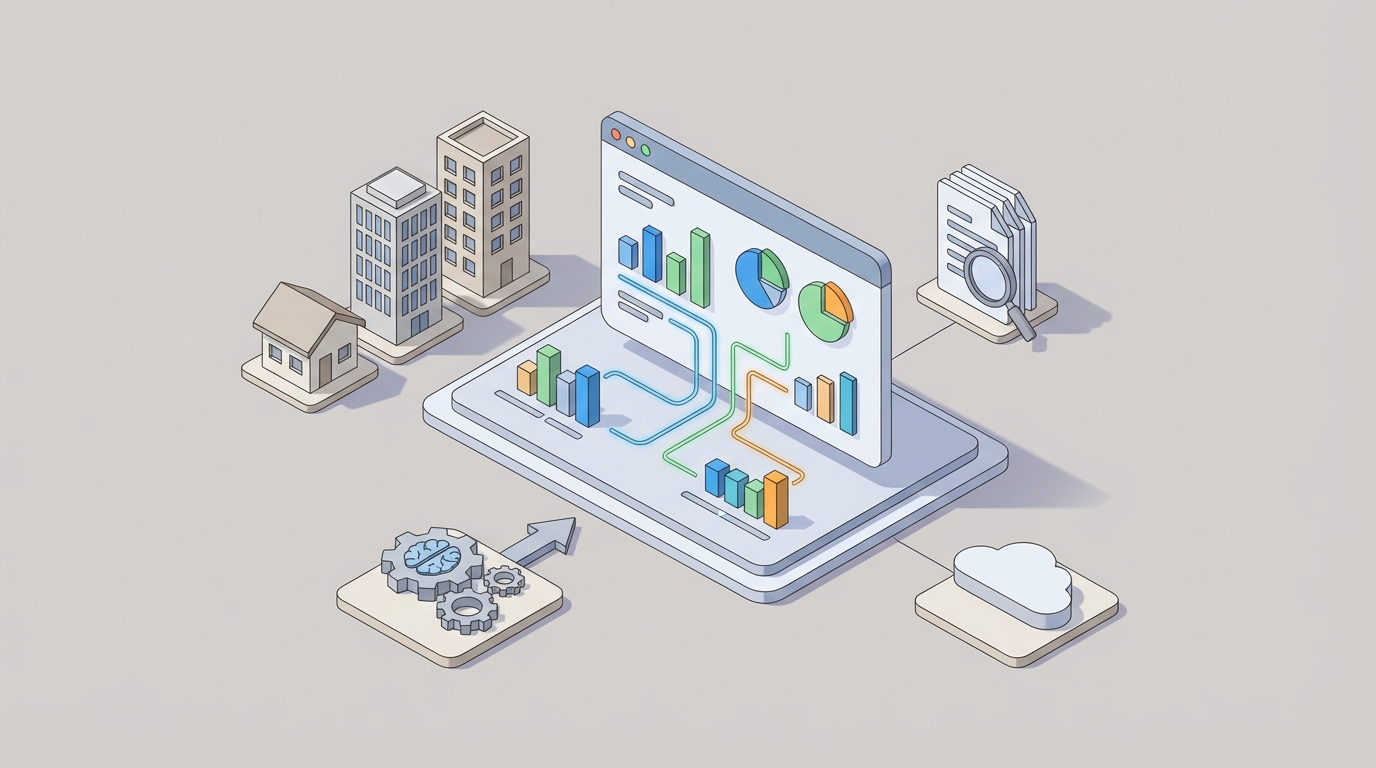
Every quarter, somewhere in a glass tower, an asset manager with a $2 billion real estate portfolio opens a folder containing fourteen different Excel files, six PDF appraisals, four rent rolls exported from Yardi, and a PowerPoint deck from last quarter that someone labeled "FINAL_v3_ACTUALLY_FINAL." They will spend the next six to nine weeks turning this chaos into a polished investor report. Most of that time isn't spent thinking. It's spent copying, pasting, reconciling, reformatting, and praying that no one transposed a number.
This is the state of real estate portfolio performance reporting in 2026. And it's exactly the kind of workflow that AI agents can demolish — not in some theoretical future, but right now.
Let me walk you through what the manual process actually looks like, why it's so painful, and how to build an AI agent on OpenClaw that handles the heavy lifting so your team can focus on the parts that actually require a brain.
The Manual Workflow Today: A Six-to-Twelve Week Odyssey
If you manage an institutional real estate portfolio — say 50 to 200 assets across office, multifamily, industrial, and retail — your quarterly reporting cycle probably looks something like this:
Step 1: Data Collection (1–3 weeks)
You're pulling rent rolls, operating statements, budgets, capital expenditure reports, and leasing activity from property managers. These come from Yardi Voyager, MRI Software, AppFolio, or RealPage — sometimes all four if your portfolio was assembled through acquisitions. Every property manager exports data in slightly different formats. Some send Excel files. Some send PDFs. One guy still sends a scanned printout.
Step 2: Data Reconciliation and Cleansing (1–2 weeks)
Now you match accounting data with lease abstracts. You resolve variances between what the property manager reported and what your investment management system shows. You normalize expense categories because one manager calls it "R&M" and another calls it "Building Maintenance" and a third just lumps it into "Other." This is pure drudgery, and it's where most errors are born.
Step 3: Valuation and Performance Metrics (1–2 weeks)
You update internal valuations using ARGUS Enterprise or custom Excel DCF models. You calculate NOI, IRR, equity multiples, occupancy rates, WALE (weighted average lease expiry), same-store growth, and a dozen other KPIs. You pull in external appraisals and cross-reference with CoStar comps and Green Street data. Half the time is spent making sure your numbers tie out.
Step 4: Market and Benchmarking Data (3–5 days)
You pull market reports, comparable transactions, and benchmark indices from CoStar, CBRE, JLL, RCA, Preqin, and NCREIF. You try to contextualize your portfolio's performance against the market. This is genuinely useful work, but it's buried under hours of pulling and formatting data from various platforms.
Step 5: Report Compilation and Narrative (1–2 weeks)
Now you build the actual deliverable: an executive summary, asset-level commentary, risk analysis, charts, tables, and appendices. This usually lives in PowerPoint, sometimes supplemented by Word and Excel. Someone has to write the narrative — "Occupancy improved 180 basis points quarter-over-quarter due to the execution of three new leases at Building X, partially offset by the known vacancy at Building Y." This gets done for every major asset.
Step 6: Review and Approval (1 week)
Multiple rounds of internal review. Then client review. Corrections. Another round. "Can you change the font on the chart on page 37?" Final sign-off.
Total: According to PwC's 2026 PropTech report, the average quarterly portfolio report for institutional owners with over $1 billion AUM requires 400 to 800 person-hours. The IREM and CCIM 2026 survey found that asset managers spend 18 to 25 hours per asset per year just on reporting activities.
That's not analysis. That's not strategy. That's data janitoring at enterprise scale.
Why This Hurts: The Real Costs
The time is bad enough. But the downstream problems are worse.
Error rates are unacceptable. KPMG's real estate audit studies consistently find 1–3% error rates in manually entered financial data. On a $2 billion portfolio, a 1% error in reported NOI is a $20 million valuation swing. That's not a rounding issue — that's a career-ending mistake if it hits an investor report.
Data fragmentation is endemic. Your data lives in 6 to 12 different systems with no single source of truth. Deloitte's 2026 Real Estate Tech Survey found that 68% of CRE executives cite "data fragmentation and manual reporting" as their top operational challenge. The Argus 2023 survey found that 74% of firms still use Excel as the "single source of truth" for final investor reports. Excel is many things. A reliable single source of truth is not one of them.
Version control is a nightmare. Everyone who has ever worked in real estate finance has a horror story about the wrong Excel file making it into the final deck. JLL's 2026 Tech Outlook found that only 23% of firms have achieved "mostly automated" portfolio reporting. The remaining 77% are living in some version of shared-drive purgatory.
Ad-hoc requests expose the whole system. When an investor calls and asks, "What's our exposure to office assets in markets with rising vacancy rates?" you can't answer that in real time. You need to go back to the spreadsheets, run the analysis, build a new slide, and get back to them in three days. By then, the moment — and sometimes the deal — has passed.
Your best people are doing your worst work. The analysts and associates who should be identifying value-add opportunities, underwriting acquisitions, or developing disposition strategies are instead spending half their time on mechanical data processing. That's an expensive misallocation of human capital.
What AI Can Actually Handle Right Now
I'm not going to tell you AI can replace your portfolio management team. It can't. But it can handle the 60–70% of this workflow that doesn't require human judgment, and it can do it in hours instead of weeks.
Here's what's firmly within the capability of an AI agent built on OpenClaw:
Data ingestion and normalization. An OpenClaw agent can connect to your property management systems, pull operating statements and rent rolls, and normalize the data into a consistent schema. "R&M," "Building Maintenance," and "Repairs" all get mapped to the same category. Data from Yardi, MRI, AppFolio, and even emailed PDFs gets parsed and structured.
Anomaly detection. The agent flags unusual expense spikes, occupancy drops, or rent collection issues before a human ever looks at the data. Instead of your analyst spending two weeks reconciling, they review a list of flagged items and resolve the ones that need attention.
Automated metric calculation. NOI, IRR, equity multiples, occupancy, WALE, same-store growth, budget-versus-actual variance — all calculated automatically once the clean data is in place. No more formula errors. No more broken Excel links.
Chart and table generation. The agent produces publication-ready charts, tables, and dashboards from the calculated metrics. These can be formatted to match your existing templates.
Draft narrative generation. This is where it gets interesting. An OpenClaw agent can take portfolio performance data and produce first-draft commentary. Not generic filler — specific, data-driven narrative: "Portfolio occupancy increased to 94.2% from 92.4% in Q2, driven primarily by three new leases totaling 47,000 SF at the Midtown Office Complex. Same-store NOI grew 3.1% year-over-year, outperforming the NCREIF Office Index by 110 basis points."
Market data integration. The agent pulls relevant market benchmarks and comps and weaves them into the narrative context. Instead of a human spending days pulling CoStar reports, the agent retrieves and synthesizes the relevant data points.
Brookfield reportedly cut their data collection time from four weeks to eight days using an AI data platform. PGIM Real Estate claims a 40–50% reduction in time on standard reporting. A mid-sized REIT in a Deloitte case study went from a nine-week quarterly cycle to four and a half weeks. These aren't hypothetical. They're happening now, and they're happening with tools less capable than what you can build with OpenClaw today.
Step by Step: Building the Automation with OpenClaw
Here's how to actually build this. I'll be specific.
Step 1: Define Your Data Sources and Schema
Before you touch any AI tooling, map out every system your data lives in and every metric your final report requires. For most portfolios, this looks like:
- Input sources: Yardi/MRI exports (CSV or API), ARGUS models (XML/Excel), rent rolls (Excel/PDF), appraisals (PDF), market data (CoStar API or reports), budget files (Excel)
- Output metrics: NOI (actual vs. budget), occupancy (physical and economic), WALE, IRR, equity multiple, same-store growth, cap rate, debt service coverage, cash-on-cash return
- Output format: PowerPoint deck, Excel data book, PDF summary
Build a canonical data schema that every input will be mapped to. This is the foundation.
Step 2: Build Data Ingestion Agents on OpenClaw
Create individual OpenClaw agents for each data source. Each agent handles one connection:
Agent: Yardi Data Ingestion
- Trigger: Scheduled (monthly) or on-demand
- Action: Connect to Yardi API / process exported CSV files
- Processing: Map Yardi chart of accounts to canonical schema
- Output: Structured JSON with property-level financials
- Validation: Flag records with missing fields or out-of-range values
Agent: Document Parser
- Trigger: New file uploaded to designated folder
- Action: Parse PDF appraisals, rent rolls, lease abstracts
- Processing: Extract key fields (appraised value, cap rate,
  tenant names, lease terms, rental rates)
- Output: Structured JSON matched to property ID
- Validation: Confidence scoring on extracted values;
  flag low-confidence items for human review
Agent: Market Data Collector
- Trigger: Quarterly (aligned with reporting cycle)
- Action: Pull market reports, vacancy rates, rent comps,
  transaction volumes from relevant APIs and data sources
- Processing: Match market data to portfolio submarket geography
- Output: Market context dataset by submarket and property type
On OpenClaw, these agents can be composed modularly — each one does its job, passes clean data downstream, and flags anything it's uncertain about.
Step 3: Build the Calculation and Analysis Layer
Once clean data flows in, a calculation agent handles the math:
Agent: Portfolio Analytics Engine
- Input: Normalized financial data from all ingestion agents
- Processing:
  - Calculate NOI (actual, budget, variance, YoY change)
  - Calculate occupancy (physical, economic, by asset and portfolio)
  - Calculate WALE by asset and portfolio
  - Calculate returns (IRR, equity multiple, cash-on-cash)
  - Run same-store analysis (isolate comparable periods)
  - Generate budget-vs-actual variance analysis
  - Flag anomalies (>5% variance from budget, >2 std dev from peers)
- Output: Complete metrics dataset + anomaly report
This agent replaces the bulk of that 1–2 week valuation and metrics step. The calculations happen in minutes. The human reviews the anomaly flags and resolves genuine issues — a task that takes hours, not weeks.
Step 4: Build the Report Generation Agent
This is the agent that produces the actual deliverable:
Agent: Report Composer
- Input: Metrics dataset, market context data, anomaly report,
  previous quarter's report (for comparison language)
- Processing:
  - Generate executive summary narrative
  - Produce asset-level commentary for each property
  - Create variance explanations (budget vs actual, QoQ, YoY)
  - Build charts and tables per template specifications
  - Integrate market benchmarking context
  - Compile risk factors and watchlist items
- Output: Draft report (PowerPoint + Excel data book + PDF)
- Configuration: Tone, level of detail, and template format
  customizable per client/fund
The narrative generation is key. OpenClaw agents can produce commentary that's specific, data-driven, and formatted to match your house style. An example output:
"The Industrial Portfolio delivered NOI of $14.7M in Q3, exceeding budget by 4.2% ($590K) and representing 6.8% YoY growth. Outperformance was concentrated in the Southeast subportfolio, where three lease renewals executed at an average 8.3% positive spread to expiring rents. The Logistics Hub at I-85 contributed $220K of the budget beat due to higher-than-projected recoveries. Portfolio occupancy stands at 97.1%, 340 bps above the Prologis Industrial Index."
That's a first draft produced in seconds. A human reviews it, adjusts the emphasis, adds strategic context ("We expect continued rent growth given the limited supply pipeline in this submarket"), and moves on. What used to take a week takes a day.
Step 5: Build the Review and Distribution Workflow
Agent: Review Coordinator
- Input: Draft report from Report Composer
- Processing:
  - Route to designated reviewers with tracked comments
  - Incorporate approved edits
  - Version control (no more FINAL_v3_ACTUALLY_FINAL)
  - Generate change log between draft versions
  - Final formatting and compliance check
- Output: Approved final report, distributed to stakeholders
Finding Pre-Built Components on Claw Mart
You don't have to build every piece from scratch. Claw Mart — the marketplace for OpenClaw agents and components — has pre-built agents for common tasks in this pipeline:
- Document parsing agents that handle PDF extraction for financial statements and appraisals
- Data normalization agents with pre-built mappings for common property management system exports
- Financial calculation modules with standard CRE metric formulas
- Narrative generation templates tuned for institutional real estate reporting
- Chart and dashboard generators with common CRE visualization formats
Browse Claw Mart for components that match your stack, customize them for your specific portfolio and reporting requirements, and compose them into a complete pipeline. This cuts your build time significantly — you're assembling tested components rather than writing everything from zero.
What Still Needs a Human
Let me be clear about what this automation does not replace:
Strategic market commentary. An AI agent can tell you that vacancy rates in downtown office increased 200 basis points. It cannot tell you whether that trend will reverse based on the new transit project, the mayor's development incentives, or the flight-to-quality dynamic you're seeing in tenant tours. That's judgment.
Forward-looking risk assessment. The agent can flag that a tenant representing 12% of portfolio revenue has a lease expiring in 18 months. The human decides whether that tenant is likely to renew, what the re-leasing risk is, and how to position that in the investor narrative.
Client-specific narrative tailoring. Different investors want different things. Your sovereign wealth fund LP wants macro context and ESG metrics. Your high-net-worth investors want simple cash yield numbers. The agent produces the raw material; the human shapes the story.
Investment thesis and recommendations. "We recommend holding Asset X and disposing Asset Y" is a fiduciary decision. AI provides the supporting analysis. A human makes the call and owns it.
Valuation sign-off. When your internal valuation model says a property is worth $85 million and the external appraisal says $92 million, a human needs to understand why and determine which is more defensible. The agent can highlight the discrepancy and identify the key drivers. The judgment is human.
Compliance and legal review. Disclaimers, regulatory language, and compliance checks require human oversight. Full stop.
The pattern is clear: AI handles data processing, calculation, and first-draft generation. Humans handle judgment, strategy, and accountability. The best implementations don't try to blur that line.
Expected Time and Cost Savings
Based on the real-world implementations cited earlier, here's a realistic expectation for a 100-asset institutional portfolio:
| Reporting Phase | Manual Time | With OpenClaw Agent | Reduction |
|---|---|---|---|
| Data Collection | 1–3 weeks | 1–2 days | ~85% |
| Reconciliation & Cleansing | 1–2 weeks | 2–3 days (human reviews flags) | ~75% |
| Metrics & Valuation | 1–2 weeks | Hours (calculation) + 2–3 days (human review) | ~70% |
| Market & Benchmarking | 3–5 days | Hours (automated) + 1 day (human context) | ~80% |
| Report Compilation & Narrative | 1–2 weeks | 1 day (AI draft) + 2–3 days (human editing) | ~75% |
| Review & Approval | 1 week | 3–5 days (streamlined workflow) | ~40% |
| Total Cycle | 6–12 weeks | 2–3 weeks | ~60–70% |
In person-hours, a quarterly cycle that currently requires 400–800 hours drops to roughly 120–250 hours. That's not because you fire people. It's because your people stop doing mechanical work and start doing analytical work. The associate who spent three weeks reconciling spreadsheets now spends three days reviewing AI-flagged anomalies and the rest of the month on actual asset management.
Cost math: If your blended cost for the reporting team is $100/hour (salary + benefits + overhead for analysts and associates), you're looking at savings of $28,000 to $55,000 per quarterly cycle. That's $112,000 to $220,000 per year in direct labor reallocation — before you factor in reduced error rates, faster investor response times, and the ability to produce ad-hoc reports on demand instead of in three days.
The build cost for an OpenClaw-based pipeline varies depending on complexity, but for a mid-sized portfolio, you're looking at a few weeks of configuration and testing to get the first version running. The ROI timeline is measured in quarters, not years.
Where to Start
Don't try to automate the entire pipeline at once. Start with the highest-pain, lowest-judgment step:
- Week 1–2: Build your data ingestion agents on OpenClaw. Get clean, normalized data flowing from your property management systems into a unified schema. Check Claw Mart for pre-built connectors that match your stack.
- Week 3–4: Add the calculation layer. Automate your standard KPI calculations and variance analysis. Validate against your existing manual process — run both in parallel for one cycle.
- Week 5–6: Add narrative generation. Start with asset-level commentary (the most repetitive part of the report). Have your team review and edit the drafts to calibrate quality.
- Week 7–8: Compose the full pipeline. Add market data integration, chart generation, and the report assembly agent. Run a full parallel cycle against your manual process.
- Ongoing: Iterate. Every cycle, the agents get better as you refine prompts, add edge cases, and tighten the schema.
By the end of your second quarter using the system, your team will wonder how they ever tolerated the old way.
Need help building this? If you want a team to design, build, and deploy your portfolio reporting automation on OpenClaw — from data architecture to finished agents — submit a project through Clawsourcing. Describe your portfolio, your systems, and your reporting requirements, and get matched with builders who specialize in real estate AI workflows. No guesswork, no six-month consulting engagements. Just a working system that saves your team thousands of hours per year.