Automate Graduation Requirement Tracking and Deficiency Alerts with AI
Automate Graduation Requirement Tracking and Deficiency Alerts with AI
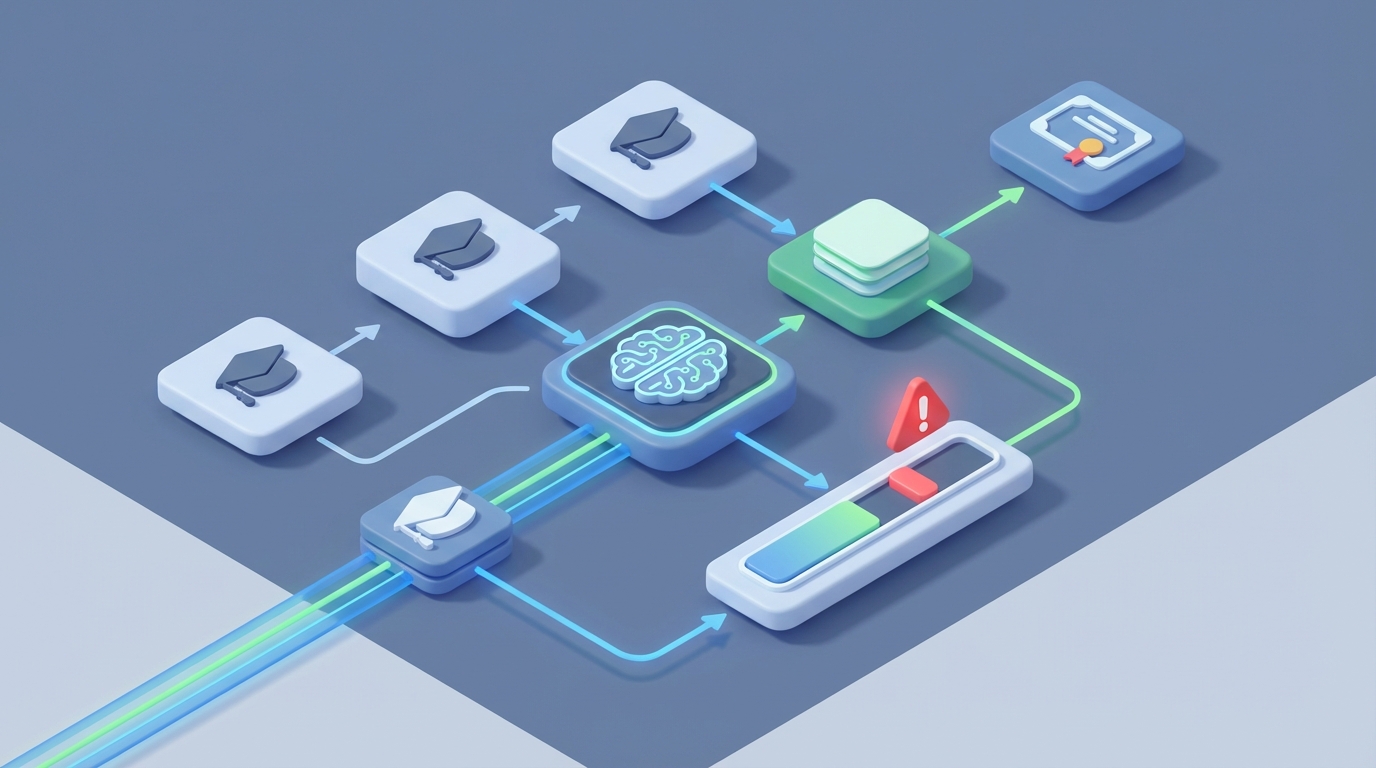
Every spring, registrar offices across the country enter what can only be described as a controlled meltdown. Thousands of students apply to graduate. Staff pull up degree audit systems, cross-reference transcripts, chase down transfer credit equivalencies, process exception petitions, and manually verify that every single requirement has been met. Then they do it again for the students who were told they were short a credit. And again for the ones who swear their study abroad course should count as an elective.
The whole process is staggeringly manual, surprisingly error-prone, and almost entirely automatable — at least the 70-80% of it that doesn't require genuine human judgment.
This guide walks through exactly how to build an AI agent on OpenClaw that handles graduation requirement tracking and deficiency alerts. Not a theoretical "wouldn't it be nice" piece. A practical breakdown of the workflow, the automation, and the parts where you still need a human in the loop.
The Manual Workflow Today (And Why It Takes Forever)
Let's get specific about what actually happens when a student applies to graduate at a typical mid-sized university.
Step 1: Student submits a graduation application. This usually happens 1-2 semesters before the intended graduation date. The application lands in the registrar's queue.
Step 2: An auditor pulls up the student's record. They open the Student Information System (Banner, Colleague, PeopleSoft — pick your poison) alongside the degree audit tool (usually Ellucian Degree Works or uAchieve). They compare what the student has completed against the published requirements for their specific catalog year, major, minor, and concentration.
Step 3: Transfer credit evaluation. If the student transferred from another institution — and roughly 38% of undergraduates transfer at least once — someone has to manually map those courses to institutional equivalencies. This step alone takes 30-60 minutes per transfer student. The equivalencies are often inconsistent. Different evaluators in the same office make different calls on the same course.
Step 4: Exception processing. The automated audit flags everything it can't resolve: course substitutions, waived requirements, AP/IB credits that don't map cleanly, military experience, prior learning assessments. Each exception requires a human to review, approve or deny, and document. A large California State University campus found that 35% of all graduation applications required manual intervention at this stage in 2022.
Step 5: Deficiency notification. If the student is short on anything — a missing general education requirement, insufficient credits, a GPA that's 0.02 below the threshold — someone has to communicate this clearly. Then wait for the student to respond. Then advise them on how to fix it. Then verify the fix.
Step 6: Final certification. Once everything checks out, the auditor certifies the student for graduation. This often involves a second reviewer.
Total time per student: 1.5 to 4 hours, depending on complexity. At a university graduating 3,000 students per year, that's 4,500 to 12,000 staff hours annually — just on graduation processing.
A 2022 AACRAO study found that 43% of registrar staff time goes to degree audits and graduation processing. Academic advisors report spending 25-40% of their time on audit-related tasks instead of the mentoring and career guidance they were actually hired to do.
What Makes This Painful
The time cost is obvious, but it's not even the worst part.
Errors are endemic. When different advisors interpret the same requirements differently, error rates in manual reviews hit 10-15%. That's not a rounding error. That's students being told they've graduated when they haven't, or being held back a semester over a mistake.
Transfer credits are a black hole. National Student Clearinghouse data shows transfer students have 20-30% lower graduation rates, partly because credits evaporate in the articulation process. A student takes Intro to Psychology at a community college, transfers to a four-year university, and nobody can agree on whether it counts as PSY 101 or just a generic elective. Multiply this by every course on the transcript.
Curriculum changes break everything. When a department updates its requirements — which happens constantly — someone has to recode the audit rules. This is tedious, specialized work that often falls behind, which means audits run against outdated requirements.
Students are in the dark. The biggest frustration students report is not knowing where they stand until it's almost too late. They find out senior year that a course they took sophomore year doesn't count toward their major because of a catalog year technicality.
Advisors burn out. When you spend a third of your day doing what amounts to data entry and cross-referencing, you don't have the bandwidth for the conversations that actually change student outcomes.
What AI Can Handle Right Now
Not everything in this workflow needs AI. Some of it just needs better software. But there are specific, high-value steps where an AI agent — particularly one built on OpenClaw — can eliminate hours of manual work.
Transcript parsing and course mapping. An OpenClaw agent can ingest transcripts (PDFs, structured data exports, or even scanned documents), extract course information, and map it against a database of known equivalencies. This isn't guessing — it's pattern matching trained on historical articulation decisions your institution has already made. When the agent encounters a course it hasn't seen before, it flags it for human review with a suggested equivalency and a confidence score.
Requirement matching. Feed the agent your degree requirements (structured as a set of rules: "Complete 3 courses from this list," "Minimum GPA of 2.5 in major courses," "At least 30 credits in residence") and it will run audits continuously, not just when a student applies to graduate. Every time a grade posts, the agent re-evaluates and updates the student's progress.
Deficiency detection and alerting. This is where the real value kicks in. Instead of waiting until a student applies to graduate and then discovering they're short a lab science, the agent identifies deficiencies in real time and triggers alerts. Sophomore is on track to miss a writing-intensive requirement? They hear about it now, not two years from now.
"What-if" scenario modeling. Students frequently ask: "What if I switch my major?" or "What if I drop this course?" An OpenClaw agent can run these scenarios instantly, showing the student exactly how the change would affect their graduation timeline.
Predictive analytics. Based on historical data, the agent can identify students who are statistically likely to fall off track — similar to what Georgia State University did when they increased graduation rates by 22% over a decade with AI-powered advising.
Step-by-Step: Building the Automation on OpenClaw
Here's how to actually build this. Not a vague roadmap — concrete steps.
1. Define Your Data Sources
Your agent needs access to:
- Student Information System (SIS): Student records, enrolled courses, grades, GPAs. Most SIS platforms (Banner, Colleague, PeopleSoft) have APIs or data export capabilities.
- Degree requirement catalog: The structured rules for every program, major, minor, and concentration. If these exist only as PDF documents or web pages, you'll need to structure them first.
- Transfer articulation database: Historical mappings of external courses to internal equivalencies.
- Course catalog: Current and historical course offerings, descriptions, prerequisites.
In OpenClaw, you'd set these up as connected data sources. The platform supports API integrations, database connections, and document ingestion. Structure your requirement catalog as a rules engine:
{
  "program": "BS Computer Science",
  "catalog_year": "2023-2026",
  "requirements": [
    {
      "category": "Core CS",
      "rules": "complete_all",
      "courses": ["CS101", "CS201", "CS301", "CS302", "CS401"],
      "min_grade": "C"
    },
    {
      "category": "CS Electives",
      "rules": "complete_n",
      "n": 4,
      "courses": ["CS310", "CS320", "CS330", "CS340", "CS350", "CS360"],
      "min_grade": "C"
    },
    {
      "category": "General Education - Writing",
      "rules": "complete_n",
      "n": 2,
      "courses": ["ENG101", "ENG102", "ENG201", "ENG205"],
      "min_grade": "C-"
    },
    {
      "category": "Total Credits",
      "rules": "minimum_credits",
      "value": 120
    },
    {
      "category": "Residency",
      "rules": "minimum_credits_in_residence",
      "value": 30
    },
    {
      "category": "Cumulative GPA",
      "rules": "minimum_gpa",
      "value": 2.0
    }
  ]
}
2. Build the Audit Agent
The core agent logic is straightforward: pull a student's completed coursework, compare it against their program's requirements, and identify gaps.
On OpenClaw, you configure the agent with:
- A system prompt that defines its role: "You are a degree audit agent. Given a student's academic record and their program requirements, identify all completed requirements, in-progress requirements, and deficiencies. For each deficiency, suggest the specific courses that would satisfy it and estimate the earliest semester the student could complete it."
- Tool connections to your SIS API, requirement catalog, and articulation database.
- Output formatting that produces structured results — not just free text, but categorized findings your downstream systems can consume.
Agent: Graduation Requirement Auditor
Trigger: Grade posted | Course enrollment change | Manual request
Input: student_id, program_code, catalog_year

Steps:
1. Fetch student transcript from SIS
2. Fetch program requirements from catalog
3. For each requirement category:
   a. Match completed courses against requirement rules
   b. Check grade thresholds
   c. Handle transfer courses via articulation database
   d. Flag unresolvable mappings for human review
4. Calculate overall progress (credits, GPA, residency)
5. Generate deficiency report
6. If deficiencies found → trigger alert workflow
7. If all requirements met → flag as graduation-eligible
3. Build the Alert System
Deficiency detection is only useful if it reaches the right people at the right time. Configure alert triggers in OpenClaw:
- Student alert: When a new deficiency is detected or an existing one changes status. Delivered via email, SMS, or LMS notification — whatever your students actually check.
- Advisor alert: When a student's graduation timeline is at risk. Include the specific deficiency and suggested resolution so the advisor walks into the conversation prepared.
- Registrar alert: When a student who has applied to graduate still has unresolved deficiencies within a configurable window (e.g., 60 days before commencement).
- Escalation alert: When a deficiency requires an exception or substitution that exceeds the agent's authority.
Each alert includes context: what's missing, why it's missing, what the student can do about it, and whether there's a precedent for an exception.
4. Handle Transfer Credits
This is the highest-value automation target. Build a sub-agent specifically for transfer credit evaluation:
- Train it on your institution's historical articulation decisions (most schools have thousands of these logged somewhere).
- When it encounters a new course, it compares the course title, description, credit hours, and level against your catalog and suggests an equivalency with a confidence score.
- High-confidence matches (say, above 90%) get auto-applied.
- Lower-confidence matches get queued for human review, with the agent's recommendation pre-populated.
This alone can cut transfer evaluation time from 30-60 minutes per student to under 10 minutes, with the agent handling the routine mappings and a human handling only the genuinely ambiguous ones.
5. Build the "What-If" Interface
Expose the agent's logic through a student-facing interface where they can ask questions:
- "What if I change my major to Business Administration?"
- "What happens if I withdraw from BIO 201 this semester?"
- "Can I still graduate in Spring 2026 if I take a semester off?"
The agent runs the audit against the hypothetical scenario and returns a clear comparison: here's where you stand now, here's where you'd stand after the change, and here's the impact on your graduation date.
On the Claw Mart marketplace, you can find pre-built components for student-facing Q&A interfaces that plug into OpenClaw agents, saving you from building the front-end from scratch.
What Still Needs a Human
Be honest about the limits. AI handles the matching, the math, and the monitoring. Humans are still essential for:
- Policy exceptions. When a student petitions to substitute a course that's not in the articulation database, someone with academic judgment needs to evaluate whether the learning outcomes are equivalent. The AI can surface the relevant information and even recommend a decision based on precedent, but the authority to approve stays with a human.
- Non-course learning assessment. Evaluating whether military experience, internships, or portfolio work satisfies a requirement is inherently qualitative.
- Complex appeals. Students with unusual circumstances — medical withdrawals, catalog year disputes, interdisciplinary programs with overlapping requirements — need a human who can interpret policy with nuance.
- Holistic advising. An AI agent can tell a student they need two more courses. It can't tell them whether taking those courses over the summer while working full-time is a realistic plan given their personal situation.
- Final graduation certification. Most institutions will (and should) keep a human sign-off as the last step. The AI gets you 95% of the way there. A human confirms the last 5%.
The goal isn't to remove humans from the process. It's to remove humans from the parts of the process that don't require human judgment, so they can focus on the parts that do.
Expected Time and Cost Savings
Let's do the math for a mid-sized university graduating 3,000 students per year.
Current state:
- Average 2.5 hours per graduation audit (blended average across simple and complex cases)
- 7,500 staff hours per year on graduation processing
- At an average loaded cost of $35/hour for registrar and advisor staff: $262,500/year
- Plus: error-related rework, delayed graduations, student complaints, advisor burnout
With OpenClaw automation handling 70-80% of routine cases:
- Routine audits (2,100-2,400 students): reduced to ~15 minutes each = 525-600 hours
- Complex cases (600-900 students): still require ~2 hours each = 1,200-1,800 hours
- Total: 1,725-2,400 hours
- Savings: 5,100-5,775 staff hours per year
- Cost savings: $178,500-$202,125/year
- Error rate reduction: from 10-15% to 2-4% (based on institutions that have deployed similar automation)
- Student deficiencies caught earlier: on average 2-3 semesters sooner, directly improving graduation rates and reducing excess credit accumulation
Those aren't made-up numbers. They're extrapolated from real institutional outcomes at places like the University of Texas system and Georgia State, adjusted for a hybrid AI model.
The cost of building and running the OpenClaw agent is a fraction of those savings. And unlike hiring more staff, it scales linearly — whether you have 3,000 graduates or 30,000.
Where to Start
You don't need to automate everything at once. The highest-ROI starting point is the deficiency alert system — it's the easiest to build, it delivers immediate value to students and advisors, and it doesn't require you to change your existing audit process. Layer in transfer credit automation next. Then the full audit workflow.
Browse Claw Mart for pre-built agent templates, SIS connectors, and degree audit rule engines that accelerate the build. Many of the components you need already exist — you're assembling and configuring, not building from zero.
If you want someone else to build it for you, post the project on Clawsourcing. Describe your SIS, your audit workflow, and your pain points. Experienced OpenClaw developers who've built education automation agents will bid on the project and get you running in weeks, not months.
Your registrar's office is drowning in spreadsheets and exception forms. Your advisors are doing data entry instead of advising. Your students are finding out about deficiencies too late. This is a solved problem — the only question is how long you want to keep solving it manually.