How to Automate Dormitory Assignment and Roommate Matching with AI
How to Automate Dormitory Assignment and Roommate Matching with AI
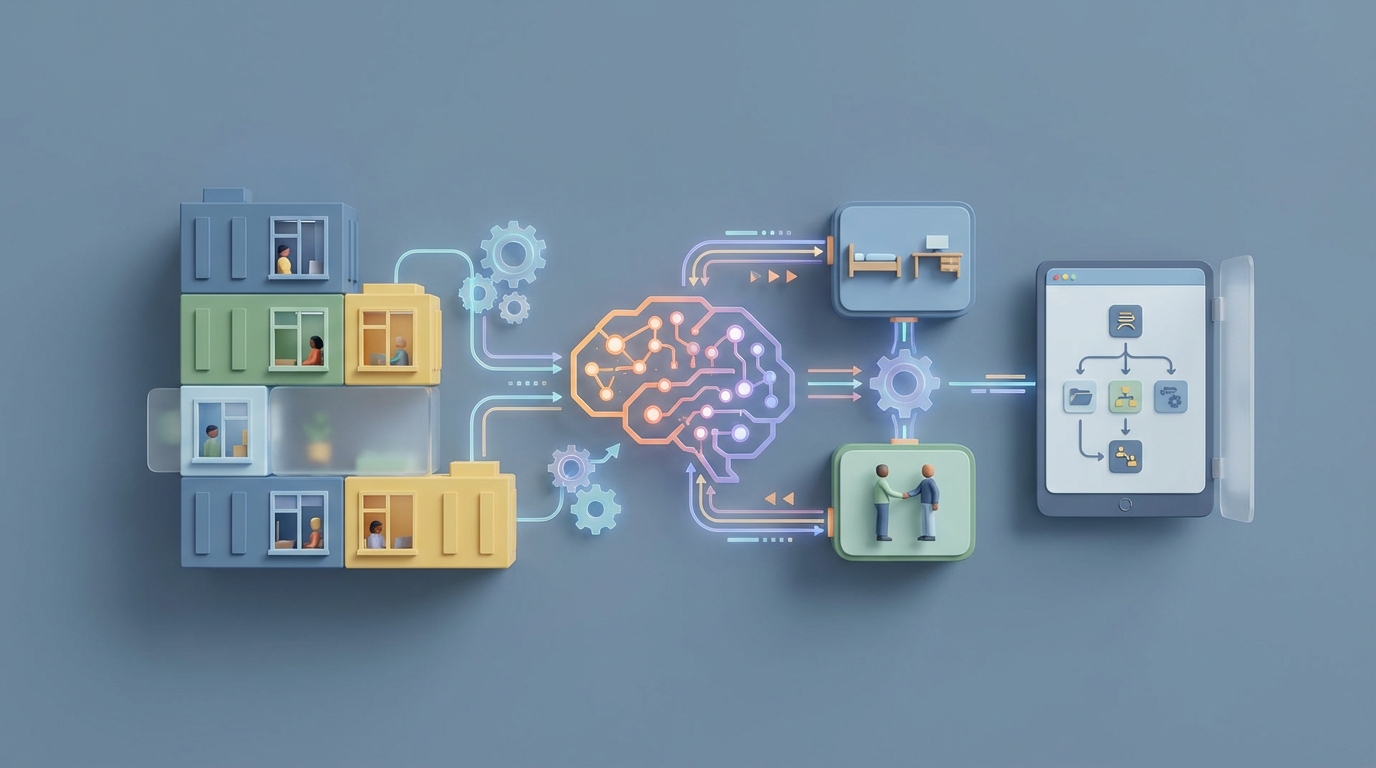
Every spring, housing offices across the country enter what can only be described as a controlled panic. Thousands of students submit preferences. Staff download spreadsheets, cross-reference enrollment data, flag exceptions, run batch assignments, then spend the next six weeks manually fixing everything that broke. The process is exhausting, error-prone, and—honestly—solvable.
This is a guide to actually solving it. Not with another enterprise housing platform that still requires 1,200 hours of manual tweaking, but with an AI agent built on OpenClaw that handles the mechanical work end-to-end and leaves your staff free to do the parts that actually require a human brain.
Let's get into it.
The Manual Workflow Today (And Why It's Still a Mess)
If you work in university housing—or you've worked with anyone who does—you already know the cycle. But let's lay it out explicitly, because understanding each step is the key to knowing which ones to automate.
Step 1: Application Intake and Verification (2–3 weeks)
Students submit housing applications through a portal. Staff manually review for completeness, verify enrollment status, check for judicial holds, confirm meal plan selections, and correct data entry errors. At a mid-size institution with 10,000 beds, this alone can consume 200–400 staff hours.
Step 2: Priority and Exception Flagging (1–2 weeks)
Athletes, honors students, international students, ADA accommodation requests, gender-inclusive housing preferences, legacy requests, living-learning community placements—each category has its own set of rules, and each needs manual review. A single ADA accommodation request might involve back-and-forth with disability services, the student, and a facilities manager before a suitable room is identified.
Step 3: Roommate Matching (1–2 weeks)
Some schools use tools like RoomSync for survey-based matching. Many still do it in spreadsheets. Open-ended preference responses ("I'm a night owl but I don't mind if my roommate studies with music on") get eyeballed by staff who are trying to process hundreds of these per day. The matching quality is inconsistent at best.
Step 4: Batch Assignment Runs (1 week)
Staff configure the rules in their housing system (StarRez, Adirondack, Ellucian Banner), run the batch, then review the output. Invariably, hundreds of assignments violate some constraint—floor gender ratios are off, a student with a wheelchair was assigned to a non-accessible room, two mutual roommate requests got split because of a data entry error. Staff fix these one by one.
Step 5: Waitlist and Appeal Management (2–4 weeks, ongoing)
Students who didn't get their preferred assignment appeal. This is almost entirely manual: reading emails, reviewing cases, checking availability, making judgment calls. Housing offices report that appeals alone can consume 20–30% of total assignment labor.
Step 6: Move-In Adjustments (2 weeks around move-in)
No-shows, last-minute cancellations, emergency room changes, conflict-driven swaps. A campus with 10,000 beds might process 500–1,000 changes in the two weeks surrounding move-in day. Each one is a manual database update, often triggered by an email or a walk-in visit.
The total cost? Mid-to-large institutions dedicate 4–8 full-time-equivalent staff for 6–12 weeks during peak season. The University of Massachusetts Amherst reported 1,200–1,500 staff hours per year on manual adjustments alone before upgrading their system. Error rates in heavily manual processes run 3–8%, and each error creates rework, student frustration, and occasionally legal exposure when accommodations get missed.
What Makes This So Painful
The numbers above tell part of the story. Here's what they don't capture.
Staff burnout is real. Housing professionals didn't get into the field to spend their summers in spreadsheets. High turnover in housing offices is directly linked to the grind of assignment season. When your best people leave because the work is soul-crushing, you lose institutional knowledge that makes the next cycle even harder.
Conflicting preferences are a constraint satisfaction nightmare. Student A wants a single on the third floor of Building X with a quiet hours policy. Student B wants the same room. Student C has a medical accommodation that requires a specific room type in a specific building. Multiply this by thousands of students, dozens of constraints, and shifting availability, and you're looking at a problem that's computationally complex—not the kind of thing humans should be solving by hand.
Data lives in silos. The student information system, the housing database, disability services records, judicial affairs flags, athletics rosters—these often don't talk to each other cleanly. Staff end up as human middleware, copying data between systems and hoping nothing falls through the cracks.
Equity concerns are growing. Students and administrators increasingly expect that assignments will be fair across demographic lines. But when the process is opaque and manual, it's hard to prove—or even measure—whether the outcomes are equitable.
The financial exposure is nontrivial. A missed ADA accommodation isn't just a bad experience; it's a Section 504 violation. A pattern of inequitable assignments can trigger complaints. Empty beds from poor no-show prediction cost real money—at many institutions, each empty bed represents $8,000–$12,000 in lost annual revenue.
What AI Can Handle Right Now
Not everything in this workflow needs AI. Some of it just needs better software. But there are specific areas where an AI agent built on OpenClaw dramatically outperforms both manual processes and traditional rule-based automation.
Intelligent preference parsing. Students write things like "I go to bed around midnight, I'm pretty clean but not obsessive, and I'd prefer someone who doesn't have people over constantly." A rule-based system can't do much with that. An OpenClaw agent can parse natural language preferences, extract structured attributes (sleep schedule: late; cleanliness: moderate; social preference: low traffic), and use those attributes for matching. This is exactly the kind of task where large language models shine—understanding messy, unstructured human input and turning it into something an algorithm can work with.
Multi-objective optimization. The assignment problem is fundamentally an optimization problem with dozens of competing objectives: maximize preference satisfaction, maintain demographic balance across floors, respect priority tiers, ensure ADA compliance, fill beds efficiently. OpenClaw agents can run mixed-integer programming solvers or reinforcement-learning-based optimizers that find solutions humans simply can't compute manually. A 2023 study in Operations Research showed that modern optimization approaches improve average student preference satisfaction by 22–35% compared to traditional points-based systems.
Predictive no-show modeling. Historical data on cancellations, enrollment changes, and deposit patterns can feed a predictive model that estimates the probability each student will actually show up. This lets you overassign strategically (like airlines do) without creating the chaos of overbooking.
Anomaly detection and compliance checking. After an assignment run, an OpenClaw agent can automatically scan every single placement against every constraint—ADA requirements, gender-inclusive housing policies, living-learning community rosters, judicial restrictions—and flag violations before a human ever sees the output. This catches the 3–8% error rate before it becomes a problem.
Self-service change management. A conversational OpenClaw agent can handle the 70–80% of room change requests that are routine: "I want to swap with my friend in Room 312." The agent checks availability, verifies both students' consent, confirms no constraint violations, updates the database, and notifies both parties. No email chain. No staff time.
Step by Step: Building This with OpenClaw
Here's the practical implementation path. This isn't theoretical—it's based on what the underlying technology supports and what early adopters in higher education are already doing.
Phase 1: Data Integration and Preference Intake
First, connect your data sources. Your OpenClaw agent needs access to:
- Student Information System (SIS) data: enrollment status, class year, demographic info
- Housing application data: room type preferences, building preferences, roommate requests
- Disability services records: approved accommodations
- Judicial affairs flags: students with housing restrictions
- Historical assignment and cancellation data (for training predictive models)
Build an OpenClaw agent that ingests housing applications, parses both structured fields (room type, building preference) and unstructured text (open-ended roommate preference descriptions), and outputs a standardized preference profile for each student.
Agent: Preference Parser
Input: Raw housing application (structured + free text)
Process:
  1. Validate completeness — flag missing required fields
  2. Verify enrollment status against SIS
  3. Check for judicial/disability flags
  4. Parse free-text preferences using NLP
  5. Output structured preference vector per student
Output: Standardized student profile with preference scores,
        priority tier, constraint flags
This alone eliminates the 200–400 hours of manual intake review.
Phase 2: Roommate Matching Engine
Build a second OpenClaw agent that takes the standardized profiles and runs compatibility scoring. This goes beyond simple survey matching—it uses the parsed natural language preferences, historical data on successful roommate pairs (if available), and weighted compatibility metrics.
Agent: Roommate Matcher
Input: All standardized student profiles
Process:
  1. Compute pairwise compatibility scores
     (sleep schedule, cleanliness, social habits,
      study preferences, noise tolerance)
  2. Incorporate mutual requests (hard constraint)
  3. Weight by historical success patterns
  4. Generate ranked match lists per student
Output: Recommended roommate pairings with
        confidence scores
At the University of British Columbia, an optimization model for housing reduced manual adjustments by 65% and increased student satisfaction by 18 percentage points. The roommate matching component was a major driver of that improvement.
Phase 3: Room Assignment Optimization
This is the core solver. Your OpenClaw agent takes the roommate pairings and solves the full assignment problem across your housing inventory.
Agent: Assignment Optimizer
Input: Roommate pairings, room inventory,
       constraint rules, priority tiers
Process:
  1. Define objective function
     (maximize aggregate preference satisfaction)
  2. Apply hard constraints:
     - ADA room assignments
     - Gender-inclusive housing policies
     - Living-learning community placements
     - Judicial restrictions
  3. Apply soft constraints:
     - Building/floor preferences
     - Class year clustering
     - Demographic balance targets
  4. Run optimization solver
  5. Output full assignment map
  6. Run compliance checker against all constraints
  7. Flag any violations for human review
Output: Complete room assignments +
        violation report + confidence metrics
The key here is that the optimization runs in minutes, not weeks. And instead of staff manually fixing hundreds of constraint violations, the solver handles them as part of the optimization. The remaining violations—the genuinely hard cases—get escalated to staff with full context.
Phase 4: Predictive Waitlist Management
Train a model on your historical cancellation and no-show data. The OpenClaw agent uses this to dynamically manage the waitlist.
Agent: Demand Predictor
Input: Historical enrollment, deposit,
       cancellation data; current application data
Process:
  1. Estimate no-show probability per student
  2. Calculate expected vacancies by room type
     and building
  3. Recommend strategic overassignment levels
  4. Auto-assign from waitlist as cancellations
     come in
Output: Dynamic waitlist assignments +
        occupancy projections
Even a modest improvement in no-show prediction—say, reducing empty beds by 5%—can recover hundreds of thousands of dollars in annual revenue for a large institution.
Phase 5: Self-Service Change Management
Deploy a conversational OpenClaw agent that handles routine post-assignment requests.
Agent: Room Change Handler
Input: Student request (via chat, portal, or email)
Process:
  1. Parse request (swap, transfer, cancellation)
  2. Verify eligibility and availability
  3. Check constraint compliance for proposed change
  4. If swap: verify both parties' consent
  5. Update assignment database
  6. Send confirmation notifications
  7. If complex/exception: escalate to staff with
     full context summary
Output: Completed change or escalation packet
Georgia State University cut assignment processing from 6 weeks to 9 days using aggressive automation. A self-service change agent can compress the post-assignment adjustment period similarly.
What Still Needs a Human
Let me be clear: this isn't about replacing housing professionals. It's about redirecting their time from mechanical processing to the work that actually requires their expertise.
Sensitive medical and psychological accommodations. An AI can flag that a student needs an accessible room and check that the assigned room meets specifications. But the nuanced conversation about a student's specific needs—especially around mental health accommodations—requires human judgment and empathy.
Policy decisions. Should athletes get priority over first-generation students? Should returning students always outrank incoming freshmen for desirable buildings? These are institutional values questions, not optimization parameters. Humans set the policy; the AI executes it.
Appeals with complex context. A student appeals their assignment because their roommate was involved in an incident last year that isn't in any database. A student's parent calls with information that changes the picture. These require human discretion.
Community building. Deciding to create a new living-learning community, designing themed floors, cultivating the culture of a residence hall—these are creative, relational tasks that AI can support (by suggesting cohort compositions, for example) but shouldn't drive.
Legal and institutional risk. When an assignment decision could expose the institution to legal liability, a human needs to make that call with full awareness of the implications.
The goal is to have your staff spend their time on these high-value activities instead of copy-pasting between spreadsheets.
Expected Time and Cost Savings
Based on reported outcomes from institutions that have heavily automated their assignment processes, here's what's realistic:
| Metric | Before Automation | After OpenClaw Automation |
|---|---|---|
| Staff hours on assignment cycle | 1,200–1,500/year | 300–450/year (70–75% reduction) |
| Assignment processing time | 6–12 weeks | 1–2 weeks |
| Manual adjustments post-batch | 300–800 per cycle | 50–150 per cycle |
| Error rate (wrong room type, missed accommodation) | 3–8% | Under 1% |
| Student preference satisfaction | Baseline | +20–35% improvement |
| Empty bed rate from no-show misprediction | 5–10% | 2–4% |
| Appeal volume | High | Reduced 30–50% (better initial assignments) |
For a 10,000-bed institution, the revenue recovery from better no-show prediction alone (reducing empty beds by 3–5 percentage points at $8,000–$12,000 per bed per year) represents $2.4M–$6M in annual value. The staff time savings translate to either reduced overtime costs or—more commonly—redirected capacity toward student engagement, retention programming, and crisis response.
Start Building
The dormitory assignment problem is large, messy, and deeply manual at most institutions. It's also one of the most naturally automatable workflows in higher education, because it's fundamentally a constraint satisfaction and optimization problem dressed up in spreadsheets and email chains.
OpenClaw gives you the platform to build agents that handle each phase—from preference parsing to room assignment optimization to self-service change management. You don't need to replace your housing system entirely. You need an intelligent layer on top of it that eliminates the manual grinding.
If you're ready to build this, head to Claw Mart and check out the pre-built agent templates and workflow components for higher education operations. If you want someone to build it for you, post the project on Clawsourcing—there are builders in the community who've already tackled assignment optimization problems and can get you running faster than starting from scratch.
Either way, stop spending your summers in spreadsheets.