How to Automate Abandoned Cart Email Recovery Campaigns with Dynamic Product Recommendations
How to Automate Abandoned Cart Email Recovery Campaigns with Dynamic Product Recommendations
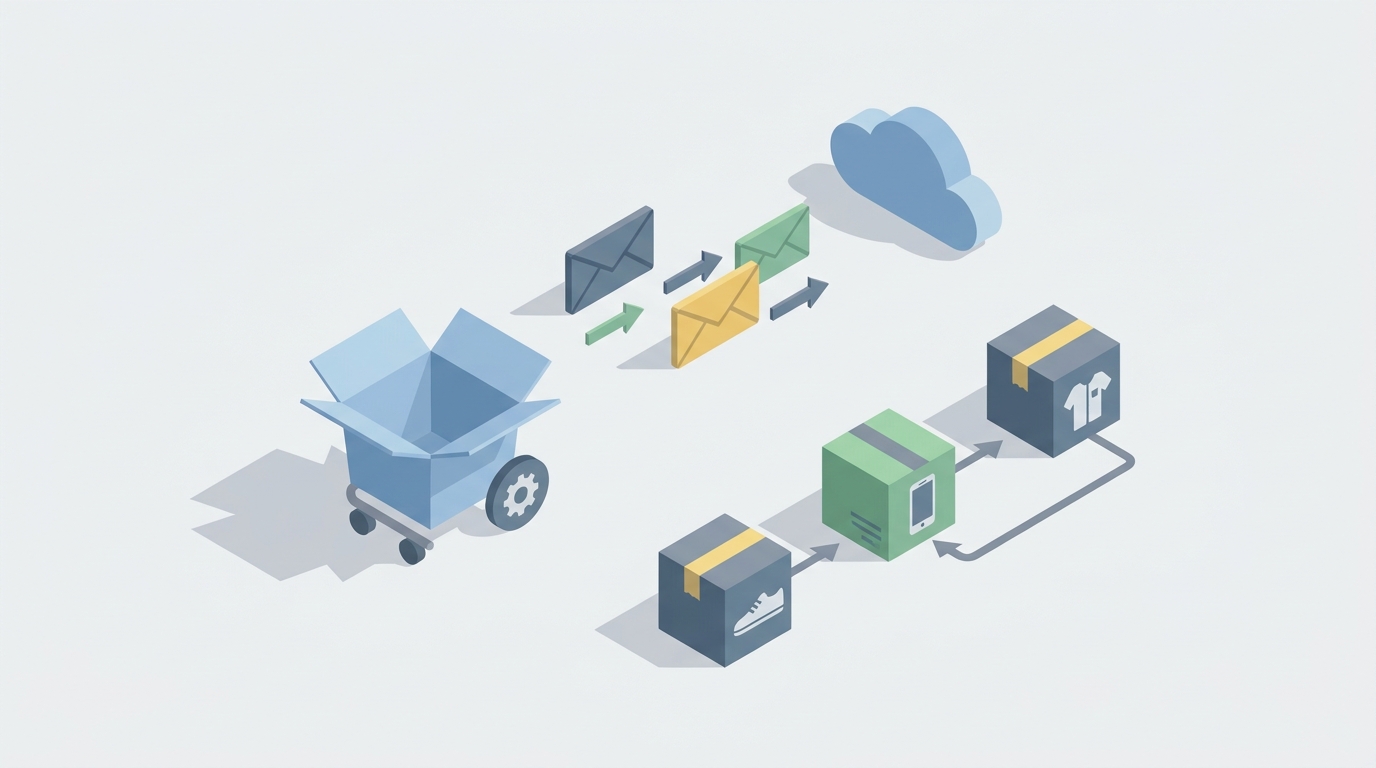
Every e-commerce store has the same leak in their bucket: roughly 70% of shoppers who add something to their cart walk away without buying. That's not a rounding error. That's the majority of your potential revenue evaporating.
The standard advice is to set up an abandoned cart email sequence. And that advice is correct — well-run recovery flows typically bring back 10–20% of those lost carts, with the best programs hitting 25–35%. The math is absurdly good. If you're doing $500K in revenue, even a mediocre recovery flow is probably worth $50–100K annually.
But here's what nobody talks about: building and maintaining these flows is a significant time sink, and most stores are running stale, generic sequences that leave enormous money on the table. The gap between "has an abandoned cart email" and "has a high-performing, dynamically personalized recovery system" is where tens of thousands of dollars hide.
Let's talk about how to close that gap using AI agents built on OpenClaw — and be specific about what that actually looks like in practice.
The Manual Workflow Today (And Why It's Brutal)
If you're setting up abandoned cart recovery the traditional way, here's what you're actually signing up for:
Initial Setup: 20–40 Hours
First, you're connecting your e-commerce platform (Shopify, WooCommerce, BigCommerce, whatever) to your email service provider — Klaviyo, Omnisend, ActiveCampaign, Mailchimp. This means configuring API connections, setting up tracking pixels, and testing that cart data actually flows through correctly. Product images, prices, variant names, inventory status — all of it needs to render properly in dynamic email blocks.
Then you're building the flow logic: When does email one fire? (Usually one hour after abandonment.) Email two? (24 hours.) Email three? (72 hours.) Do you include a discount? At what point? Do high-value carts get different treatment than $15 carts? What about returning customers versus first-time visitors?
Creative Production: 15–30 Hours Per Flow
This is where most teams bleed time. You need:
- 3–5 email variations across the sequence (initial reminder, social proof, urgency/scarcity, discount offer, last chance)
- 8–15 subject line variants for A/B testing
- Responsive HTML templates that look good on mobile and desktop
- SMS copy if you're running a multi-channel sequence (you should be)
- Dynamic product recommendation blocks that pull in not just the abandoned items but complementary products
Each email needs to match your brand voice. Each subject line needs testing. Each dynamic block needs QA across email clients (Gmail renders differently than Apple Mail renders differently than Outlook, and yes, people still use Outlook).
Ongoing Maintenance: 8–20 Hours Per Month
The flow doesn't just run itself forever. Every month, you're:
- Monitoring open rates, click rates, and recovery rates across each email in the sequence
- A/B testing new subject lines when performance dips
- Updating creative for seasonal campaigns and new product launches
- Fixing broken dynamic blocks when products go out of stock or get delisted
- Rotating discount codes to prevent abuse (people share these on coupon sites within hours)
- Analyzing why certain segments are underperforming
- Adjusting send times based on new data
A small store spends 8–15 hours per month on this. Mid-market brands ($5–50M) often dedicate 30–50% of an email marketer's time to flow management and segmentation alone. One Klaviyo agency partner I've seen referenced publicly reported 18–25 hours to create a single four-email flow from scratch.
What Makes This Painful
Time and money are the obvious costs. But the deeper problems are subtler:
Creative fatigue is real. There are only so many ways to write "Hey, you left something behind!" before your team starts phoning it in. And customers can smell it. The 47th "Did you forget something? 😊" subject line in someone's inbox isn't clever — it's noise.
Generic recommendations kill conversion. Most abandoned cart emails show the exact items left in the cart and nothing else. That's table stakes. The high-performing flows serve dynamic product recommendations — "People who bought this also bought X" or "This pairs well with Y" — personalized to browsing history, purchase history, and real-time inventory. Building that logic manually is a nightmare of conditional blocks and Liquid templating.
Discount code abuse eats your margins. If your third email offers 15% off, congratulations: savvy shoppers now know they can abandon every cart and wait for the discount. Broad, static discount strategies cannibalize full-price revenue. You need dynamic incentive logic — different offers for different customer segments based on lifetime value, purchase frequency, and cart value — and building that manually is where most brands give up and just blast the same 10% code to everyone.
Testing paralysis. You should be testing subject lines, send times, offer types, creative variants, and channel sequencing. That's a combinatorial explosion. Most teams test one variable at a time, slowly, and miss the multi-variate insights that actually move the needle.
Data fragmentation. Your behavioral data lives in your e-commerce platform. Your email performance data lives in Klaviyo. Your ad retargeting data lives in Meta or Google. Your customer service data lives in Gorgias. Synthesizing all of this into a coherent recovery strategy requires manual analysis that nobody has time for.
The result? Most stores run "good enough" flows that leave 40–60% of recoverable revenue on the table.
What AI Can Handle Now (With OpenClaw)
This is where things get interesting. OpenClaw lets you build AI agents that can automate the highest-leverage, most time-consuming parts of this workflow while keeping you in control of the decisions that actually matter.
Here's what an OpenClaw-powered abandoned cart agent can handle:
Dynamic Copy Generation at Scale
Instead of your team writing three subject line variants and hoping for the best, an OpenClaw agent can generate 20–30 variations calibrated to your brand voice, test them programmatically, and surface the winners. Not generic AI slop — copy that's been tuned to your specific tone, your product language, and your customer segments.
The agent can produce full email sequences: the casual first-touch reminder, the social-proof-heavy second email, the urgency-driven third touch, and the final discount offer. Each one adapted per segment: a high-AOV returning customer gets different language than a first-time visitor who abandoned a $22 cart.
Intelligent Product Recommendations
This is where the "dynamic" in the title earns its keep. An OpenClaw agent can analyze a customer's abandoned cart contents alongside their browsing history, your product catalog, margin data, and current inventory levels to generate genuinely relevant recommendations — not just "frequently bought together" (which is often stale or wrong), but contextually intelligent suggestions.
Cart contains a winter jacket? The agent recommends the matching gloves that are currently overstocked (helping you move inventory) rather than another jacket (which the customer obviously doesn't need two of). Cart contains a high-end skincare serum? The agent recommends the complementary moisturizer from the same line, with copy that explains why they work together.
This kind of merchandising intelligence used to require a dedicated person. Now it's a workflow.
Adaptive Incentive Logic
Rather than blasting a flat discount to everyone, an OpenClaw agent can implement dynamic offer strategies:
- First-time visitor, low cart value: Free shipping offer (low margin impact, high conversion lift)
- Returning customer, high cart value: No discount — just a reminder with strong product imagery (they already like you; don't train them to wait for discounts)
- Lapsed customer, medium cart value: Targeted percentage discount based on their historical price sensitivity
- VIP customer, any cart value: Personal-feeling outreach, early access framing, or loyalty points bonus instead of a discount
This logic can be encoded into the agent's decision framework, pulling from your customer data in real time and adjusting offers accordingly.
Automated Performance Analysis and Optimization
Instead of someone spending four hours a month staring at Klaviyo dashboards, the agent monitors flow performance continuously and surfaces actionable insights: "Email two's open rate dropped 12% this week — here are three new subject line variants to test." Or: "The 72-hour email is underperforming for customers in the $50–100 cart value range. Recommend switching from percentage discount to free shipping for this segment."
Step-by-Step: Building the Automation on OpenClaw
Here's the practical implementation path:
Step 1: Define Your Data Inputs
Your OpenClaw agent needs access to:
- Cart abandonment events (product IDs, quantities, prices, customer ID, timestamp)
- Customer profile data (purchase history, lifetime value, acquisition source, email engagement history)
- Product catalog (full inventory with margins, stock levels, categories, and related product mappings)
- Email performance data (historical open rates, click rates, and conversion rates by segment and email type)
Most of this comes through your e-commerce platform's API and your ESP's API. OpenClaw handles the integration layer — you're defining what data the agent can access and how it should use it.
Step 2: Build the Decision Logic
This is where you encode your strategy. In OpenClaw, you're defining the agent's rules and reasoning framework:
TRIGGER: Cart abandoned > 45 minutes, customer has valid email, not suppressed

SEGMENT ASSIGNMENT:
- IF new_customer AND cart_value < $50 → Segment A (light touch)
- IF new_customer AND cart_value >= $50 → Segment B (high-value new)
- IF returning_customer AND last_purchase < 90 days → Segment C (active returner)
- IF returning_customer AND last_purchase >= 90 days → Segment D (win-back)

OFFER LOGIC (per segment):
- Segment A: Email 1 (1hr, no discount) → Email 2 (24hr, free shipping) → SMS (48hr, free shipping reminder)
- Segment B: Email 1 (1hr, no discount, strong recommendations) → Email 2 (24hr, no discount, social proof) → Email 3 (72hr, 10% off)
- Segment C: Email 1 (1hr, no discount, personalized recs) → Email 2 (48hr, no discount, loyalty points reminder)
- Segment D: Email 1 (1hr, 15% off, "we miss you" framing) → Email 2 (24hr, SMS, urgency)

SUPPRESSION:
- Exclude if customer completes purchase at any point
- Exclude if customer has received abandonment email in last 7 days
- Exclude if customer is in active support ticket
Step 3: Configure Dynamic Content Generation
For each email in the sequence, define what the agent generates dynamically:
- Subject lines: Agent generates five variants per send, selecting based on historical performance for that customer's segment
- Body copy: Agent writes contextual copy based on the specific products in the cart, the customer segment, and the email's position in the sequence
- Product recommendations: Agent selects 2–3 complementary products based on the cart contents, browsing history, margin targets, and current inventory
- Urgency elements: Agent adds real-time stock levels or social proof ("12 people are looking at this right now") when appropriate — and omits them when they'd feel manipulative for the segment
Step 4: Connect to Your ESP
The OpenClaw agent pushes the generated content to your existing email platform via API. You're not replacing Klaviyo or Omnisend — you're supercharging them. The agent:
- Creates the email content and passes it to your ESP's template system
- Sets the send schedule based on the flow logic
- Generates unique, rotating discount codes per customer (preventing abuse)
- Monitors delivery, opens, clicks, and conversions through the ESP's reporting API
Step 5: Set Up the Feedback Loop
This is what separates a static automation from an intelligent system. The agent continuously:
- Tracks which subject lines, offers, and recommendations drive the highest recovery rates per segment
- Adjusts its content generation based on what's working
- Flags anomalies for human review ("Recovery rate for Segment B dropped 18% — possible issue with new product images or pricing change")
- Generates weekly performance summaries with specific, actionable recommendations
What Still Needs a Human
Let's be honest about this, because overpromising is how you end up with a robot sending tone-deaf emails to your best customers.
Brand voice calibration. The OpenClaw agent can learn your voice and get 85–90% of the way there. But the initial training — feeding it examples of your best copy, defining what your brand sounds like and what it definitely does not sound like — requires a human with deep brand knowledge. Plan to spend time upfront on this, and review the output regularly.
Offer strategy and margin protection. The agent can execute your discount logic flawlessly. But deciding that Segment C should never get more than free shipping, or that your new premium line should never be discounted in recovery emails, or that you're willing to sacrifice margin on a loss-leader product to acquire a customer — those are strategic business decisions that require human judgment.
Edge cases and VIP handling. When someone abandons a $2,500 cart, you probably don't want them getting the same automated flow as a $30 cart. High-value opportunities may warrant personal outreach from your sales team. The agent can flag these; a human should decide the response.
Creative direction. The agent can generate dozens of email variants. But deciding that this month's recovery emails should tie into your new collection launch, or that the tone should shift for a holiday campaign, or that you want to try a completely different creative approach — that's still human territory.
Compliance sign-off. GDPR, CCPA, CAN-SPAM, and platform-specific rules change. A human needs to verify that the agent's output meets current legal requirements, especially in regulated categories like health, beauty, or children's products.
Expected Time and Cost Savings
Based on what brands are seeing when they move from manual or semi-automated flows to AI-agent-powered systems:
| Activity | Before (Manual/Monthly) | After (OpenClaw Agent/Monthly) |
|---|---|---|
| Creative production | 15–25 hours | 2–4 hours (review + refinement) |
| A/B test management | 4–8 hours | 30 minutes (review agent recommendations) |
| Performance analysis | 3–6 hours | 30 minutes (review agent summaries) |
| Segmentation updates | 2–4 hours | Automated, human review quarterly |
| Discount code management | 2–3 hours | Fully automated |
| Total | 26–46 hours | 3–5 hours |
That's roughly an 85–90% reduction in hands-on time. For a mid-market brand paying an email marketer $70–90K per year, reclaiming 20–40 hours per month is the equivalent of freeing up a significant portion of a full-time role.
But the bigger number is on the revenue side. Brands that move from generic, static flows to dynamically personalized, continuously optimized sequences typically see recovery rates increase by 40–100%. If your current flow recovers $8,000/month, a well-built OpenClaw agent could push that to $12,000–16,000/month — an additional $48,000–96,000 per year.
The ROI calculation isn't close. This is one of those rare cases where the automation genuinely pays for itself in the first month.
The Bottom Line
Abandoned cart recovery isn't a "set it and forget it" tactic — it's a living system that needs constant feeding. The brands that win are the ones generating fresh, personalized creative, testing relentlessly, and adapting their offers to individual customer contexts. That used to require a dedicated person. Now it requires a well-built AI agent and a person spending a few hours a month on strategic oversight.
The work shifts from doing to directing. You stop writing the 47th "Did you forget something?" email and start deciding which customer segments deserve which treatment. That's a better use of your time, and it produces better results.
Ready to build this? Browse the Claw Mart marketplace for pre-built abandoned cart recovery agents and email automation components built on OpenClaw — or post your specific workflow requirements through Clawsourcing and get matched with a specialist who can build a custom agent tailored to your brand, your platform, and your recovery targets. Stop leaving money in abandoned carts.