AI Agent for ZoomInfo: Automate Contact Enrichment, Intent Data Monitoring, and Prospecting
Automate Contact Enrichment, Intent Data Monitoring, and Prospecting
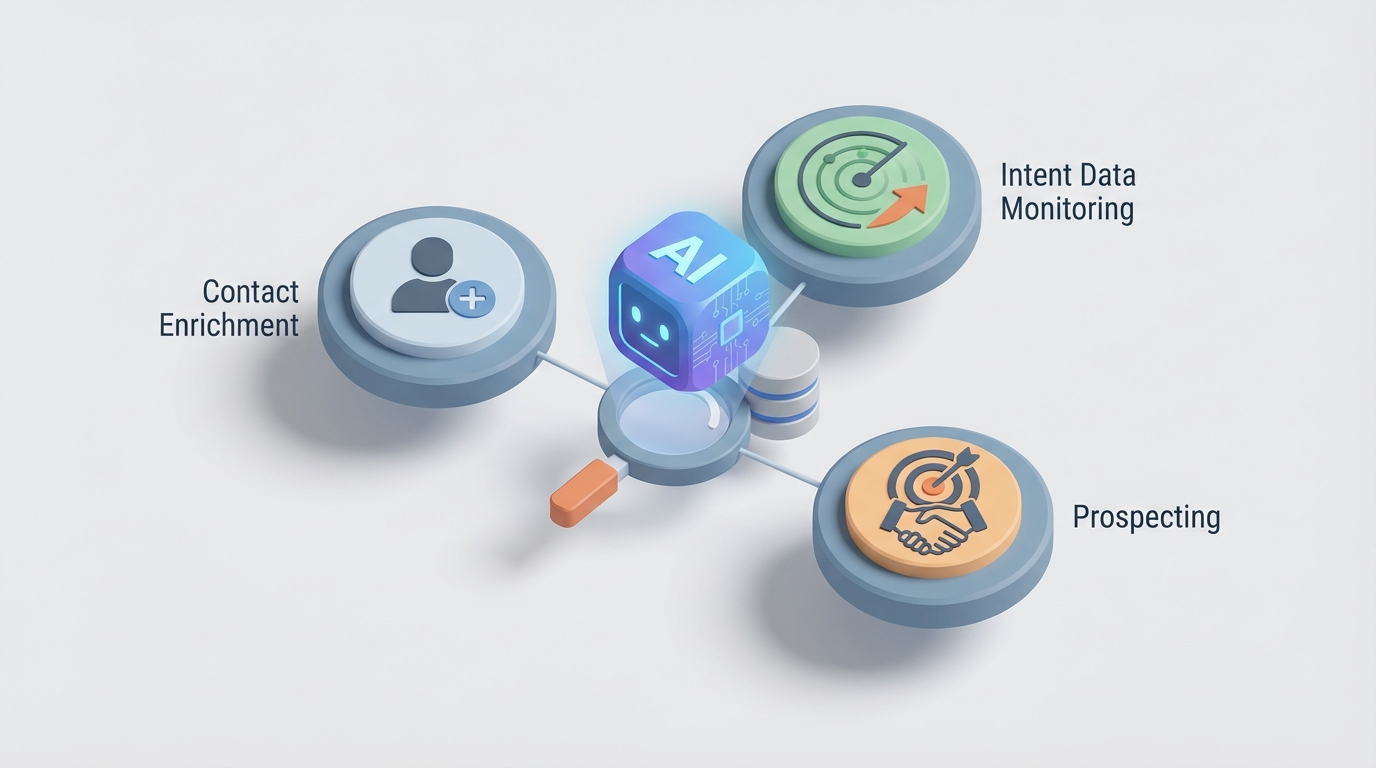
Most sales teams treat ZoomInfo like a glorified phone book. They log in, run a search, export a CSV, and dump it into their CRM. Maybe they set up a basic workflow to auto-enrich new records. Then they wonder why they're paying $25k a year for a tool that still leaves them drowning in unqualified contacts and bounced emails.
The problem isn't ZoomInfo's data — it's actually quite good as a raw data source. The problem is that ZoomInfo's native automation is shallow. It's rule-based. It can't reason. It can't combine signals from multiple sources, learn from your past wins, or make nuanced decisions about which accounts deserve attention right now. Their "Copilot" feature helps write emails and summarize company profiles, but it's not an autonomous agent that can execute multi-step research and outreach workflows on your behalf.
The real unlock is treating ZoomInfo as what it actually is — a massive, queryable database of B2B contacts and company intelligence — and connecting it to a custom AI agent that can actually think about the data, act on it, and improve over time.
That's exactly what you can build with OpenClaw.
The Architecture: ZoomInfo as Data Layer, OpenClaw as Brain
Here's the mental model. ZoomInfo has three things you care about:
- Contact and company data (emails, direct dials, titles, firmographics, technographics, org charts)
- Intent signals (which accounts are researching topics relevant to your product)
- Scoops and triggers (funding rounds, executive hires, technology migrations, company news)
ZoomInfo exposes all of this through a REST API. You can search, enrich, pull intent scores, and retrieve scoops programmatically. The API uses API key or OAuth authentication, and your contract determines your rate limits and monthly record caps.
The problem is that ZoomInfo's own workflow engine — the thing that's supposed to help you do something with this data — is limited to basic if/then rules. No complex branching. No natural language understanding. No ability to cross-reference external data sources. No learning loops.
OpenClaw sits on top of ZoomInfo's API and acts as the intelligent orchestration layer. It can:
- Translate natural language queries into ZoomInfo API calls
- Chain multiple API calls together with reasoning steps in between
- Combine ZoomInfo data with other sources (your CRM, LinkedIn, company websites, email verification services)
- Make prioritization decisions based on your specific ICP and historical win patterns
- Execute actions like pushing enriched contacts to your sequencer or flagging high-priority accounts for human review
- Run continuously, monitoring for new signals and reacting autonomously
Let me walk through the specific workflows where this matters most.
Workflow 1: Intelligent Contact Enrichment (Not Just Appending Fields)
What most teams do: Upload a list of target companies to ZoomInfo, pull back every contact that matches a title filter, dump it all into Salesforce or HubSpot.
What an OpenClaw agent does instead:
The agent takes your target account list and runs a multi-step enrichment process:
Step 1 — Initial ZoomInfo query. The agent hits the ZoomInfo Company Search API to pull firmographic data (revenue, headcount, industry, tech stack) for each target account. It uses the People Search API to identify contacts matching your buying committee titles.
# OpenClaw agent step: Query ZoomInfo for buying committee
search_params = {
    "companyName": account.name,
    "jobTitle": ["VP Engineering", "CTO", "Director of Infrastructure"],
    "managementLevel": ["Director", "VP", "C-Level"],
    "companyRevenue": {"min": 10000000, "max": 500000000}
}
contacts = zoominfo_api.search_people(search_params)
Step 2 — Cross-reference and verify. Instead of trusting ZoomInfo's "verified" emails at face value (remember, users regularly report 30-40% bounce rates), the agent cross-references contact data against an email verification service. It flags contacts where the email domain doesn't match the company domain, where the person's LinkedIn shows a different current employer, or where the phone number has been reported as disconnected.
Step 3 — Intelligent filtering. This is where OpenClaw's reasoning capability matters. The agent doesn't just return everyone who matches a title filter. It evaluates each contact against your actual ICP criteria — which might include things like:
- Does this person's LinkedIn activity suggest they're actively evaluating solutions?
- Has this company's tech stack changed recently (from ZoomInfo's technographic data)?
- Is this person new in their role (more likely to make changes)?
- Does the company's hiring pattern suggest they're scaling the team this person leads?
Step 4 — Structured output to CRM. The agent pushes enriched, verified, scored contacts to your CRM with custom fields populated: ICP fit score, key signals identified, recommended messaging angle, and confidence level on the contact data.
The difference between this and raw ZoomInfo enrichment is the difference between getting a phone book and getting a curated list of people who are likely to take your meeting, with notes on exactly why.
Workflow 2: Proactive Intent Data Monitoring
ZoomInfo's intent data tells you which accounts are researching topics related to your product. The problem is that their intent signals are a black box — you get a score from 1-100, but it's hard to know why an account is flagged or how to act on it. And the native alerting is basic: you get an email or a notification, and then it's on the SDR to figure out what to do.
An OpenClaw agent transforms intent monitoring from passive alerting to proactive action:
Continuous polling. The agent queries the ZoomInfo Intent API on a scheduled basis (hourly, daily, whatever your contract allows) for your target account list:
# OpenClaw agent: Poll intent data for monitored accounts
intent_results = zoominfo_api.get_intent_signals(
    topic_ids=["cloud-migration", "data-infrastructure", "cost-optimization"],
    company_ids=monitored_account_ids,
    min_score=65
)
Signal triangulation. When an account's intent score spikes, the agent doesn't just fire off an alert. It investigates. It pulls the account's recent scoops from ZoomInfo (any funding? leadership changes? layoffs?), checks if they've visited your website, looks for relevant job postings on the company's careers page, and searches for recent news mentions. All of this context gets synthesized into a brief.
Automated account brief generation. The agent produces a one-page account brief for the SDR that includes:
- Why this account is showing intent (inferred from multiple signals, not just ZoomInfo's opaque score)
- Who the relevant buying committee members are (already enriched and verified)
- What messaging angle is most likely to resonate based on the specific signals
- Recommended next action (cold email, LinkedIn connect, phone call, or warm intro request)
Priority routing. Based on the combined signal strength, the agent routes the account to the appropriate team member. Tier 1 accounts (strong intent + strong ICP fit + recent trigger event) get routed to senior AEs. Tier 2 goes to SDRs for standard outreach. Tier 3 gets added to a nurture sequence.
This is the kind of multi-step, reasoning-heavy workflow that ZoomInfo's native rule engine simply cannot do. It requires an agent that can chain API calls, synthesize unstructured information, and make judgment calls.
Workflow 3: Autonomous Prospecting Sequences
This is where things get genuinely powerful. Most teams use ZoomInfo to find contacts and then manually (or semi-manually) move them through an outreach sequence in Outreach or Salesloft. The personalization is usually surface-level — maybe a merge field for the company name and industry.
An OpenClaw agent can run the entire prospecting workflow autonomously:
1. Identify targets. The agent uses ZoomInfo's search and intent APIs to find accounts matching your criteria, using natural language instructions rather than rigid filter configurations:
"Find Series B or C fintech companies with 50-500 employees that use Snowflake or Databricks and have hired a VP of Engineering or VP of Data in the last 90 days."
The agent translates this into the appropriate combination of ZoomInfo API parameters — company filters for funding stage, headcount, and industry; technographic filters for Snowflake/Databricks; and scoops filters for recent executive hires.
2. Research each account. For every matching account, the agent pulls the full ZoomInfo company profile, identifies the relevant contacts, and then does supplementary research: scraping the company's about page, recent blog posts, press releases, and any relevant public case studies or product announcements.
3. Generate personalized outreach. Using all of this context, the agent generates email copy that's specific to each prospect's situation. Not "I noticed your company is in fintech" — more like "Saw that [Company] just brought on [Name] as VP of Data Engineering — given that you're running Snowflake at scale, the transition period is usually when teams discover the gap between their current data pipeline and what the new leader wants to build."
4. Execute with guardrails. The agent pushes the crafted messages to your sequencer (Outreach, Salesloft, or even direct SMTP) with human-in-the-loop checkpoints for high-value accounts. For standard-tier prospects, it can execute autonomously within parameters you define (send limits, opt-out handling, domain exclusions).
5. Learn and iterate. The agent tracks which messages get replies, which get bounced, and which get meetings booked. Over time, it adjusts its scoring, messaging approach, and targeting based on actual results — not just ZoomInfo's generic intent scores.
Dealing with ZoomInfo's Data Quality Problem
Let's be honest about this. ZoomInfo's data accuracy is its biggest weakness. Emails go stale. People change jobs. Phone numbers get recycled. If you're relying on ZoomInfo data without a verification layer, you're going to burn through your sender reputation and waste your SDRs' time.
An OpenClaw agent can implement a data quality layer that runs automatically:
- Email verification before any contact enters a sequence (using services like ZeroBounce, NeverBounce, or MillionVerifier via API)
- Duplicate and conflict detection — flagging when ZoomInfo data conflicts with what's already in your CRM
- Freshness scoring — weighting contacts based on when their data was last verified by ZoomInfo, deprioritizing stale records
- Cross-source validation — checking contact details against LinkedIn profile data or company website team pages
- Automatic suppression — removing contacts at companies that have opted out, are existing customers, or are competitors
This alone can save thousands of dollars in wasted email credits, protect your domain reputation, and dramatically improve your reply rates.
Technical Implementation Notes
A few practical details for teams considering this:
ZoomInfo API access requires an enterprise-level contract. If you're on a lower tier, you may not have API access at all. Check with your ZoomInfo rep. Most enterprise contracts include some level of API calls, but the limits vary significantly.
Rate limits and record caps are real constraints. Your agent needs to be designed with these in mind — batching requests, caching results, and being smart about when to make API calls versus when to use cached data. OpenClaw handles this orchestration natively, queuing and throttling API calls to stay within your contract limits.
Data storage restrictions matter. ZoomInfo's terms of service generally prohibit storing their data indefinitely in your own systems. Your agent should be designed to use ZoomInfo data for real-time decision-making and enrichment, not as a long-term data warehouse. Enriched records that get pushed to your CRM are generally fine (that's the intended use), but building a shadow copy of ZoomInfo's database is not.
Authentication setup:
# ZoomInfo API authentication
import requests

auth_response = requests.post(
    "https://api.zoominfo.com/authenticate",
    json={
        "username": ZOOMINFO_USERNAME,
        "password": ZOOMINFO_PASSWORD
    }
)
jwt_token = auth_response.json()["jwt"]

# Use token in subsequent requests
headers = {
    "Authorization": f"Bearer {jwt_token}",
    "Content-Type": "application/json"
}
The agent manages token refresh, error handling, and retry logic automatically — which sounds trivial but becomes important when you're running hundreds of API calls per day across multiple workflows.
What This Looks Like in Practice
A mid-market SaaS company running this setup might have their OpenClaw agent doing the following on a daily basis:
- 6:00 AM — Agent polls ZoomInfo intent API for all monitored accounts. Identifies 12 accounts with rising intent scores.
- 6:15 AM — For each of those 12 accounts, agent pulls scoops, checks for recent hires, cross-references with CRM for existing relationships, and scrapes company news.
- 6:45 AM — Agent generates account briefs for 5 Tier 1 accounts and routes them to AEs with recommended actions. 7 Tier 2 accounts get enriched contacts pushed directly into SDR sequences with personalized first-touch emails.
- 7:00 AM — Agent runs nightly CRM enrichment job: identifies 45 CRM records with stale data, re-enriches via ZoomInfo API, verifies updated emails, and updates CRM fields.
- Ongoing — Agent monitors for new scoops and trigger events throughout the day, re-prioritizing accounts as new information comes in.
The SDR team comes in at 8 AM to a queue of pre-researched, pre-prioritized, pre-personalized outreach tasks instead of spending their first two hours manually searching ZoomInfo and building lists.
The Bottom Line
ZoomInfo is a powerful data platform. It's just not a powerful intelligence platform. Its native automation is too rigid, its intent data is too opaque, and its workflows can't handle the kind of multi-step, multi-source reasoning that modern prospecting requires.
Building an OpenClaw agent on top of ZoomInfo's API gives you the best of both worlds: ZoomInfo's massive data asset, combined with intelligent orchestration that can research, reason, prioritize, verify, personalize, and execute — continuously and autonomously.
You keep your ZoomInfo investment. You just make it dramatically more effective.
Next Steps
If you want to build a ZoomInfo-connected AI agent but don't want to architect the whole thing from scratch, check out Clawsourcing. The team builds custom OpenClaw agent implementations tailored to your sales stack, your ICP, and your existing ZoomInfo contract. They'll handle the API integration, workflow design, and deployment so your team can focus on closing deals instead of debugging API calls.