AI Agent for Vanta: Automate Compliance Monitoring, Evidence Collection, and Audit Prep
Automate Compliance Monitoring, Evidence Collection, and Audit Prep
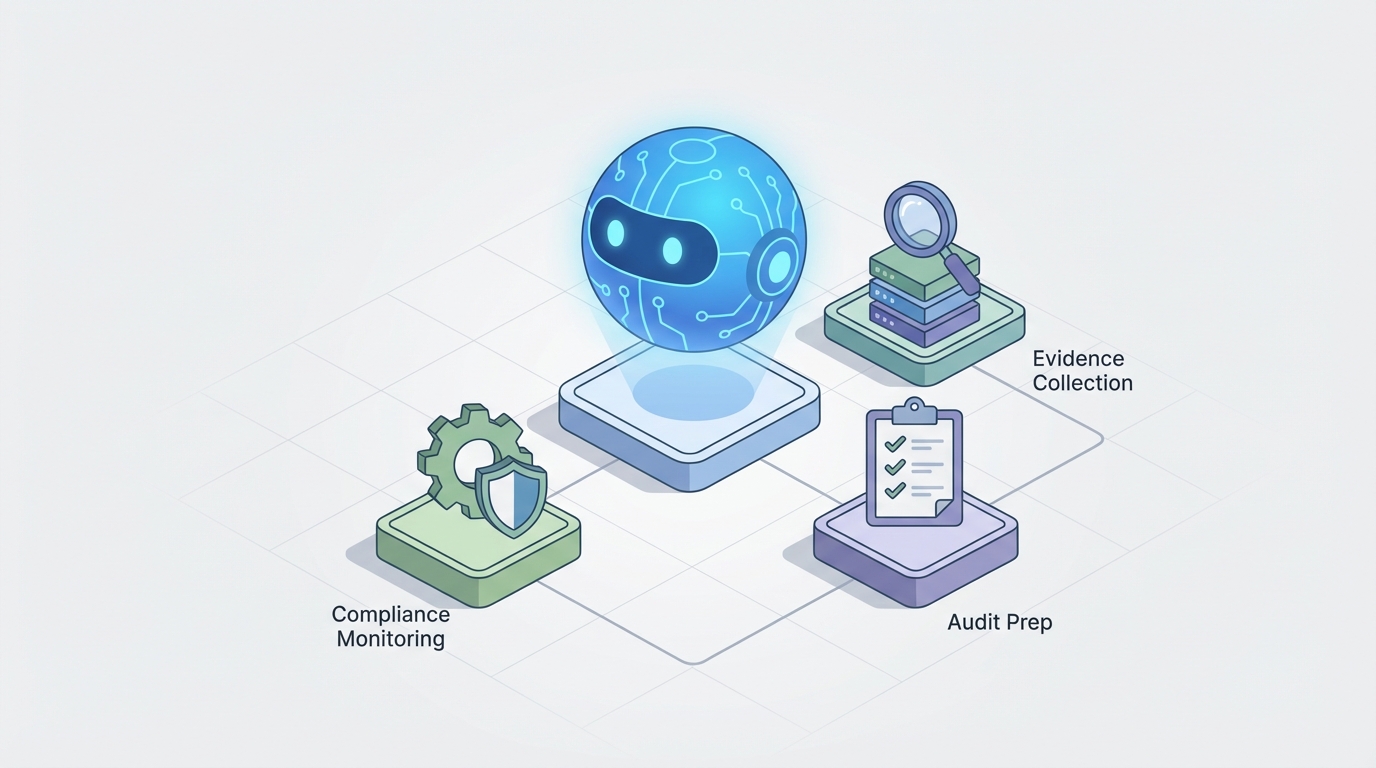
Let's be honest about what Vanta actually is: an extremely good data vacuum cleaner for compliance. It connects to your cloud providers, your identity tools, your HR systems, and it sucks up evidence. It runs tests. It flags failures. And for the first SOC 2 audit, it's genuinely transformative compared to the old "screenshot everything into a Google Drive folder" approach.
But after that first audit? The cracks show.
You still have a compliance team (or more likely, a single overworked security engineer) triaging hundreds of alerts, half of which are false positives or known exceptions. You still have people manually uploading evidence for anything Vanta doesn't natively integrate with. You still have auditors asking questions that require someone to dig through three different systems, synthesize the answer, and write it up in auditor-speak. You still have access reviews that are technically "automated" but actually just mean Slack messages that nobody responds to.
Vanta is great at collection. It's mediocre at intelligence. And it's essentially non-existent at autonomous action.
That's where a custom AI agent comes in — not Vanta's built-in AI features (which are mostly just LLM-assisted questionnaire responses), but an actual reasoning layer that sits on top of Vanta's API, connects to your internal systems, and does the thinking and doing that Vanta can't.
Here's how to build one with OpenClaw.
Why Vanta Alone Isn't Enough
Before getting into the build, it's worth being specific about the gaps. These aren't hypothetical — they come from teams running Vanta at Series A through Series C companies.
Integration blind spots. Vanta supports 300+ integrations, which sounds like a lot until you realize your company uses an internal deployment tool, a custom RBAC system, a niche SaaS for data labeling, and an on-prem legacy database that the compliance framework absolutely cares about. For all of those, someone is manually exporting CSVs and uploading them. Every. Single. Month.
Alert noise. Vanta flags a security group with 0.0.0.0/0 access. Sounds bad. Except it's a load balancer that's supposed to be public-facing, and you've documented this exception three times already. The alert keeps firing. Your engineer keeps ignoring it. Your compliance posture dashboard shows yellow when it should be green. Multiply this by dozens of similar cases.
No contextual reasoning. Vanta can tell you that control CC6.1 failed. It cannot tell you why it failed in the context of a deployment that happened yesterday, whether the failure is actually risky given your architecture, or what specifically needs to happen to fix it. That interpretation layer is entirely human-powered.
Audit prep is still manual. Yes, Vanta has an auditor portal. It's better than a shared drive. But when an auditor asks "Can you explain how your change management process ensures separation of duties for production deployments?", someone still has to synthesize information from GitHub branch protection rules, your CI/CD pipeline config, your Vanta control evidence, and maybe a Notion doc describing the process — and then write a coherent answer.
No predictive capability. Vanta is reactive. It tells you what's broken now. It doesn't tell you that you're about to hire 20 engineers next quarter and your access review process, which barely works for 30 people, is going to collapse at 50.
The Architecture: OpenClaw + Vanta API + Your Stack
The mental model is straightforward:
Vanta = source of truth for compliance controls, test results, and integrated evidence.
OpenClaw = reasoning and orchestration layer that interprets, decides, and acts.
Your internal tools = the rest of the data and action surface (GitHub, Jira/Linear, Slack, Notion, internal APIs, cloud consoles).
OpenClaw connects to Vanta's REST and GraphQL APIs, ingests your compliance state, combines it with context from your other systems, and then either surfaces insights or takes autonomous action — creating tickets, uploading evidence, drafting audit responses, triaging alerts.
Here's a simplified view of the data flow:
Vanta API (controls, tests, evidence, vendors, personnel)
    ↓
OpenClaw Agent (reasoning, RAG over internal docs, function calling)
    ↓
Actions:
  → Upload custom evidence back to Vanta
  → Create remediation tickets in Linear/Jira
  → Post summaries to Slack
  → Draft audit responses
  → Update risk register
  → Trigger cloud configuration changes
The key insight: Vanta's API is actually quite capable for read/write operations on evidence and compliance data. What's missing is the brain that decides what to read, how to interpret it, and what to write back. OpenClaw is that brain.
Workflow 1: Intelligent Alert Triage
This is probably the highest-ROI starting point.
Vanta fires webhooks when controls fail. Right now, those either go to a Slack channel where they get buried, or to an email inbox where they get ignored. An OpenClaw agent intercepts these webhooks and does something actually useful with them.
Here's the logic:
# OpenClaw agent function: triage_vanta_alert

async def triage_vanta_alert(alert_payload):
    control_id = alert_payload["control_id"]
    test_id = alert_payload["test_id"]
    failure_details = alert_payload["details"]

    # Step 1: Pull historical context from Vanta
    history = await vanta_api.get_control_history(control_id, days=90)
    exceptions = await vanta_api.get_exceptions(control_id)

    # Step 2: Check if this is a known exception
    if openclaw.reason(
        f"Given these documented exceptions: {exceptions}, "
        f"does this failure match an existing exception? "
        f"Failure details: {failure_details}"
    ).is_known_exception:
        # Auto-acknowledge with documentation reference
        await vanta_api.acknowledge_alert(
            alert_id=alert_payload["id"],
            note=f"Auto-acknowledged: matches exception {exception_id}"
        )
        await slack.post(channel="#compliance",
            message=f"ℹ️ Alert for {control_id} auto-resolved (known exception)")
        return

    # Step 3: Assess severity with architectural context
    architecture_context = await openclaw.rag_query(
        "internal_docs",
        f"What is the architecture context for {failure_details['resource']}?"
    )

    severity = openclaw.reason(
        f"Given this control failure: {failure_details}, "
        f"this architectural context: {architecture_context}, "
        f"and this 90-day history: {history}, "
        f"rate the actual risk severity (critical/high/medium/low/informational) "
        f"and explain your reasoning."
    )

    # Step 4: Generate remediation steps
    remediation = openclaw.reason(
        f"Generate specific remediation steps for: {failure_details}. "
        f"Include any relevant Terraform/CLI commands if applicable."
    )

    # Step 5: Create ticket or notify based on severity
    if severity.level in ["critical", "high"]:
        ticket = await linear.create_issue(
            title=f"[Compliance] {control_id}: {severity.summary}",
            description=remediation.steps,
            priority="urgent",
            label="compliance"
        )
        await slack.post(channel="#security-urgent",
            message=f"🚨 {control_id} failed — {severity.summary}. Ticket: {ticket.url}")
    elif severity.level == "medium":
        await linear.create_issue(
            title=f"[Compliance] {control_id}: {severity.summary}",
            description=remediation.steps,
            priority="normal",
            label="compliance"
        )
    else:
        # Log and move on
        await vanta_api.add_note(control_id, severity.explanation)
The difference between this and what Vanta does natively is enormous. Vanta says "MFA not enabled for user X." OpenClaw says "This is a service account used by the CI/CD pipeline, it's in a restricted OU with conditional access policies, the risk is low, and here's the exception documentation to upload." Or it says "This is a new engineer's personal account, they onboarded yesterday, here's a ticket assigned to their manager with a 48-hour SLA."
Workflow 2: Automated Evidence Collection for Custom Systems
This is the second biggest time sink. Anything not in Vanta's 300+ integration list requires manual evidence.
An OpenClaw agent can connect to your internal systems, extract the relevant data, format it as evidence, and upload it to Vanta via the API — on a schedule or triggered by events.
# OpenClaw scheduled task: collect custom evidence

async def collect_custom_evidence():
    # Example: Internal RBAC system that Vanta doesn't integrate with
    rbac_data = await internal_api.get_access_matrix()

    # Transform into evidence format
    evidence = openclaw.reason(
        f"Given this access matrix: {rbac_data}, "
        f"generate a compliance evidence document for SOC 2 CC6.3 "
        f"(Logical Access Controls). Include a summary table and "
        f"highlight any access that appears excessive."
    )

    # Upload to Vanta
    await vanta_api.upload_evidence(
        control_id="CC6.3",
        title=f"Internal RBAC Access Review — {date.today()}",
        body=evidence.document,
        attachments=[evidence.table_csv]
    )

    # If the agent found excessive access, flag it
    if evidence.excessive_access:
        for finding in evidence.excessive_access:
            await linear.create_issue(
                title=f"[Access Review] Excessive access: {finding.user} → {finding.resource}",
                description=finding.recommendation
            )
You can run this for internal deployment tools, custom databases, on-prem systems, homegrown admin panels — anything with an API or even a database you can query. OpenClaw handles the reasoning about what constitutes proper evidence and what looks anomalous.
Workflow 3: Audit Response Drafting
When auditors submit questions through Vanta's audit hub (or more commonly, via email or a shared doc), someone on your team spends hours pulling together answers. An OpenClaw agent can draft these in minutes.
async def draft_audit_response(question: str):
    # Pull relevant evidence from Vanta
    relevant_controls = await vanta_api.search_controls(question)
    evidence = []
    for control in relevant_controls:
        evidence.extend(await vanta_api.get_evidence(control.id))

    # Pull supplementary context from internal docs
    internal_context = await openclaw.rag_query(
        sources=["notion_wiki", "confluence", "github_readmes"],
        query=question
    )

    # Pull previous audit responses for consistency
    prior_responses = await openclaw.rag_query(
        sources=["previous_audit_responses"],
        query=question
    )

    # Generate response
    response = openclaw.reason(
        f"You are drafting a response to an auditor's question for a SOC 2 Type II audit. "
        f"Question: {question}\n\n"
        f"Relevant Vanta evidence: {evidence}\n\n"
        f"Internal documentation: {internal_context}\n\n"
        f"Prior audit responses for reference: {prior_responses}\n\n"
        f"Draft a clear, professional response that directly addresses the question, "
        f"references specific evidence, and is consistent with our prior responses. "
        f"Flag any areas where evidence may be insufficient."
    )

    return response
This doesn't replace human review — your compliance lead should still read and approve every audit response. But the difference between reviewing a well-drafted response and writing one from scratch is the difference between 5 minutes and 45 minutes per question. Across an audit with 50+ questions, that's saving your team a full week.
Workflow 4: Predictive Compliance Monitoring
This is where things get genuinely interesting. Instead of just reacting to failures, the agent monitors signals across your systems and predicts compliance issues before they happen.
async def predictive_compliance_check():
    # Check upcoming changes that could affect compliance
    upcoming_hires = await hr_api.get_pending_onboards(next_days=30)
    planned_deployments = await linear.get_upcoming_releases()
    infra_changes = await github.get_open_prs(repo="infrastructure", label="terraform")

    analysis = openclaw.reason(
        f"Given these upcoming changes:\n"
        f"- {len(upcoming_hires)} new employees onboarding\n"
        f"- Planned deployments: {planned_deployments}\n"
        f"- Infrastructure PRs: {infra_changes}\n\n"
        f"And the current compliance state from Vanta: {await vanta_api.get_dashboard_summary()}\n\n"
        f"Identify any compliance risks these changes could introduce. "
        f"Be specific about which controls might be affected and what "
        f"proactive steps should be taken."
    )

    if analysis.risks:
        await slack.post(
            channel="#compliance",
            message=f"📋 Weekly Compliance Forecast:\n{analysis.formatted_summary}"
        )
Imagine getting a Monday morning Slack message that says: "Heads up — 8 new engineers start this month. Based on current patterns, 3 will likely not complete security training within the required 7-day window. The access review for your production database hasn't been done in 87 days (due at 90). And there's a Terraform PR that would open port 443 on a non-load-balancer resource, which will fail control CC6.1."
That's not collection. That's intelligence. And Vanta doesn't do it.
Implementation: Getting Started
The practical steps:
-
Audit your Vanta pain points. Talk to whoever manages compliance. Ask: "What do you spend the most time on that feels like it shouldn't be manual?" You'll get your priority list in 10 minutes.
-
Set up OpenClaw with Vanta API access. You'll need API keys from Vanta (available in Settings → API). OpenClaw handles the connection layer, tool definitions, and reasoning framework. Start with read-only access to build confidence before enabling write operations.
-
Start with alert triage. It's the lowest-risk, highest-value workflow. You're not changing anything in Vanta — just adding context and routing to alerts that already exist. This builds trust with your compliance team.
-
Add custom evidence collection. Identify 2-3 systems that require manual evidence uploads. Build OpenClaw functions that pull the data, format it, and upload it. Set them on a schedule. Watch your compliance team's monthly manual hours drop.
-
Layer in audit prep and predictive monitoring. Once you have the data flowing and the team trusts the agent's reasoning, expand to these higher-value workflows.
What This Actually Saves
For a typical Series B company (50–200 employees, SOC 2 + one additional framework):
- Alert triage: 5–10 hours/week → 1–2 hours/week (review only)
- Custom evidence collection: 10–15 hours/month → near zero
- Audit preparation: 2–3 weeks of focused work → 2–3 days of review
- Exception management: Ongoing friction → automated documentation
That's not a marginal improvement. That's the difference between needing a dedicated compliance hire and having your existing security engineer handle it as 20% of their role.
The Honest Caveat
An AI agent doesn't eliminate the need for compliance expertise. Someone on your team still needs to understand the frameworks, make judgment calls on risk acceptance, and maintain relationships with auditors. What the agent eliminates is the drudgery — the evidence gathering, the alert triage, the copy-pasting between systems, the repetitive documentation.
Vanta does the plumbing. OpenClaw does the thinking. Your team does the deciding.
If you want help scoping an OpenClaw agent for your Vanta setup — or if you've got a compliance workflow that's eating your team alive and want someone to just build the damn thing — check out Clawsourcing. We'll assess your current Vanta configuration, identify the highest-ROI automation targets, and build agents that actually work with your specific stack. No generic demos, no theoretical architectures — just working automation against your real compliance data.