AI Agent for Thinkific: Automate Online Course Delivery, Student Communication, and Analytics
Automate Online Course Delivery, Student Communication, and Analytics
Most course creators I talk to have the same setup: Thinkific handles the courses, Zapier connects a few things, ConvertKit or Klaviyo sends the emails, maybe Circle or Skool runs the community. It works. Sort of.
The problem isn't any single tool. The problem is that the entire stack is dumb. Nothing in that chain actually understands what's happening inside your courses. A student fails a quiz three times and the system does nothing. Someone buys your flagship program and disappears for two weeks — crickets. Your completion rate tanks and you find out when you happen to check the dashboard six weeks later.
Thinkific is genuinely good at what it does: hosting courses, processing payments, delivering content. But it's a delivery mechanism, not an intelligent system. And the gap between "content delivery" and "learning experience" is where most course businesses lose students, revenue, and their minds trying to duct-tape automations together.
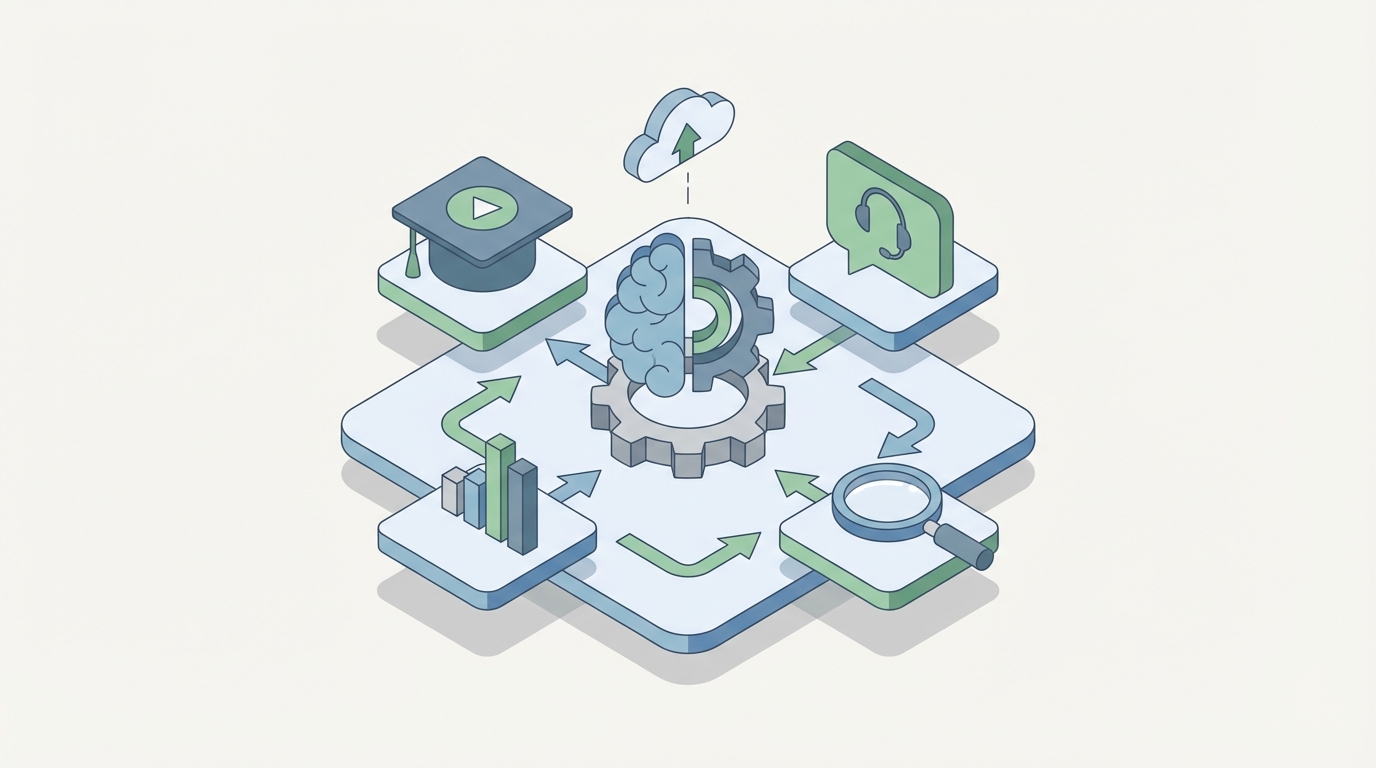
That gap is exactly where a custom AI agent comes in — not Thinkific's built-in AI features (which are mostly content generation tools), but an actual autonomous agent that connects to Thinkific's API, monitors what's happening across your entire student base, and takes action.
Here's how to build one with OpenClaw, and why it changes the economics of running a course business.
Why Thinkific's Native Automations Aren't Enough
Let's be specific about what Thinkific gives you out of the box for automation. Their native system (formerly called Flows) supports a handful of triggers: new enrollment, course completed, lesson completed, order placed, tag added, subscription events. Actions are limited to enrolling in another course, adding or removing a tag, sending a basic email, adding a delay, and simple conditional branching.
That's it.
You cannot build a workflow that says "if a student hasn't logged in for 10 days after purchasing and they're less than 20% through the course, send them a personalized re-engagement email referencing the specific lesson they stopped at, and if they don't respond within 3 days, alert me in Slack."
You can't say "when a student fails the Module 3 quiz, check their lesson completion times — if they rushed through the content, recommend they revisit Lessons 3.2 and 3.4 specifically, then unlock a supplementary video."
You definitely can't say "analyze all students who dropped off in the last 30 days, find the common lesson where they stopped, and generate a report on what might be wrong with that content."
Most creators solve this by stacking Zapier automations, which quickly becomes expensive ($50–$100+/month for serious usage), brittle (Zapier steps fail silently more often than you'd like), and limited (you're still working with rigid if/then logic, not actual intelligence).
What a Custom AI Agent Actually Does Differently
An AI agent built on OpenClaw and connected to Thinkific via its REST API and webhooks doesn't just react to triggers with predetermined actions. It maintains context, reasons about situations, and takes autonomous action within boundaries you define.
The difference is architectural. Instead of:
Trigger → Fixed Action → Done
You get:
Event → Agent observes → Agent reasons using context (student history, course structure, business rules, content knowledge) → Agent decides on action → Agent executes → Agent monitors outcome
That second flow is what turns a course delivery platform into something that actually manages the student experience.
The Technical Foundation
Thinkific's API (v1, REST) gives you enough to work with:
- Users/Students: Create, read, update student records
- Enrollments: Manage who has access to what, and their progress
- Courses, Chapters, Lessons: Full CRUD on your content structure
- Orders & Subscriptions: Payment data and subscription states
- Webhooks:
enrollment.created,order.created,course.completed,user.created,subscription.cancelled, and several more
Authentication is via API key or OAuth. Rate limits exist but are manageable for most course businesses (you're not processing millions of requests).
Here's what a basic webhook listener setup looks like for capturing Thinkific events and routing them to your OpenClaw agent:
// Thinkific webhook receiver
app.post('/webhooks/thinkific', async (req, res) => {
  const event = req.body;

  switch(event.resource) {
    case 'enrollment':
      if (event.action === 'created') {
        await openClawAgent.process({
          type: 'new_enrollment',
          studentId: event.payload.user_id,
          courseId: event.payload.course_id,
          enrolledAt: event.payload.created_at,
          context: await getStudentContext(event.payload.user_id)
        });
      }
      break;

    case 'course':
      if (event.action === 'completed') {
        await openClawAgent.process({
          type: 'course_completed',
          studentId: event.payload.user_id,
          courseId: event.payload.course_id,
          completionData: await getCoursePerformance(
            event.payload.user_id,
            event.payload.course_id
          )
        });
      }
      break;

    case 'order':
      if (event.action === 'created') {
        await openClawAgent.process({
          type: 'new_purchase',
          studentId: event.payload.user_id,
          products: event.payload.items,
          orderValue: event.payload.amount_dollars
        });
      }
      break;
  }

  res.status(200).send('OK');
});
That's the intake layer. The intelligence layer — the OpenClaw agent — is where things get interesting.
Five Workflows That Actually Move the Needle
I'm going to focus on workflows that directly impact revenue and retention, not theoretical nice-to-haves.
1. Intelligent Dropout Prevention
This is the highest-ROI automation you can build for a course business, full stop. Most courses have completion rates between 5% and 15%. Even moving that to 25% dramatically impacts testimonials, referrals, upsell potential, and refund rates.
The OpenClaw agent monitors student progress by polling the Thinkific API on a schedule (since Thinkific doesn't fire webhooks for "student hasn't done anything"):
# Scheduled job: runs daily
async def check_student_progress():
    enrollments = thinkific_api.get_active_enrollments()

    for enrollment in enrollments:
        student = enrollment.user
        progress = enrollment.percentage_completed
        last_activity = enrollment.last_sign_in_at
        days_inactive = (now() - last_activity).days

        # Send to OpenClaw agent with full context
        await openclaw_agent.evaluate({
            "student": student,
            "course": enrollment.course,
            "progress_pct": progress,
            "days_inactive": days_inactive,
            "quiz_scores": get_quiz_scores(student.id, enrollment.course_id),
            "lessons_completed": get_completed_lessons(student.id, enrollment.course_id),
            "purchase_history": get_orders(student.id),
            "action_history": get_previous_agent_actions(student.id)
        })
The OpenClaw agent then reasons about each student. Not with rigid rules, but with actual contextual understanding:
- A student who bought yesterday and hasn't started? Normal. Do nothing.
- A student who's 40% through, was engaged for three weeks, and suddenly went silent for 8 days? That's a dropout risk. The agent crafts a personalized re-engagement email referencing their specific progress and the next lesson waiting for them.
- A student who's been stuck at 60% for two weeks and failed the same quiz twice? Different problem. The agent might trigger a supplementary resource, offer to schedule a coaching call, or surface the issue to the instructor.
The key difference from a Zapier automation: the agent considers the combination of signals and tailors its response. It doesn't just blast "Hey, come back!" to everyone who's been gone for 7 days.
2. Smart Post-Purchase Onboarding
The first 48 hours after purchase are when you either hook a student or lose them. Most Thinkific setups send a single welcome email and hope for the best.
An OpenClaw agent can run a proper onboarding sequence:
Hour 0: Student purchases. Webhook fires. Agent receives the enrollment event, checks what the student bought, whether they're a returning customer or brand new, and what their quiz/survey responses were (if you use a pre-course assessment).
Hour 1: Agent sends a personalized welcome message through your email platform (via API — Klaviyo, ConvertKit, whatever you use) that's tailored to the student's situation. Not a generic template. An actually personalized message that references why they might have enrolled and what they should do first.
Hour 24: Agent checks if the student has logged in and started the first lesson. If yes, it sends encouragement. If no, it sends a different message focused on removing friction (login issues? overwhelmed? not sure where to start?).
Hour 48: Agent evaluates early engagement. Student who completed three lessons gets a "you're ahead of most students" message. Student who hasn't started gets a "here's literally the one thing to do today" nudge with a direct link to Lesson 1.
This feels like having a dedicated customer success manager for every single student. It's not — it's an OpenClaw agent making API calls. But the student experience is dramatically different from a three-email drip sequence.
3. Dynamic Course Recommendations and Upsells
Thinkific has order bumps and upsells, but they're static. Everyone sees the same offer.
An OpenClaw agent can make intelligent recommendations based on actual student behavior:
# Triggered when a student completes a course
async def handle_course_completion(student_id, course_id):
    student_profile = await build_student_profile(student_id)

    # Profile includes: all courses owned, completion rates,
    # quiz performance by topic, engagement patterns,
    # purchase history, total spend

    recommendation = await openclaw_agent.recommend({
        "student_profile": student_profile,
        "completed_course": course_id,
        "available_products": get_all_products(),
        "business_rules": {
            "max_discount_pct": 20,
            "priority": "lifetime_value",
            "exclude_recently_promoted": True
        }
    })

    # Agent returns: product to recommend, messaging angle,
    # discount (if any), delivery channel (email/in-app)
    await execute_recommendation(recommendation)
A student who crushed your beginner SEO course with high quiz scores gets recommended the advanced course with messaging about how they're clearly ready to level up. A student who struggled through the same course might get recommended a supplementary course or a coaching package instead. Same trigger, completely different — and appropriate — responses.
4. Proactive Student Support
This one is underrated. A huge chunk of student support tickets are the same questions asked repeatedly: "How do I access the bonus materials?" "When does the next module unlock?" "Can I get a certificate?" "Is there a community?"
An OpenClaw agent loaded with your course content, FAQ, and support documentation can handle the majority of these as an AI-powered support layer. But more importantly, it can be proactive.
When a student reaches the lesson that always generates confusion (you know which one it is — every course has it), the agent can preemptively send a clarification message. When a student's drip content is about to unlock, the agent can send a heads-up with context about what's coming and how it connects to what they just learned.
This is the difference between reactive support (waiting for someone to ask) and proactive guidance (anticipating what they need). It's what great teachers do. Now your platform can do it at scale.
5. Analytics and Business Intelligence
Thinkific's built-in analytics are surface-level. Revenue, enrollments, completion rates — all at the aggregate level. Getting segment-specific insights or understanding why something is happening requires exporting CSVs and doing manual analysis.
An OpenClaw agent that's continuously ingesting data from the Thinkific API can answer natural language questions about your business:
- "Which lesson has the highest dropout rate across all courses?"
- "What's the average time between purchasing Course A and purchasing Course B?"
- "Show me students who bought in the last 30 days, haven't completed 25%, and have been inactive for 7+ days."
- "What's my revenue from students who completed the free mini-course first vs. direct purchasers?"
This isn't a dashboard you stare at. It's a business intelligence layer you talk to. The agent maintains a continuously updated picture of your student base, pulled from the Thinkific API, and can surface insights you wouldn't even know to look for.
Implementation: Where to Start
Don't try to build all five workflows at once. Here's the order I'd recommend based on impact and implementation complexity:
Week 1-2: Dropout Prevention Set up webhook listeners and a daily progress polling job. Connect them to your OpenClaw agent. Start with simple rules and let the agent learn from outcomes. This single workflow can measurably improve completion rates within 30 days.
Week 3-4: Post-Purchase Onboarding Layer on the onboarding flow. This requires connecting your email platform's API (most have excellent APIs) so the agent can send messages through your existing deliverability infrastructure. Don't use Thinkific's built-in email for this — route through Klaviyo or ConvertKit.
Month 2: Support + Recommendations Once you have data flowing and the agent has context on student behavior patterns, add the proactive support layer and dynamic recommendations.
Month 3: Analytics By now the agent has enough historical data to provide meaningful insights. Build the query interface.
The Economic Argument
Let's do quick math. Say you sell a $500 course and enroll 100 students per month.
- Completion rate improvement (10% → 25%): 15 more students complete. They're 3x more likely to buy your next product and 5x more likely to refer someone. Conservative estimate: 5 additional sales per month = $2,500/month.
- Dropout recovery: Of the 75 who would have dropped out, recovering even 10% = 7.5 students who stay engaged, don't request refunds, and have a chance of completing. Reduced refund rate alone might save $500–$1,000/month.
- Smart upsells: Personalized recommendations convert at 2–3x generic offers. If you're currently converting 5% of completers to your next product, moving to 10–15% is realistic.
You're looking at $3,000–$5,000 in additional monthly revenue from a setup that, once built, runs autonomously. The ROI math works even for relatively small course businesses.
What You Need to Get Started
- A Thinkific account with API access (available on all paid plans)
- OpenClaw for building and hosting the AI agent
- A server or serverless function to receive webhooks (Vercel, Railway, AWS Lambda — whatever you're comfortable with)
- Your email platform's API credentials (Klaviyo, ConvertKit, etc.)
- Your course content in a format the agent can reference (for the support and content intelligence features)
The Thinkific API documentation is decent. Not amazing, but workable. The webhook setup is straightforward — you register endpoints in your Thinkific admin, and they'll POST event data to your URLs.
Stop Duct-Taping, Start Building
The course creator market is maturing. The businesses that win aren't the ones with the best video production or the fanciest sales pages. They're the ones that deliver a genuinely good learning experience — and that requires intelligence in the system.
Thinkific gives you the delivery layer. OpenClaw gives you the intelligence layer. Together, they create something that neither could do alone: a course platform that actually manages the student experience instead of just hosting content and hoping for the best.
The setup isn't trivial, but it's far less complex than maintaining a sprawling Zapier-to-ConvertKit-to-Google-Sheets-to-Slack automation chain. And it's dramatically more capable.
If you want help implementing this for your Thinkific setup — whether it's the full stack or just the dropout prevention workflow to start — check out our Clawsourcing service. We'll scope it, build it, and get it running against your actual course data. No twelve-week implementation timeline. Just the agent, connected, working.
Your students signed up to learn something. Build the system that actually helps them do it.