AI Agent for Mighty Networks: Automate Community Courses, Events, and Member Management
Automate Community Courses, Events, and Member Management
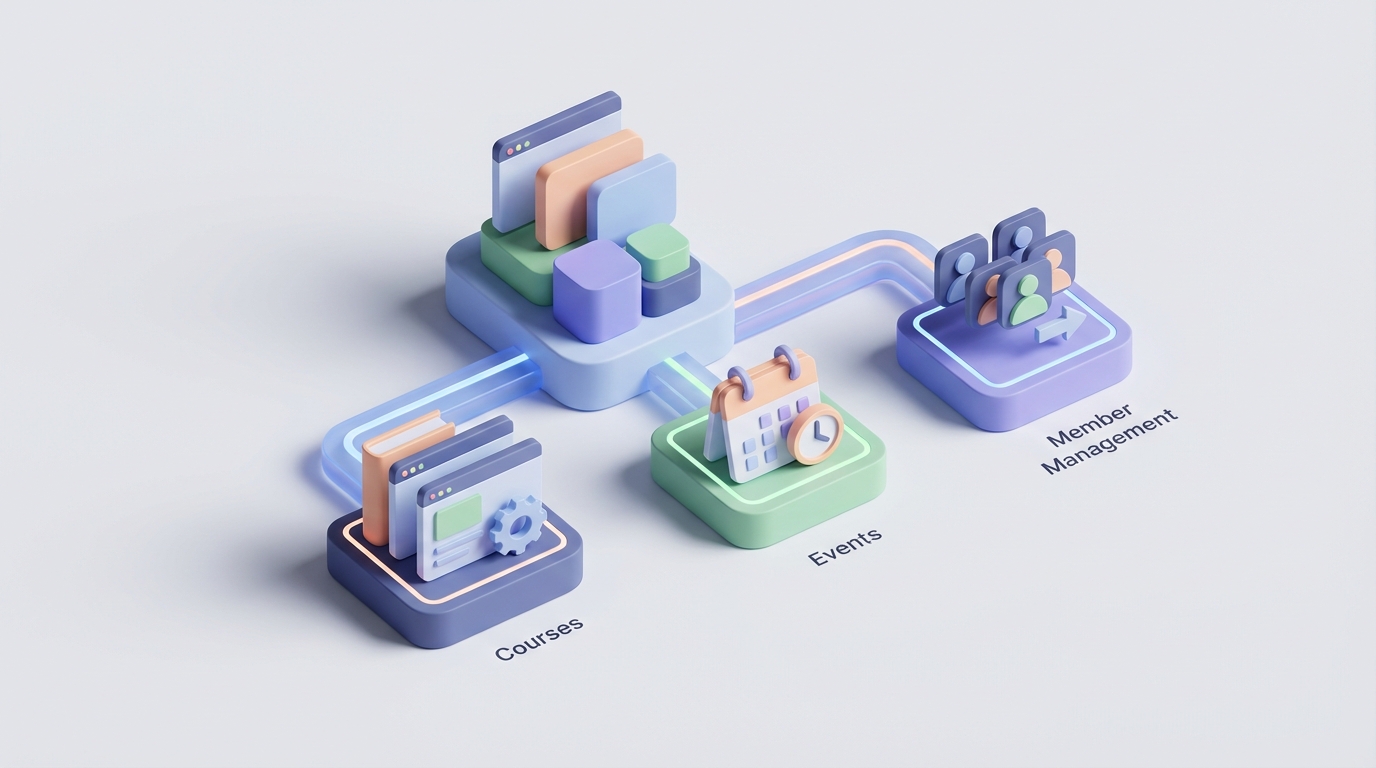
Mighty Networks is one of those platforms that does a lot of things well enough that you stick with it — branded mobile apps, built-in payments, courses and community in one place — but eventually you hit a wall. The wall is automation. The wall is intelligence. The wall is trying to do anything beyond "when member joins, send welcome message" without duct-taping Zapier to Make to a spreadsheet to your own sanity.
The native automation builder in Mighty Networks is, to put it generously, basic. No conditional branching. No behavioral triggers worth mentioning. No way to say "if a member completed 80% of the course but hasn't posted in two weeks, nudge them with something specific." You get tags, you get simple triggers, and you get the growing realization that you're going to need something external.
That something is an AI agent. Not the built-in AI features Mighty Networks has been rolling out (content summaries, discussion prompts — fine but shallow). I'm talking about a custom agent that connects to Mighty Networks via its API, monitors what's happening in your community, reasons about it, and takes action autonomously. The kind of thing that turns a community platform into an actual intelligent business system.
Here's how to build one with OpenClaw, and why it matters more than you think.
What Mighty Networks Can't Do On Its Own
Before getting into the build, let's be specific about the gaps. If you've run a Mighty Networks community at any scale, you've probably felt these:
Engagement is a black box. You can see who posted and who didn't, but there's no system that interprets patterns. You can't automatically identify that a cluster of members in your paid cohort are going quiet at week three, correlate that with the module they're stuck on, and do something about it.
Onboarding is one-size-fits-all. A new member fills out an intake form. Maybe they get tagged. Maybe they get added to a space. But there's no logic that reads their answers, understands their goals, and routes them to the right content, people, and spaces dynamically.
Re-engagement is manual or nonexistent. You either personally notice that someone went silent and DM them, or you don't. The native system can't trigger on "member hasn't posted in 30 days" because that's not an event — it's the absence of one.
Content moderation doesn't scale. Once you're past a few hundred active members, you can't read every post. Toxic content, off-topic threads, and spam slip through. Native tools don't help here.
Analytics require export and prayer. Getting meaningful insights out of Mighty Networks means exporting CSV files and building your own reports. Want a natural language answer to "which spaces have the highest engagement per member this month"? Good luck.
Upselling is guesswork. You have free members who should be in your paid tier and paid members who are ready for your premium cohort, but there's no lead scoring, no behavioral signals being tracked, no automated nudge system.
All of these are solvable. They just require an intelligence layer that Mighty Networks doesn't provide.
The Architecture: OpenClaw + Mighty Networks API
The Mighty Networks REST API (v2) is reasonably capable. It exposes endpoints for members, spaces, feeds, courses, events, messaging, payments, and webhooks. It's not perfect — rate limits are strict, some admin actions aren't exposed, bulk operations are limited — but it's enough to build a powerful agent on top of.
Here's the high-level architecture:
Mighty Networks Webhooks
        ↓
   OpenClaw Agent
   (reasoning + memory + tools)
        ↓
   Mighty Networks API (write-back)
   + External tools (email, CRM, Slack, etc.)
OpenClaw is the platform where you build, host, and manage the agent. It handles the reasoning layer — receiving events, deciding what to do, executing multi-step workflows with real conditional logic, and writing back to Mighty Networks and any other tool in your stack.
The key advantage of building this in OpenClaw rather than cobbling together Zapier + Make + a GPT wrapper is that you get a single agent with persistent memory, real branching logic, and the ability to chain complex operations without the latency and fragility of multi-platform automation stacks.
Let's get into specific workflows.
Workflow 1: Intelligent Member Onboarding
Trigger: member.joined webhook from Mighty Networks.
What the agent does:
- Receives the webhook payload with member data (name, email, custom field responses from the intake form).
- Reads and interprets the intake form answers — not just matching keywords, but understanding intent. "I'm a coach looking to grow my practice" vs. "I run a SaaS company and want to build a customer community" should route very differently.
- Determines the optimal set of spaces to add the member to.
- Sends a personalized welcome DM that references their specific situation and points them to the most relevant first steps.
- Tags the member with inferred attributes for future segmentation.
- If the member matches a profile likely to benefit from a premium offering, flags them in your CRM for follow-up.
Here's what the OpenClaw agent configuration looks like for this:
agent: onboarding-router
trigger: webhook.mighty_networks.member_joined

steps:
  - id: fetch_member_profile
    tool: mighty_networks_api
    action: GET /members/{member_id}

  - id: analyze_intake
    reason: |
      Read this member's intake form responses and determine:
      1. Primary goal (education, networking, business growth, certification)
      2. Experience level (beginner, intermediate, advanced)
      3. Relevant spaces from: [list of space IDs and descriptions]
      4. Whether they match our premium cohort ICP
    input: "{{fetch_member_profile.custom_fields}}"

  - id: add_to_spaces
    tool: mighty_networks_api
    action: POST /spaces/{space_id}/members
    for_each: "{{analyze_intake.recommended_spaces}}"

  - id: send_welcome_dm
    tool: mighty_networks_api
    action: POST /messages
    body:
      recipient_id: "{{member_id}}"
      content: "{{analyze_intake.personalized_welcome}}"

  - id: apply_tags
    tool: mighty_networks_api
    action: POST /members/{member_id}/tags
    body:
      tags: "{{analyze_intake.inferred_tags}}"

  - id: flag_for_upsell
    condition: "{{analyze_intake.premium_match}} == true"
    tool: crm_api
    action: create_lead
    body:
      email: "{{fetch_member_profile.email}}"
      score: "{{analyze_intake.lead_score}}"
      source: "mighty_networks_onboarding"
This replaces what would otherwise be a static automation that adds every new member to the same three spaces and sends the same generic welcome message. The agent actually reads, reasons, and personalizes.
Workflow 2: Proactive Engagement Recovery
This is the workflow that Mighty Networks literally cannot do natively, because it requires detecting the absence of activity.
Trigger: Scheduled (daily or every few days).
What the agent does:
- Pulls the member list with activity timestamps via the API.
- Identifies members who were active but have gone quiet — specifically, members whose activity dropped below their own baseline (not a static threshold, but relative to their personal pattern).
- For each at-risk member, checks their course progress, last posts, and recent events attended.
- Generates a personalized re-engagement message that's contextually relevant: "Hey Sarah, I noticed you made it through Module 3 of the Brand Strategy course — Module 4 is where most people say it really clicks. Want me to connect you with a study buddy who's at the same stage?"
- Sends the message via Mighty Networks DM.
- Logs the outreach and tracks whether the member re-engages within a defined window.
- If no response after the second attempt, alerts the community manager in Slack with a summary.
agent: engagement-recovery
trigger: schedule.every_2_days

steps:
  - id: get_members
    tool: mighty_networks_api
    action: GET /members?status=active&fields=last_activity,tags,course_progress

  - id: identify_at_risk
    reason: |
      Analyze member activity data. Flag members where:
      - Last activity > 14 days ago AND they were previously active weekly
      - Course progress stalled (no new lesson completed in 21+ days)
      - They attended events before but RSVP'd to none in the last 30 days
      Exclude members already tagged "re-engagement-sent-recently"
    input: "{{get_members.data}}"

  - id: generate_outreach
    for_each: "{{identify_at_risk.flagged_members}}"
    reason: |
      Based on this member's profile, course progress, and last activity,
      write a short, genuine DM (under 100 words) that:
      - References something specific about their activity
      - Offers a clear, low-friction next step
      - Doesn't feel automated
    input: "{{member.profile}}"

  - id: send_messages
    for_each: "{{generate_outreach.messages}}"
    tool: mighty_networks_api
    action: POST /messages

  - id: tag_outreached
    for_each: "{{identify_at_risk.flagged_members}}"
    tool: mighty_networks_api
    action: POST /members/{member_id}/tags
    body:
      tags: ["re-engagement-sent-recently", "re-engagement-attempt-{{attempt_count}}"]

  - id: alert_if_critical
    condition: "{{identify_at_risk.flagged_members.length}} > 10"
    tool: slack_api
    action: POST /chat.postMessage
    body:
      channel: "#community-ops"
      text: "⚠️ {{identify_at_risk.flagged_members.length}} members flagged for disengagement this cycle. Top patterns: {{identify_at_risk.pattern_summary}}"
This is the kind of workflow that directly impacts retention and, by extension, revenue. A community that proactively reaches out to disengaging members will retain measurably better than one that waits for people to quietly disappear.
Workflow 3: Content Moderation and Summarization
Trigger: post.created webhook.
What the agent does:
- Receives the new post content.
- Evaluates it against your community guidelines — not just keyword matching, but contextual understanding. A post about "killing it in sales this week" isn't a violation; a post with targeted harassment is.
- If the post is flagged, it's hidden and the community manager is notified with the agent's reasoning.
- If the post is fine, the agent also checks whether it's a question that's been answered before and, if so, replies with a link to the relevant thread or resource.
- On a weekly schedule, the agent summarizes the top discussions across all spaces and posts a "Weekly Digest" that members actually want to read.
This alone saves community managers hours per week and makes large communities navigable — solving two of Mighty Networks' biggest pain points (moderation at scale and content discoverability).
Workflow 4: Dynamic Cohort Management
For course creators running cohort-based programs, this is where things get really interesting.
The agent monitors course progress across all members in a cohort and:
- Auto-groups members into accountability pods based on pace, interests, and complementary skills (not random assignment).
- Rotates pods on a schedule so members get fresh perspectives.
- Posts discussion prompts in cohort spaces that are tailored to where the group actually is in the curriculum — not generic pre-written prompts that ignore whether the group is ahead or behind.
- Identifies members who are falling behind and offers them specific support options (office hours, 1:1 with a TA, peer buddy).
- Generates end-of-cohort reports for the instructor with completion rates, engagement patterns, and recommendations for the next cohort.
All of this runs autonomously. The instructor focuses on teaching. The agent handles the operational intelligence.
Workflow 5: Lead Scoring and Upsell Engine
If you're running a freemium model on Mighty Networks (free community → paid membership → premium cohort), you need a way to identify who's ready to upgrade. Manually tracking this is impossible at scale.
The OpenClaw agent continuously monitors member behavior and maintains a lead score based on:
- Engagement frequency and depth (posting vs. just lurking)
- Content consumption patterns (watching free content that's adjacent to paid offerings)
- Event attendance
- DM activity and community connections made
- Time in community
When a member crosses a scoring threshold, the agent triggers an upsell sequence — a personalized DM, an email via your ESP, or a notification to your sales team. The message references the member's actual behavior: "You've been crushing the free modules and your questions in the Strategy space are next-level — our advanced cohort starting next month might be exactly what you're looking for."
Why OpenClaw Instead of DIY
You could theoretically build all of this yourself. Set up a server, write webhook handlers, integrate an LLM API, manage state, handle retries, deal with rate limiting, build a monitoring dashboard.
You could. But you shouldn't, for the same reason you use Mighty Networks instead of building a community platform from scratch: it's not your core business.
OpenClaw gives you the agent infrastructure — the reasoning engine, tool integrations, memory, scheduling, monitoring, and deployment — so you focus on defining the workflows that matter for your community. The agent configurations above aren't pseudocode; they represent the actual level of abstraction you work at in OpenClaw. You define the logic, OpenClaw handles the execution.
The platform connects to Mighty Networks' API and webhooks natively, handles rate limiting and retries, maintains conversation memory so agents have context across interactions, and lets you monitor everything from a single dashboard.
Getting Started
Here's the practical sequence I'd recommend:
- Start with onboarding. It's the highest-leverage workflow because every new member hits it and it directly impacts first-week engagement (which predicts long-term retention).
- Add engagement recovery. Once you've got onboarding dialed in, the next biggest win is catching members before they churn.
- Layer in moderation and summarization. This scales your community management capacity without hiring.
- Build the upsell engine last. It's the most revenue-direct, but it works best when the other workflows are already improving the member experience.
For each workflow, plan on a week of setup and a week of tuning. The agent will need adjustment based on your specific community's patterns, tone, and goals.
Next Steps
If you're running a Mighty Networks community and you're tired of the automation ceiling, the path forward isn't switching platforms — it's adding an intelligence layer on top.
For hands-on builders: Dig into OpenClaw and start with the onboarding workflow above. The Mighty Networks API docs (developers.mightynetworks.com) will be your reference for available endpoints.
If you'd rather have someone build this for you: Check out Clawsourcing. It's our service for getting custom AI agents built and deployed by people who do this full-time. You describe the workflows you need, they build and configure the OpenClaw agents, connect everything to your Mighty Networks instance, and hand you a working system. No need to learn the API yourself.
Either way, the gap between what Mighty Networks provides natively and what's possible with a custom agent layer is enormous. The communities that close that gap are the ones that retain better, engage deeper, and monetize more effectively. The ones that don't will keep exporting CSVs and writing welcome messages by hand.
Your call.