AI Agent for Kajabi: Automate Course Sales Funnels, Email Marketing, and Student Management
Automate Course Sales Funnels, Email Marketing, and Student Management
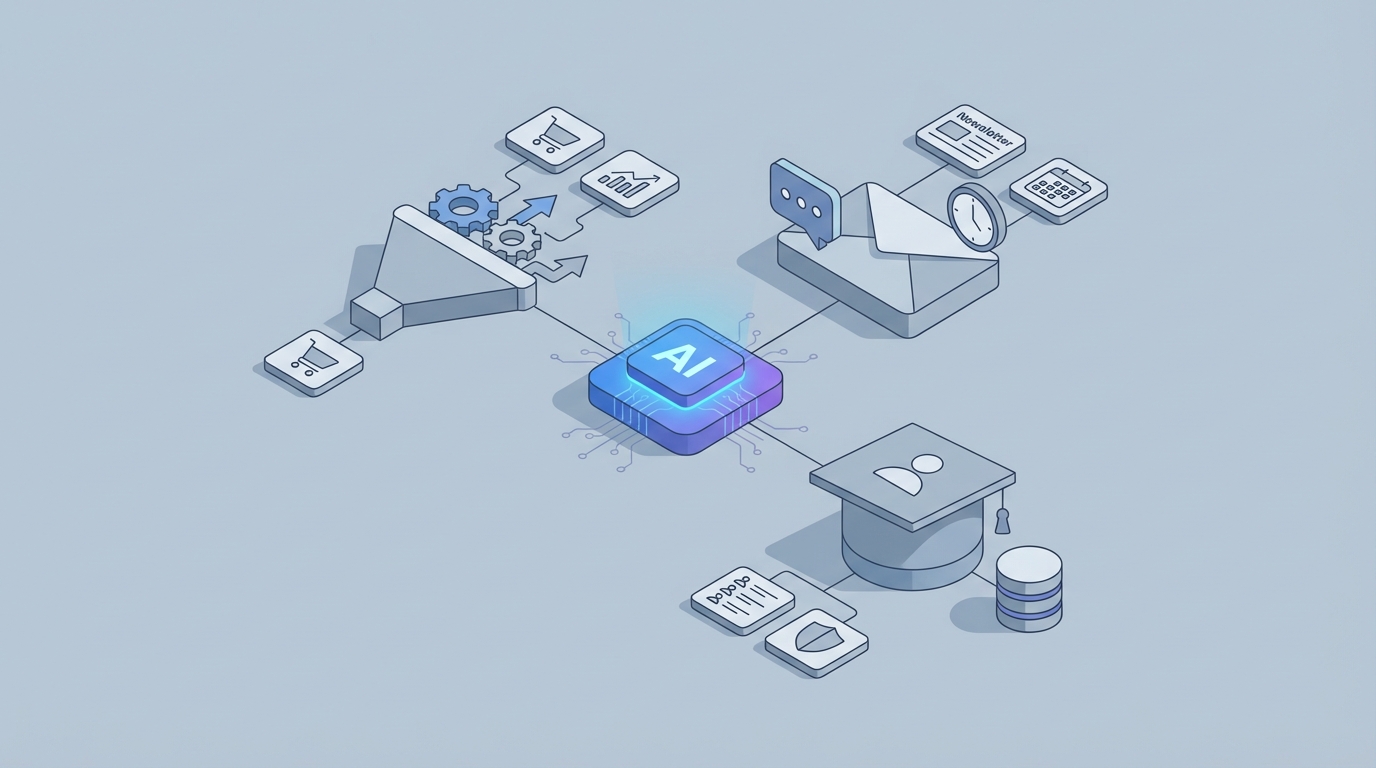
Kajabi is a fantastic box. I mean that genuinely — if you're selling courses, coaching, or memberships, it packages up an absurd number of features into one platform. Website builder, email marketing, checkout pages, course delivery, community, CRM. All in one. For most knowledge businesses, it's enough to get from zero to six or even seven figures.
But then you hit the ceiling.
You realize the automations are basically glorified if-then statements. Your email sequences are static — they don't know or care whether someone binged your entire course in two days or hasn't logged in for three weeks. Your "CRM" is really just a contact list with tags. And the analytics? You get surface-level dashboards that tell you what happened but never why.
Kajabi gives you the infrastructure. What it doesn't give you is intelligence.
That's the gap. And it's exactly the kind of gap a custom AI agent — built on OpenClaw, connected to Kajabi's API — can fill without ripping out your entire tech stack.
Let me walk through what this actually looks like in practice.
The Core Problem: Kajabi Automations Are Dumb
I don't mean that as an insult. They do what they're designed to do. But Kajabi's native automation builder operates on a very simple model:
Trigger → Action.
Someone purchases? Tag them. Someone fills out a form? Add them to an email sequence. Someone gets tagged? Enroll them in a product.
You can build some branching logic, but it's shallow. You cannot say: "If this person purchased Course A more than 30 days ago AND has completed less than 40% of the content AND has not opened any of the last five emails, then send them a personalized re-engagement message based on which specific modules they've completed."
That kind of conditional, context-aware logic simply doesn't exist in Kajabi. And that's not even a particularly exotic use case — it's basic retention.
The common workaround is bolting on Zapier or Make.com, which introduces latency, additional monthly costs, and fragile multi-step workflows that break silently at 2 AM. You end up spending hours debugging Zap failures instead of running your business.
What you actually need is an intelligent layer that sits on top of Kajabi, listens to what's happening in your business, and makes smart decisions autonomously.
That's what OpenClaw lets you build.
What an OpenClaw Agent Connected to Kajabi Actually Does
Let's get specific. An OpenClaw agent integrates with Kajabi through its REST API and webhooks. Kajabi fires webhooks on key events — purchases, subscription changes, form submissions, tag additions. The OpenClaw agent listens for these events, processes them through an LLM with access to your business context and historical data, then takes action by calling Kajabi's API (or any other tool in your stack) back.
The architecture looks like this:
Kajabi Webhook Event
        ↓
  OpenClaw Agent
  (LLM + Memory + Business Rules)
        ↓
  Decision Engine
        ↓
  Actions: Kajabi API, Email, Slack, Sheets, etc.
This isn't theoretical. Here are five concrete workflows that solve real Kajabi pain points.
1. Intelligent Student Retention and Re-Engagement
The problem: You have no idea which students are struggling until they request a refund or just disappear. Kajabi gives you completion percentages, but you can't act on patterns automatically.
The OpenClaw solution: The agent monitors enrollment data and engagement signals via Kajabi's API. It maintains a profile for each student in its memory layer — when they enrolled, which modules they've accessed, their purchase history, email engagement, and any form or survey responses they've submitted.
When the agent detects a student who's gone cold (customizable to your business — maybe it's no login for 10 days, or stalling at a specific module that historically has high drop-off), it generates and triggers a personalized intervention.
Not a generic "Hey, come back!" email. An actual personalized message:
"Hey Sarah — I noticed you made it through Modules 1 and 2 really quickly but haven't started Module 3 yet. That module covers [topic], and a lot of students find it helpful to [specific tip]. Here's a direct link to pick up where you left off."
The agent writes this based on the actual context of that student's journey. It can route the message through Kajabi's email system or flag high-value students for personal outreach by sending a notification to your Slack.
# Example: OpenClaw agent logic for retention monitoring
def evaluate_student_engagement(student):
    days_since_last_activity = (now - student.last_active).days
    completion_rate = student.progress_percentage
    enrollment_age = (now - student.enrolled_date).days

    if days_since_last_activity > 10 and completion_rate < 50:
        risk_level = "high"
        # Agent generates personalized message using LLM
        # with context about which modules they've completed
        # and their original goals from intake form
        message = agent.generate_reengagement(
            student_context=student.profile,
            completed_modules=student.completed_modules,
            intake_responses=student.form_data
        )
        kajabi_api.send_email(student.id, message)
        kajabi_api.add_tag(student.id, "at-risk-intervention-sent")
This alone — proactive, personalized retention — can measurably reduce churn in a membership or course business. And it runs continuously without you touching it.
2. Dynamic Lead Qualification and Sales Routing
The problem: You run an application funnel for a high-ticket coaching program. Applications come in through a Kajabi form, and you or a team member manually reviews each one to decide who gets a sales call. This takes hours, introduces delays, and qualified leads go cold while they wait.
The OpenClaw solution: When an application form is submitted, Kajabi fires a webhook. The OpenClaw agent receives the form data, analyzes the responses using natural language understanding, and scores the lead based on criteria you define — budget indicators, urgency, business stage, goal alignment, whatever matters for your specific offer.
High-scoring leads get immediately tagged in Kajabi ("qualified-hot"), entered into your fast-track email sequence, and you get a Slack notification with the agent's summary and reasoning. Medium leads go into a nurture sequence. Low-fit leads get a polite redirect to a more appropriate offer.
The agent doesn't just pattern-match on keywords — it understands context. Someone who writes "I've been stuck at $8K/month for six months and I need to break through to $20K" gets scored differently than someone who writes "just exploring options," even though neither contains an obvious keyword trigger.
# Lead scoring via OpenClaw agent
def process_application(webhook_payload):
    form_responses = webhook_payload['form_data']

    score, reasoning = agent.evaluate_lead(
        responses=form_responses,
        scoring_criteria=business_config.ideal_client_profile,
        historical_conversions=data_store.past_successful_applicants
    )

    if score >= 85:
        kajabi_api.add_tag(contact_id, "qualified-hot")
        kajabi_api.add_to_sequence(contact_id, "fast-track-booking")
        slack.notify(f"🔥 Hot lead: {contact_name}\nScore: {score}\n{reasoning}")
    elif score >= 50:
        kajabi_api.add_tag(contact_id, "qualified-nurture")
        kajabi_api.add_to_sequence(contact_id, "nurture-to-call")
    else:
        kajabi_api.add_tag(contact_id, "low-fit")
        kajabi_api.add_to_sequence(contact_id, "redirect-to-course")
You go from manually reading applications to having qualified leads on your calendar within minutes of submitting the form.
3. Automated Email Sequence Generation and Optimization
The problem: Writing email sequences is one of the most time-consuming parts of running a Kajabi business. Launch sequences, onboarding sequences, cart abandonment, nurture campaigns, upsell flows — each one takes hours to write, and once written, they're static forever.
The OpenClaw solution: The agent can draft entire email sequences based on your existing content, brand voice, and strategic goals. Feed it your course curriculum, past emails that performed well, your brand guidelines, and the objective of the sequence. It generates a complete sequence that you review and approve.
But more importantly, it can make your existing sequences adaptive. Instead of everyone getting the same seven-email onboarding sequence, the agent can dynamically adjust what gets sent based on what the student has already done. Completed the first module in day one? Skip the "getting started" emails and move to advanced tips. Haven't opened the last three emails? Switch to a different subject line approach and shorter format.
This isn't A/B testing — it's genuine personalization at scale. The kind of thing a human would do if they had the time to individually manage every student's email experience. They don't. The agent does.
4. Intelligent Cross-Sell and Upsell Timing
The problem: Most Kajabi users set up simple upsell flows — buy Course A, get offered Course B after some arbitrary number of days. There's no intelligence behind the timing or the offer selection.
The OpenClaw solution: The agent tracks each customer's full history — what they bought, how engaged they are with it, what topics they've shown interest in (via community posts, email clicks, quiz responses, support questions), and where they are in their customer lifecycle.
When the agent identifies that someone is ready for the next offer — they've completed most of a course, they're highly engaged, they've been clicking on content related to a specific topic — it triggers the right offer at the right time with the right framing.
It can even generate custom pitch angles per student. Someone who's been asking questions about advanced funnel strategy in the community gets a different upsell message for your marketing course than someone who's been focused on content creation, even though they're being offered the same product.
5. Weekly Business Intelligence Reports
The problem: Kajabi's analytics dashboard gives you top-line numbers — revenue, new members, page views. It doesn't tell you what to do about any of it.
The OpenClaw solution: The agent pulls data from Kajabi's API on a scheduled basis — enrollments, completions, revenue, churn, email performance, tag distributions — and generates an actual analysis. Not a dashboard. A written brief.
"Revenue is up 12% week-over-week, driven primarily by an uptick in Offer B conversions from the webinar funnel. However, churn in Membership A increased from 4.2% to 6.8% — this correlates with a drop in community engagement after the last live session was cancelled. Recommendation: schedule a makeup session and send a targeted re-engagement email to the 47 members who haven't logged in since [date]. Three students in the coaching program are at high risk of not completing before their renewal — consider personal outreach."
That's not a fantasy. That's what happens when you connect data access to an LLM that understands your business context.
Technical Implementation: What You Need
Here's what the actual integration requires:
On the Kajabi side:
- API access (available on all plans, better access on higher tiers)
- Webhook configuration for key events (purchases, subscriptions, form submissions, tags)
- Your API key and site identifier
On the OpenClaw side:
- An agent configured with your business logic and goals
- Webhook receiver endpoints to catch Kajabi events
- API connectors for Kajabi's REST API (contacts, tags, offers, enrollments)
- Memory/context layer for student profiles and business history
- Scheduled tasks for recurring workflows (like weekly reports or daily engagement scans)
Important Kajabi API notes:
- Kajabi's API supports contacts (CRUD + tagging), purchases, product access (enroll/unenroll), offers, and forms
- Webhooks cover: purchase made, subscription started/cancelled, tag added/removed, form submitted
- Rate limits exist, so the agent should batch requests intelligently
- You cannot create course content (lessons, videos) through the API — this is a content management layer, not a content creation tool
- All data flows through REST — no GraphQL
The most effective approach is to start with one high-impact workflow (retention monitoring is usually the biggest ROI for course/membership businesses), prove it out, then expand to additional use cases.
What This Means for Your Business
The fundamental shift is this: Kajabi gives you a static system. You set up your funnels, your emails, your automations, and they run the same way for every person forever until you manually change them.
An OpenClaw agent turns that static system into an adaptive one. It watches, it learns, it acts. Not in some vague "AI magic" way — in specific, measurable workflows that directly impact retention, revenue, and your time.
You're not replacing Kajabi. You're making it significantly smarter than it was designed to be.
For most Kajabi businesses — especially those in the $20K–$100K+/month range — the math is straightforward. If better retention saves you even a few percentage points of monthly churn on a membership, or if smarter lead qualification puts more qualified prospects on sales calls, the ROI is there within weeks.
Getting Started
If you're running a knowledge business on Kajabi and you're tired of fighting the platform's automation limitations — or spending hours on repetitive work that should be handled by something smarter — this is worth exploring.
Through Clawsourcing, you can work with Claw Mart's team to scope, build, and deploy a custom OpenClaw agent tailored to your specific Kajabi setup. Not a generic chatbot. Not a template. An actual AI agent that understands your products, your students, and your business logic — and takes action accordingly.
Start with one workflow. See results. Then expand. That's the pragmatic path, and it's the one that actually works.
Recommended for this post

Adam
Full-Stack Engineer
Your full-stack AI engineer that architects, builds, deploys, and automates entire applications from a single conversation. 23+ Core Capabilities.
 Clarence Maker
Your Linear expert that automates issue tracking, builds workflows, and streamlines project management.
 SpookyJuice.ai
Three-level OODA strategy, five-phase Ralph execution, and a recursive feedback engine. Your agent gets faster — this makes it get better.
 JerryRunsOps