AI Agent for Hostaway: Automate Vacation Rental Operations, Booking Management, and Revenue Optimization
Automate Vacation Rental Operations, Booking Management, and Revenue Optimization
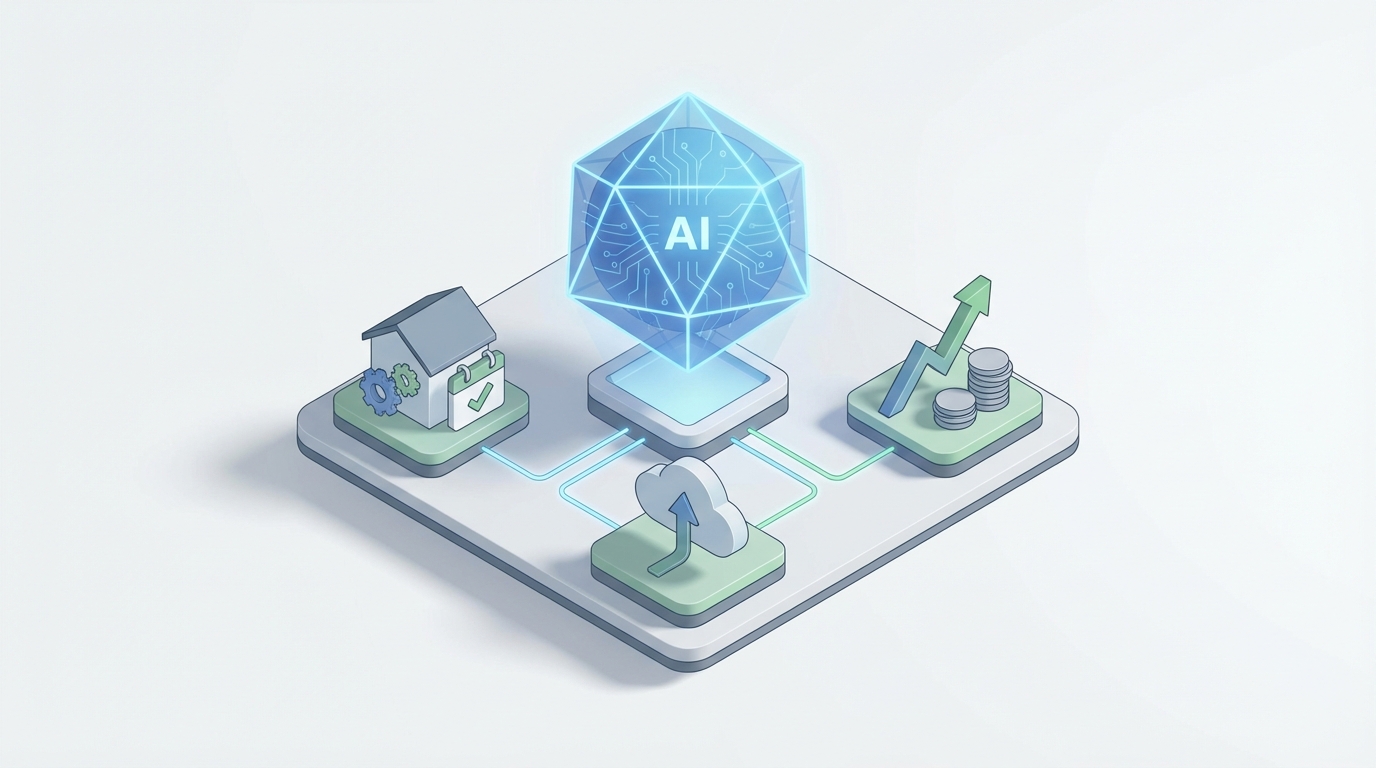
Most vacation rental managers I talk to are stuck in the same loop: they bought Hostaway because it promised to centralize everything, and it does — sort of. The channel management works. The unified inbox exists. The automation engine runs. But somewhere around 30 properties, the whole thing starts to feel like you're managing the software instead of the software managing you.
The built-in automations are rigid. The messaging templates are dumb. And every edge case — a guest whose flight got delayed, a cleaner who no-showed, a pricing anomaly on a holiday weekend you didn't anticipate — requires a human to step in, interpret context, and make a judgment call.
This is exactly where a custom AI agent changes the equation. Not Hostaway's own AI features (which are limited and template-bound), but a purpose-built agent that sits on top of Hostaway's API, listens to its webhooks, reasons about what's happening across your portfolio, and takes action autonomously.
I'm going to walk through what this looks like in practice, how to build it with OpenClaw, and why the technical architecture matters more than most people realize.
The Core Problem: Hostaway Is a Database, Not a Brain
Hostaway is genuinely one of the better PMS platforms out there. Its API is robust — RESTful, well-documented, covering properties, reservations, guests, messages, tasks, invoices, and more. The webhook system fires real-time events for bookings, messages, status changes, and other triggers. For a property management system, the technical foundation is solid.
But here's the thing: Hostaway is fundamentally a system of record. It stores data and executes rules. It does not understand anything.
When a guest messages "Hey, our flight got rerouted through Dallas and we won't land until 11pm — is there any way to still check in tonight?" — Hostaway's automation engine sees text. It can pattern-match against keywords and fire a template. But it cannot parse intent, check your property's self-check-in capabilities, look up whether the smart lock supports late-night code generation, decide whether to proactively send updated access instructions, and respond in a tone that matches the conversational context.
That requires reasoning. And reasoning is what an AI agent built on OpenClaw provides.
What the Architecture Actually Looks Like
Before getting into specific workflows, it helps to understand the technical layer. The architecture for a Hostaway AI agent has four components:
1. Event Ingestion (Hostaway Webhooks → OpenClaw)
Hostaway's webhook system pushes real-time notifications when key events occur: new reservation, message received, booking canceled, task status changed. OpenClaw ingests these events and routes them to the appropriate agent logic.
2. Knowledge Layer
This is where most people underinvest. Your AI agent is only as good as the context it can access. You need a structured knowledge base that includes:
- Property details (amenities, access instructions, house rules, quirks)
- House manuals and local recommendations
- Past guest interaction history
- Your business rules and exception policies
- Cleaning and maintenance SOPs
OpenClaw lets you build this knowledge layer directly into the agent, so every decision it makes is grounded in your actual operational reality — not generic responses.
3. Reasoning Engine
This is the OpenClaw agent itself. When an event comes in — say, a new guest message — the agent:
- Retrieves relevant context (property details, reservation info, guest history)
- Interprets the guest's intent
- Decides on the appropriate action (respond, escalate, trigger a task, update a record)
- Executes via Hostaway's API
4. Action Layer (OpenClaw → Hostaway API)
The agent writes back to Hostaway: sending messages, creating tasks, updating reservation notes, adjusting availability. It can also reach out to adjacent systems — smart locks, cleaning platforms, accounting tools — if those integrations are configured.
The key insight is that OpenClaw acts as the intelligence layer between Hostaway's data and your operations. Hostaway remains the system of record. OpenClaw becomes the system of action.
Five Workflows That Actually Move the Needle
Let me get specific. These are the workflows where a Hostaway AI agent delivers the most measurable impact.
1. Intelligent Guest Communication (The Big One)
This is the highest-ROI workflow, hands down. Most property managers spend 2-4 hours per day on guest messaging across their portfolio. The vast majority of these messages are answerable — they just require context that Hostaway's template engine can't access.
How it works with OpenClaw:
A guest sends a message through Airbnb: "What's the WiFi password? Also, is there a good sushi place nearby? And can we get a late checkout on Sunday?"
Three distinct requests in one message. Hostaway's automation engine would either ignore this (no keyword match) or fire a generic template that answers one question and ignores the other two.
The OpenClaw agent:
- Parses all three requests
- Pulls the WiFi password from the property knowledge base
- Retrieves restaurant recommendations tagged to that property's neighborhood
- Checks the reservation calendar to see if late checkout is feasible (no same-day turnover? approve it. tight window? offer a modified time. fully booked? decline gracefully.)
- Composes a single, natural response addressing all three points
- Sends it back through Hostaway's messaging API so it appears natively in the channel
The guest gets a helpful, complete answer in minutes instead of hours. You didn't have to touch it.
Where this gets really powerful is multi-turn conversations. The agent maintains conversation memory, so when the same guest follows up with "Actually, can you make the late checkout 2pm instead of 1pm?" — it knows exactly what's being referenced without re-processing the entire thread.
Property managers running this workflow through OpenClaw typically report a 40-70% reduction in manual messaging workload. That's not a theoretical number — it's the range I've seen repeatedly across operators managing 20-200+ units.
2. Proactive Operations Monitoring
Most PMS workflows are reactive. Something happens, you respond. But the most expensive operational failures are the ones where the absence of something happening is the signal.
Examples:
- A guest was supposed to check in at 3pm. It's now 5pm. No messages, no smart lock activation. Something might be wrong.
- A cleaning task was assigned for a 2pm turnover. It's 1:30pm and the cleaner hasn't started the task. The next guest arrives at 4pm.
- A reservation was booked 3 days ago and the guest hasn't responded to any pre-arrival messages. Check-in is tomorrow.
Hostaway doesn't monitor for the absence of events. It can't. Its automation engine evaluates triggers, not gaps.
An OpenClaw agent can. You configure monitoring rules that track expected events against actual events, and the agent takes appropriate action when things diverge:
- Sends a friendly "Hey, just checking — are you still planning to arrive today?" message to the silent guest
- Alerts the operations manager and identifies a backup cleaner when a turnover is at risk
- Escalates the non-responsive pre-arrival guest and holds off on sending access codes until contact is confirmed
This is the difference between managing by exception (which requires you to notice the exception) and having an agent that notices for you.
3. Smart Turnover Coordination
Turnover management is where vacation rental operations either scale or break. The basic workflow — booking ends, cleaning task gets created — is simple enough in Hostaway. But real turnover coordination involves dozens of variables:
- How long does this specific property take to clean?
- Is there a same-day arrival? What's the gap?
- Does this property need a deep clean (long stay) or a standard turn?
- Is the assigned cleaner available? Who's the backup?
- Does maintenance need to inspect anything based on the guest's reported issues?
- Are linens being delivered or are they on-site?
With OpenClaw, the agent evaluates all of these factors when a checkout event fires:
Webhook received: reservation_checkout (Property #47)

Agent reasoning:
- Stay duration: 9 nights → flag for deep clean
- Next check-in: today at 4pm (5-hour window)
- Assigned cleaner: Maria (available, confirmed)
- Guest reported "shower drain slow" on day 3 → create maintenance task for plumber
- Linen service: scheduled, delivery confirmed for 1pm
- Smart lock: generate new access code for next guest

Actions taken:
1. Created deep clean task → assigned to Maria with 2pm deadline
2. Created maintenance task → assigned to preferred plumber with "before next check-in" priority
3. Generated new smart lock code → stored in reservation notes
4. Sent pre-arrival message to incoming guest with updated check-in time and access details
All of this happens without human intervention. The agent orchestrates across Hostaway's task system, your smart lock integration, and the guest messaging pipeline simultaneously.
4. Revenue Intelligence and Pricing Decisions
Hostaway integrates with dynamic pricing tools like PriceLabs and Beyond Pricing, which is great. But there's still a gap between "the pricing tool suggests a rate" and "someone evaluates whether that rate makes sense in context."
An OpenClaw agent can serve as the reasoning layer on top of your pricing data:
- Anomaly detection: "PriceLabs is suggesting $89/night for your beachfront property on July 4th weekend. Historical average for this period is $340. This looks like a data error." The agent flags it before the rate pushes to channels.
- Contextual adjustments: "This property has a 2-star review from the last guest mentioning cleanliness. Suggest holding the cleaning team accountable before boosting rates for this weekend."
- Vacancy gap-filling: "Property #12 has a 2-night gap between bookings next Thursday-Friday. Current rate is $200. Suggest dropping to $150 and opening a 1-night minimum to fill. Expected revenue gain: $150-300 vs. $0."
- Owner communication: Automatically generate plain-language revenue summaries for property owners. "Your property earned $8,400 in October, up 12% from last year. Occupancy was 87%. The pricing adjustment we made for the fall festival weekend added an estimated $600 in revenue."
This isn't about replacing your pricing tool. It's about putting an intelligent layer between the pricing tool and your channels so that bad data doesn't cost you money and good opportunities don't get missed.
5. Automated Review Management
Reviews are the lifeblood of vacation rental visibility on OTAs, and most property managers handle them inconsistently. Either they write every response manually (time-consuming) or they use generic templates (which guests and algorithms can smell from a mile away).
An OpenClaw agent handles the full review lifecycle:
- Proactive review solicitation: After checkout, the agent evaluates the stay (any complaints? maintenance issues? length of stay?) and crafts a personalized review request. A guest who reported zero issues gets a straightforward ask. A guest who had a problem that was resolved gets an acknowledgment of the issue plus a request that emphasizes how it was handled.
- Review response drafting: When a review comes in, the agent drafts a response that references specific details from the stay. A 5-star review mentioning the ocean view gets a response that thanks them and mentions the sunset view from the balcony specifically. A 3-star review mentioning noise gets a response acknowledging the concern and noting that you've since added soundproofing (if true — the agent checks your property records).
- Pattern detection: "Properties #14, #18, and #22 have all received noise complaints in the last 30 days. All three are in the same building. This may be a building-level issue worth investigating."
Why OpenClaw Instead of Duct-Taping This Together
You could theoretically build all of this with a combination of Zapier, a hosted LLM API, a vector database, and a lot of custom code. Some people do. Here's why that approach tends to fail at scale:
Fragility. Every integration point is a potential failure point. When your Zapier webhook handler times out and drops an event, you've got a guest sitting in an Uber outside your property with no access code and no response to their messages.
No unified reasoning. When your messaging agent doesn't know what your operations agent is doing, you get situations where the AI tells a guest "your room will be ready at 3pm" while the cleaning task is flagged as delayed until 5pm.
Maintenance burden. Every change to your business logic requires updating multiple systems. New property? Update the vector database, the Zapier flows, the prompt templates, and the integration configs. Miss one and things break silently.
OpenClaw solves this by providing a single platform where the agent, the knowledge base, the integrations, and the reasoning logic all live together. When a webhook fires from Hostaway, the OpenClaw agent has immediate access to everything it needs — property context, guest history, operational state, business rules — to make a decision and act on it. One platform, one source of truth for agent behavior, one place to update when your operations change.
The Hostaway integration specifically benefits from OpenClaw's ability to handle bidirectional API communication: reading reservation data, guest profiles, and property details from Hostaway while writing messages, tasks, and updates back to Hostaway. The agent operates within your existing PMS workflow rather than creating a parallel one.
What Implementation Actually Looks Like
I'm not going to pretend this is a weekend project. A well-built Hostaway AI agent requires:
- Mapping your operational workflows — What decisions do you currently make manually? Which ones are high-volume and pattern-based? Start there.
- Building the knowledge base — Property details, house rules, FAQs, SOPs, exception policies. This is the most tedious part and also the most important.
- Configuring webhook ingestion — Connect Hostaway's webhook events to your OpenClaw agent. Define which events trigger which reasoning chains.
- Testing extensively — Run the agent in "shadow mode" first — it processes everything but only suggests actions, doesn't take them. Review its decisions for a week or two before enabling autonomous operation.
- Iterating based on real data — The agent will get things wrong initially. The quality of the knowledge base and the specificity of your business rules determine how quickly it converges on reliable behavior.
For teams that don't want to build this in-house, this is exactly the kind of project that fits the Clawsourcing model. You bring the operational expertise and Hostaway access; the Clawsourcing team handles the OpenClaw configuration, API integration, knowledge base architecture, and testing. Most implementations reach production-ready status in 2-4 weeks depending on portfolio complexity.
The Bottom Line
Hostaway gives you a solid foundation — good API, reliable channel management, decent operational tools. But it's a database with rules, not an intelligent system. The gap between what Hostaway can do natively and what your operations actually require grows with every property you add.
An OpenClaw agent closes that gap. It turns Hostaway from a system you manage into a system that manages itself — handling guest communication intelligently, monitoring operations proactively, coordinating turnovers autonomously, and surfacing revenue insights you'd otherwise miss.
The vacation rental operators who will scale to 100, 500, 1000+ properties in the next few years won't do it by hiring linearly. They'll do it by building intelligent systems on top of their PMS. The API and webhook infrastructure in Hostaway already supports this. OpenClaw provides the reasoning layer to make it real.
If you want to explore what this looks like for your specific portfolio, start with Clawsourcing and skip the months of trial and error.