AI Agent for Google Classroom: Automate Assignment Distribution, Grading, and Parent Communication
Automate Assignment Distribution, Grading, and Parent Communication
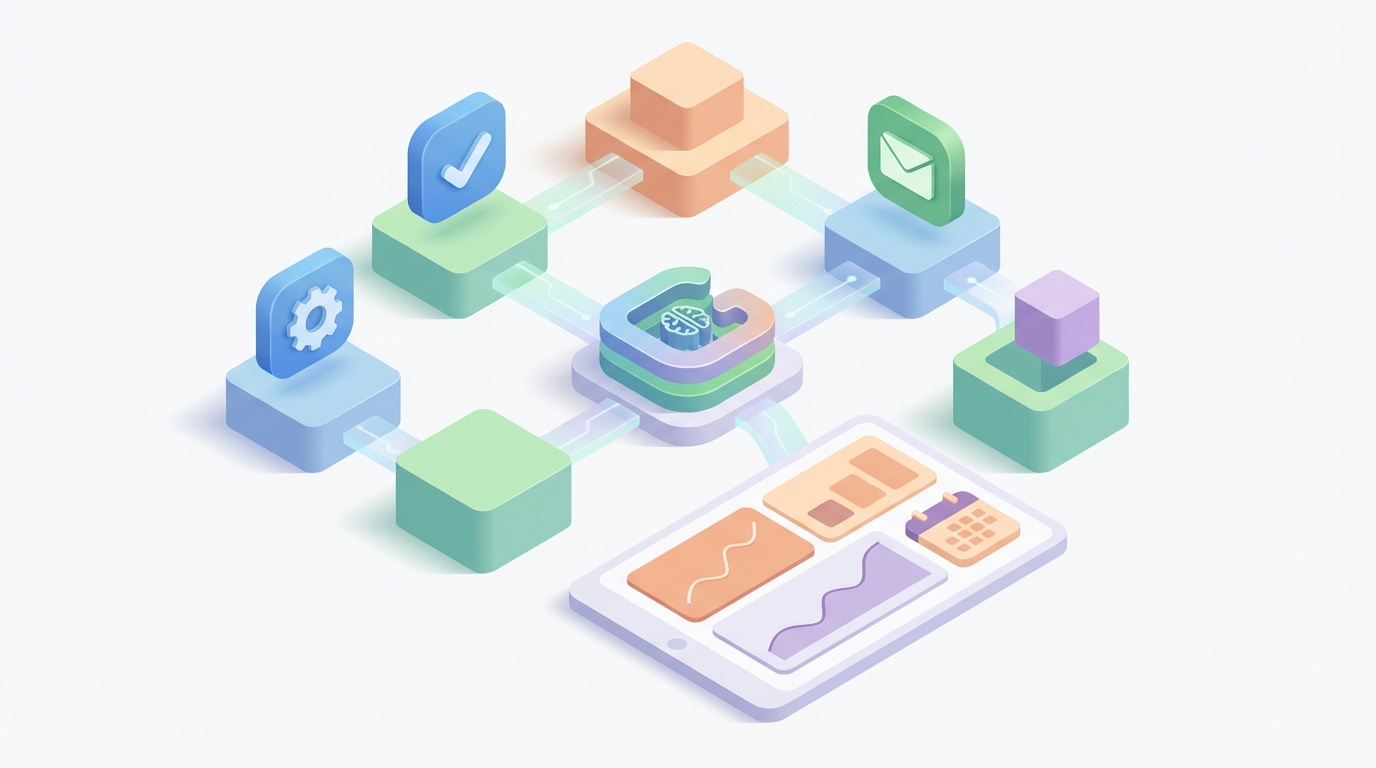
Google Classroom is a weird product. It was built for K-12 teachers, adopted by universities, and then quietly became the LMS of choice for thousands of businesses that already run on Google Workspace and don't want to pay $15/user/month for Docebo or Cornerstone.
And honestly? It works fine — until it doesn't.
The moment you have more than a couple dozen people running through training, the cracks show up fast. You're manually enrolling people. You're grading submissions one by one. You're copy-pasting the same feedback into private comments. You're exporting data to Sheets just to figure out who actually completed onboarding. And you're definitely not sending meaningful updates to managers or stakeholders, because that would require another three hours you don't have.
Google Classroom has almost zero built-in automation. No workflow engine. No conditional logic. No triggers. No integrations with your HRIS, CRM, or communication tools unless you build them yourself.
Here's the thing though: the Google Classroom API is actually pretty good. It supports full CRUD on courses, topics, assignments, submissions, rosters, announcements, and more. The problem isn't capability — it's that nobody's wired it up to anything intelligent.
That's exactly what you can do with OpenClaw.
What We're Actually Building
Let me be specific about what I mean by "AI agent for Google Classroom," because the phrase "AI agent" has been beaten to death.
We're talking about a system that:
- Monitors Google Classroom for events (new submissions, missed deadlines, enrollment changes)
- Decides what to do based on context and rules you define
- Acts autonomously — grading, sending messages, creating content, updating records, notifying stakeholders
This isn't a chatbot. It's not a prompt you paste into something. It's a persistent agent that runs in the background, connected to your Google Classroom instance via API, and handles the operational grunt work that currently eats 10-15 hours a week of someone's time.
OpenClaw is the platform you build this on. It gives you the agent framework, the API connectivity layer, and the intelligence to handle decisions that would otherwise require a human in the loop.
Let's break down the three biggest workflow categories.
Workflow 1: Automated Assignment Distribution
The problem: You have a new-hire onboarding program. Every Monday, three to five new people start. Someone has to create or duplicate a class, invite the new hires, post the right materials for their role, set due dates, and make sure nothing falls through the cracks. This is usually a People Ops coordinator doing it manually.
What the agent does:
The OpenClaw agent monitors your HRIS (or even just a Google Sheet that HR updates) for new hires. When a new record appears, the agent:
- Creates a new Google Classroom course (or enrolls the learner in an existing cohort) via the Classroom API's
courses.createorinvitations.createendpoints - Determines the correct learning path based on role, department, and location
- Posts the appropriate CourseWork items with calculated due dates using
courses.courseWork.create - Schedules drip-release of content (since Google Classroom has no native scheduling, the agent handles this by posting materials on the right dates)
- Sends a welcome message via the Stream using
courses.announcements.create
Here's what the Classroom API call looks like for creating an assignment:
POST https://classroom.googleapis.com/v1/courses/{courseId}/courseWork

{
  "title": "Module 1: Company Overview & Values",
  "description": "Complete the reading and submit your reflection (300+ words). Due by end of your first week.",
  "materials": [
    {
      "driveFile": {
        "driveFile": {
          "id": "1aBcDeFgHiJkLmNoPqRsTuVwXyZ",
          "title": "Company Overview 2026.pdf"
        },
        "shareMode": "STUDENT_COPY"
      }
    }
  ],
  "workType": "ASSIGNMENT",
  "state": "PUBLISHED",
  "dueDate": {
    "year": 2026,
    "month": 7,
    "day": 18
  },
  "dueTime": {
    "hours": 17,
    "minutes": 0
  },
  "maxPoints": 100
}
The OpenClaw agent constructs and sends these calls programmatically. You configure the logic once — "Sales reps get modules 1-5, engineers get modules 1, 2, 6, 7" — and the agent handles the rest every single time someone new shows up.
What this replaces: 30-60 minutes of manual setup per new hire. For a company hiring 20 people a month, that's 10-20 hours saved, and zero chance of someone getting the wrong materials or being forgotten entirely.
Workflow 2: Intelligent Grading and Feedback
This is where the AI part actually matters, not just the automation part.
The problem: You have 50 people going through compliance training. They each submit a short written response explaining how they'd handle a data privacy scenario. Someone has to read all 50, grade them against a rubric, write individual feedback, and return the submissions. This takes an entire afternoon, and the quality of feedback degrades with every submission because humans get tired and bored.
What the agent does:
The OpenClaw agent polls for new submissions using courses.courseWork.studentSubmissions.list with a state filter for TURNED_IN. When it finds ungraded work, it:
- Retrieves the submission content — pulls the attached Google Doc via the Drive API, extracts the text
- Evaluates against your rubric — the agent uses the grading criteria you've defined (not generic AI vibes, but your actual rubric with specific point allocations)
- Generates detailed feedback — specific to what the learner wrote, referencing the training materials where relevant
- Assigns a grade and returns the submission via the Classroom API
The grading call looks like this:
PATCH https://classroom.googleapis.com/v1/courses/{courseId}/courseWork/{courseWorkId}/studentSubmissions/{submissionId}?updateMask=assignedGrade,draftGrade

{
  "assignedGrade": 85,
  "draftGrade": 85
}
And the feedback goes via:
POST https://classroom.googleapis.com/v1/courses/{courseId}/courseWork/{courseWorkId}/studentSubmissions/{submissionId}/addComment

{
  "text": "Strong understanding of the data minimization principle. Your example of the customer requesting data deletion was on point. Two areas to revisit: (1) You didn't address the 30-day response window requirement from Module 3, and (2) the escalation path you described skips the DPO, which is required under our internal policy. Review Section 4.2 of the Privacy Handbook before moving to Module 5."
}
The critical thing here: the agent doesn't just say "good job" or "needs improvement." It references the actual training content. Because OpenClaw can ingest your training materials into the agent's knowledge base, the feedback is grounded in your specific policies and procedures, not generic platitudes.
For quizzes, it's even simpler. Google Forms-based quizzes can be auto-graded natively, but the agent adds value by analyzing patterns: "12 out of 50 people got question 7 wrong — that section of the training material might need revision." It flags this to the training admin proactively.
What this replaces: Hours of grading per submission cycle. More importantly, it replaces inconsistent, fatigue-degraded feedback with consistently thorough, rubric-aligned responses every single time.
Workflow 3: Proactive Parent (Stakeholder) Communication
In the education world, "parent communication" means keeping guardians informed. In the business world, it means keeping managers, HR, compliance officers, and executives informed about training progress without anyone having to ask.
The problem: Google Classroom's native reporting is essentially nonexistent for business use cases. There's no dashboard. There's no way to see completion rates across departments. There's no automatic notification when someone falls behind. Every status update requires someone to manually dig through the Classroom UI and compile a report.
What the agent does:
The OpenClaw agent continuously monitors the state of all learners across all active courses. It maintains its own tracking layer (since the Classroom API doesn't give you great aggregate data), and then:
For managers:
- Sends a weekly digest: "3 of your 5 direct reports have completed Module 4. Sarah and James are behind by 3+ days. Here's a summary of their progress."
- Triggers immediate alerts for critical deadlines: "Marcus has not completed mandatory security training. Deadline is tomorrow."
- These can go via email, Slack, Teams — whatever your org uses. OpenClaw agents can connect to multiple output channels.
For compliance officers:
- Generates completion reports on demand or on schedule
- Tracks certification expiration dates and triggers re-enrollment automatically
- Maintains an audit trail of who completed what and when (critical for SOC 2, HIPAA, etc.)
For the learners themselves:
- Smart nudges that aren't just "you have an assignment due" but actually helpful: "You're 80% through the compliance module. The last section covers incident reporting — here's a 2-minute summary of the key points to review before the final quiz."
- Contextual reminders based on their actual progress, not generic spam
For training administrators:
- Weekly analytics roll-up: completion rates by department, average scores by module, identification of content that's confusing people, predicted completion rates for in-progress cohorts
- Automatic flagging of systemic issues: "Module 6 has a 40% fail rate on the first attempt across all cohorts. Consider revising."
The agent constructs these reports by pulling data from multiple Classroom API endpoints — studentSubmissions.list, courses.students.list, courseWork.list — cross-referencing with your organizational data, and synthesizing it into something actually useful.
Why OpenClaw Instead of Duct-Taping It Yourself
You could, in theory, build all of this with Google Apps Script, some Cloud Functions, and a lot of patience. People do. And then the person who built it leaves the company and nobody knows how it works.
OpenClaw gives you:
- A persistent agent framework — the agent runs continuously, maintains state, and handles the orchestration between monitoring, deciding, and acting
- Pre-built API connectors — including Google Classroom, Drive, and the rest of the Workspace ecosystem, so you're not hand-rolling OAuth flows and fighting rate limits
- An intelligence layer — the AI isn't just pattern matching. It can understand the context of a submission, evaluate it against your rubric, generate nuanced feedback, and make decisions about what to do next
- Configurable logic — you set the rules, thresholds, and preferences. The agent executes. You're not writing if/else statements in Apps Script; you're defining outcomes and the agent figures out the implementation
- Auditability — every action the agent takes is logged. Important for compliance-heavy environments where you need to prove that training was completed and graded consistently
The practical difference: an Apps Script approach might take a developer 40-80 hours to build, will be fragile, and will break every time Google changes something. An OpenClaw agent can be configured and running in a fraction of that time, and it degrades gracefully when things change because the AI layer can adapt.
Implementation: Where to Start
Don't try to automate everything at once. Here's the order I'd recommend:
Week 1-2: Automated enrollment and course setup. This is the highest-ROI, lowest-risk starting point. Connect your source of truth (HRIS, Google Sheet, whatever) to OpenClaw, configure the enrollment logic, and let the agent handle new learner setup. It's mostly deterministic — no AI judgment calls required — so you can validate it quickly.
Week 3-4: Stakeholder reporting. Wire up the monitoring and start generating weekly digests for managers and compliance. Again, relatively low-risk because you're reading data and synthesizing it, not modifying anything in Classroom.
Week 5-6: Grading and feedback. Start with a single course or module. Have the agent grade submissions and post feedback, but flag anything below a confidence threshold for human review. Run it in parallel with manual grading for a cycle to validate quality. Once you trust it, expand to more courses.
Week 7+: Advanced workflows. Adaptive learning paths, content generation, predictive analytics, certificate automation. These build on the foundation you've already established.
The Math
Let's be blunt about costs vs. value.
A mid-market company with 500 employees doing quarterly training cycles typically has 1-2 people spending 15-25% of their time on LMS administration — enrollment, grading, reporting, follow-up. That's roughly $15,000-$30,000/year in labor cost for what is essentially operational overhead.
A dedicated corporate LMS (Docebo, Cornerstone, TalentLMS at scale) runs $5-$15/user/month, so $30,000-$90,000/year for 500 users, plus implementation costs.
Google Classroom is free (included with Workspace). An OpenClaw agent layered on top gives you 80% of the functionality of those enterprise LMS platforms — enrollment automation, intelligent grading, compliance reporting, stakeholder communication — at a fraction of the cost, without ripping out the tools your organization already uses.
The ROI calculation isn't theoretical. It's "we stopped paying someone to copy-paste enrollment emails" and "compliance reporting that took a full day now takes zero days because it's automatic."
What This Doesn't Solve
Let me be honest about the limits.
Google Classroom still looks like a school product. If your executive team cares about branding and learner experience design, you'll eventually outgrow it. The API has rate limits (~1,000 queries per 100 seconds) that matter at scale — if you have 5,000+ learners, you'll need to architect around that. And there's no SCORM/xAPI support, so if you're buying off-the-shelf e-learning content from vendors, Google Classroom can't natively track it.
But for companies that are already in Google Workspace, running training programs for hundreds (not tens of thousands) of people, and don't want to invest six figures in an enterprise LMS? Google Classroom plus an OpenClaw agent is a genuinely compelling setup.
Next Steps
If you're running corporate training on Google Classroom and spending too many hours on the manual parts — or if you're considering Google Classroom but worried about the operational overhead — this is exactly the kind of problem we solve.
Check out Clawsourcing to scope out an AI agent built on OpenClaw that connects to your Google Classroom instance. We'll map your current workflows, identify the highest-impact automations, and get an agent running that actually does the work instead of just talking about it.
No six-month implementation. No enterprise sales cycle. Just a working agent that handles enrollment, grading, and reporting so your team can focus on making the training content actually good — which is the part that matters and the part that no amount of automation can replace.