AI Agent for Customer.io: Automate Behavioral Messaging, Workflow Orchestration, and Data Pipelines
Automate Behavioral Messaging, Workflow Orchestration, and Data Pipelines
Most marketing teams using Customer.io are sitting on a goldmine of behavioral data and executing against maybe 15% of its potential. Not because they're lazy — because the platform, as good as it is at reliable message execution, fundamentally operates as a rules engine. If this, then that. Event fires, message sends. User hits threshold, Journey triggers.
That's fine for your first 10 workflows. It falls apart somewhere around workflow 47, when you've got spaghetti Journeys cross-referencing each other, a Liquid template so nested it looks like a Choose Your Own Adventure book, and a Slack channel full of "why didn't this user get the email?" messages.
The missing layer isn't more rules. It's reasoning. And that's exactly what a custom AI agent, built on OpenClaw and connected to Customer.io's API, provides.
Let me walk through what this looks like in practice — specific architectures, actual workflows, and the integration points that matter.
What Customer.io Does Well (and Where It Stops)
Credit where it's due: Customer.io has one of the better APIs in the marketing automation space. The Track API handles identify, track, page, and group calls with low latency. The Journeys API lets you programmatically start people in workflows with context. The Profiles API gives you full CRUD over customer data. Webhooks flow both directions.
The data model is solid too. Unified customer profiles pulling from Segment, RudderStack, mParticle, direct API calls, reverse ETL from your warehouse — it all lands in one place. Real-time event ingestion. Audience segmentation on attributes, behaviors, and computed traits. The newer "objects" model even supports relational data.
Where Customer.io stops is where things get interesting:
No reasoning engine. You can't say "look at this user's last 8 events, their support ticket history, their predicted LTV, and the current state of their subscription — then decide the best message, channel, and timing." You can approximate this with branching logic, but it's brittle and unmaintainable.
Static content at send time. Liquid templating is powerful for rule-based personalization. It's not capable of generating genuinely adaptive copy that accounts for a user's full behavioral context.
Stateless Journeys. Each Journey is essentially independent. Tracking where someone sits in a complex lifecycle across dozens of concurrent Journeys requires you to manually write attributes back to the profile and hope nothing races.
Painful debugging. Figuring out why a user didn't enter a Journey, or why they're stuck at step 3, requires manual investigation across events, attributes, segment membership, and Journey logic. At scale, this eats hours every week.
No autonomous optimization. A/B testing exists, but someone has to set it up, monitor it, decide when significance is reached, and implement the winner. Multiply that by 50 Journeys and it doesn't happen.
These aren't bugs. They're architectural boundaries. Customer.io is a message execution platform with a visual workflow builder. To turn it into something that thinks, you need an agent layer.
The Architecture: OpenClaw + Customer.io
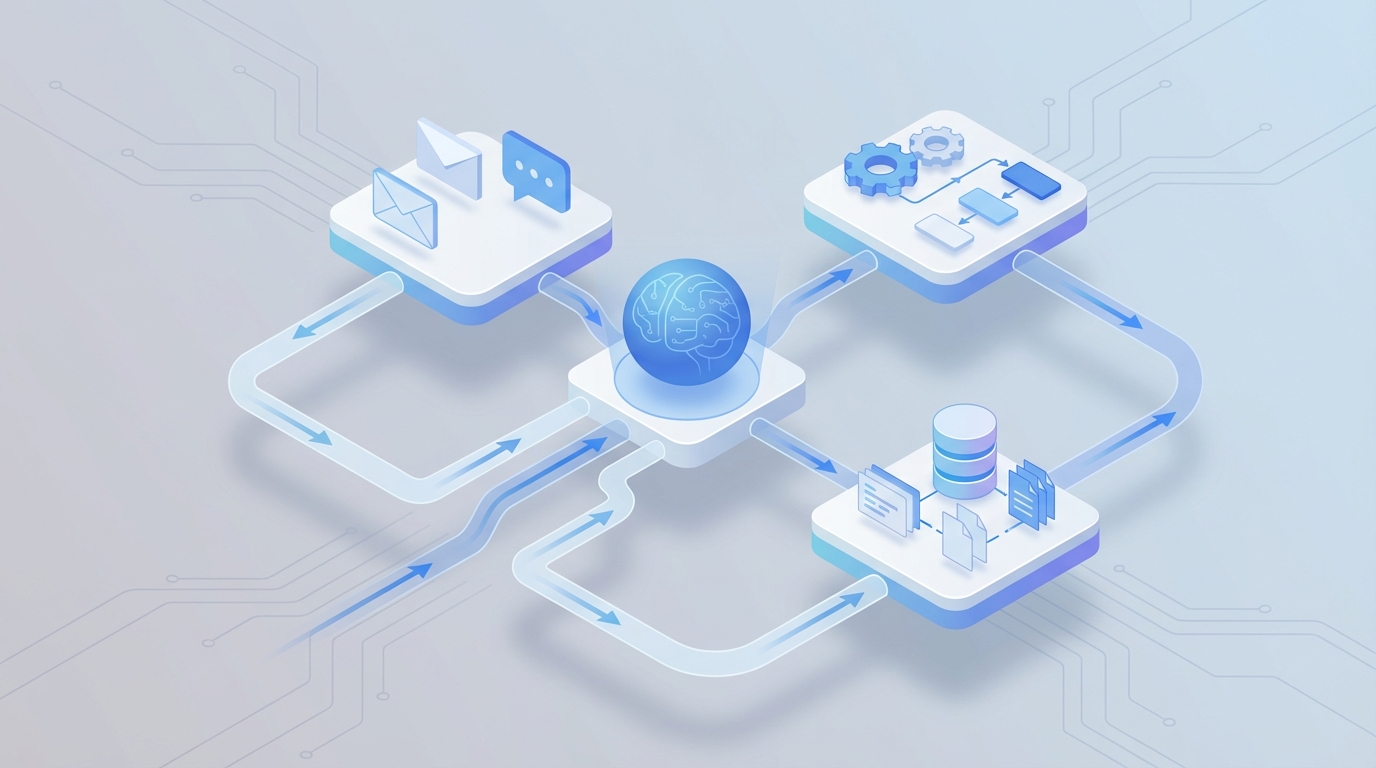
Here's the mental model. Customer.io remains your execution layer — it sends the emails, the push notifications, the SMS. It stores profile data and manages delivery. What you're adding with OpenClaw is an intelligence layer that sits between your data and Customer.io's API, making decisions that would be impossible (or impossibly complex) to encode as static Journey logic.
OpenClaw agents connect to Customer.io through the platform's REST and Track APIs. The agent can:
- Read customer profiles, events, segments, campaign performance, and Journey state
- Write profile attributes, trigger events, start Journeys, update objects
- Listen via webhooks for real-time signals (deliveries, opens, clicks, subscription changes)
- Act by orchestrating multi-step workflows that span Customer.io and other systems
The key architectural insight is that OpenClaw agents maintain state and memory across interactions. Unlike a Journey that forgets context once a user exits, an OpenClaw agent can maintain a longitudinal understanding of each customer's relationship with your product — and use that understanding to make decisions.
Here's a simplified view of data flow:
[Your Product] → events → [Customer.io Track API]
                                    ↓
                            [Customer.io Profiles + Events]
                                    ↓ (webhook / polling)
                            [OpenClaw Agent]
                                    ↓ (reasoning + decision)
                            [Customer.io API calls]
                                    ↓
                            [Messages sent via Customer.io]
The agent isn't replacing Customer.io. It's making Customer.io dramatically smarter about what to send, when, to whom, and through which channel.
Five Workflows That Actually Matter
Let me get specific. These aren't hypothetical — they're patterns that map directly to real pain points Customer.io users hit at scale.
1. Intelligent Onboarding That Adapts in Real Time
The problem: Most onboarding Journeys are linear. Sign up → welcome email → day 2 tip → day 4 feature highlight → day 7 check-in. Maybe some branching based on whether someone completed a key action. But the Journey doesn't understand what the user is actually struggling with.
What the OpenClaw agent does:
The agent monitors the stream of product events for new users via Customer.io webhooks. Instead of following a fixed sequence, it evaluates the user's behavior pattern against successful activation profiles and decides the next action dynamically.
# OpenClaw agent logic (pseudocode)
def evaluate_new_user(user_profile, recent_events):
    # Pull full event history from Customer.io Profiles API
    events = customerio.get_events(user_profile.id)

    # Analyze activation progress
    completed_steps = extract_activation_milestones(events)
    time_since_signup = now() - user_profile.created_at

    # Agent reasoning: what's the biggest friction point?
    analysis = openclaw.reason(
        context={
            "user_attributes": user_profile.attributes,
            "completed_steps": completed_steps,
            "time_since_signup": time_since_signup,
            "similar_user_outcomes": lookup_cohort_data(user_profile)
        },
        goal="Determine highest-impact next action to drive activation"
    )

    # Execute decision via Customer.io API
    if analysis.recommended_action == "personalized_help_email":
        customerio.track(user_profile.id, "agent_trigger_help", {
            "topic": analysis.friction_point,
            "message_variant": analysis.content_key,
            "channel": analysis.best_channel
        })
    elif analysis.recommended_action == "sales_handoff":
        customerio.update_profile(user_profile.id, {
            "sales_ready": True,
            "handoff_reason": analysis.reasoning
        })
The agent writes its decisions back to Customer.io as events or attributes, which then trigger the appropriate pre-built Journeys. Customer.io handles delivery. OpenClaw handles the thinking.
Why this matters: A SaaS company with a multi-step activation flow might have 6 different friction points where users stall. Instead of building 6 separate branching paths in the Journey builder (and hoping you guessed the right conditions), the agent evaluates each user individually and routes them to the right intervention.
2. Cross-System Lifecycle Orchestration
The problem: Customer.io knows about marketing interactions. It doesn't know that a user just filed a frustrated support ticket in Zendesk, or that their invoice in Stripe is 15 days overdue, or that their account owner in Salesforce just flagged them as at-risk.
What the OpenClaw agent does:
It acts as a coordinator across systems. When the agent detects signals from multiple sources, it synthesizes them and updates Customer.io with enriched context — or suppresses messaging entirely.
# Agent monitors webhook from Zendesk: negative sentiment ticket
def on_support_ticket(ticket):
    user_id = resolve_user(ticket.requester_email)

    # Pull current state from Customer.io
    profile = customerio.get_profile(user_id)

    # Pull billing state from Stripe
    subscription = stripe.get_subscription(profile.stripe_id)

    # Agent synthesizes cross-system state
    decision = openclaw.reason(
        context={
            "support_ticket": ticket,
            "sentiment": ticket.sentiment_score,
            "subscription_status": subscription.status,
            "current_journeys": profile.active_journeys,
            "recent_messages_sent": profile.messages_last_7_days
        },
        goal="Prevent churn while respecting customer frustration"
    )

    # Update Customer.io profile with synthesized intelligence
    customerio.update_profile(user_id, {
        "risk_score": decision.risk_score,
        "suppress_marketing": decision.should_suppress,
        "suppress_until": decision.suppress_until,
        "escalation_type": decision.escalation_type
    })
Now your Customer.io Journeys can reference risk_score and suppress_marketing without needing to know anything about Zendesk or Stripe directly. The agent does the integration work and the reasoning. Customer.io does what it's good at: executing the conditional messaging.
3. Autonomous A/B Testing and Journey Optimization
The problem: You set up an A/B test in a Journey. It runs for two weeks. Someone eventually checks the results. Maybe they push the winner live. Multiply this by 40 active Journeys and optimization effectively doesn't happen.
What the OpenClaw agent does:
It continuously monitors Journey performance via the Customer.io Reporting API, evaluates statistical significance, and makes optimization decisions — either alerting humans or making changes autonomously within predefined guardrails.
# Scheduled agent task: runs daily
def optimize_journeys():
    active_campaigns = customerio.list_campaigns(state="active")

    for campaign in active_campaigns:
        metrics = customerio.get_campaign_metrics(campaign.id)

        if has_active_ab_test(campaign):
            significance = calculate_significance(metrics.variants)

            if significance.is_conclusive:
                winner = significance.winning_variant

                # Agent decides: auto-implement or alert
                if campaign.tags.includes("auto-optimize"):
                    customerio.set_winning_variant(campaign.id, winner.id)
                    notify_team(f"Auto-promoted variant {winner.name} "
                               f"in '{campaign.name}' — "
                               f"{winner.conversion_rate:.1%} vs "
                               f"{significance.loser.conversion_rate:.1%}")
                else:
                    notify_team_with_recommendation(campaign, significance)

        # Also flag underperforming campaigns
        if metrics.conversion_rate < campaign.target_rate * 0.7:
            alert_underperformance(campaign, metrics)
This turns optimization from a manual, sporadic effort into a continuous automated process. The agent respects boundaries — campaigns tagged auto-optimize get handled autonomously; everything else gets human-readable recommendations pushed to Slack.
4. Dynamic Content Generation with Brand Guardrails
The problem: You have 12 audience segments and 4 channels. That's 48 message variants if you want real personalization. Nobody writes 48 variants. So you write 3 and call it "personalized."
What the OpenClaw agent does:
When Customer.io fires a webhook indicating a message is about to be sent (or when the agent is pre-generating content for an upcoming campaign), OpenClaw generates contextually appropriate copy based on the user's full profile and behavioral history.
The critical detail: this isn't "slap the user's name into a template." The agent considers their product usage patterns, communication history, lifecycle stage, and even the tone of their previous interactions to generate a message that actually feels relevant.
def generate_campaign_content(segment, campaign_context):
    for user in segment.members:
        profile = customerio.get_profile(user.id)
        recent_events = customerio.get_events(user.id, limit=20)

        content = openclaw.generate(
            template=campaign_context.base_template,
            constraints={
                "brand_voice": "conversational, direct, no corporate speak",
                "max_length": 150,  # words
                "required_cta": campaign_context.cta,
                "compliance": ["include_unsubscribe", "no_false_urgency"]
            },
            personalization_context={
                "user_attributes": profile.attributes,
                "behavior_summary": summarize_events(recent_events),
                "lifecycle_stage": profile.computed_lifecycle_stage,
                "previous_message_engagement": profile.engagement_history
            }
        )

        # Store generated content as user attribute for Liquid rendering
        customerio.update_profile(user.id, {
            "dynamic_content_subject": content.subject,
            "dynamic_content_body": content.body,
            "dynamic_content_cta_text": content.cta_text
        })
In Customer.io, your email template just references {{customer.dynamic_content_body}}. The agent did the hard work upstream.
The guardrails matter here. OpenClaw lets you define constraints — brand voice, compliance requirements, length limits, required elements — so generated content stays on-brand without requiring manual review of every variant.
5. Proactive Journey Debugging and Anomaly Detection
The problem: Your activation Journey has been silently leaking 40% of users at step 3 for two weeks. Nobody noticed because the dashboard doesn't alert on Journey-level anomalies, and the team is busy building the next campaign.
What the OpenClaw agent does:
It runs periodic analysis of Journey performance, compares against historical baselines, and surfaces problems before they compound.
def monitor_journey_health():
    journeys = customerio.list_journeys(state="active")

    for journey in journeys:
        step_metrics = customerio.get_journey_step_metrics(journey.id)
        historical_baseline = get_baseline(journey.id, lookback_days=30)

        anomalies = openclaw.analyze(
            current=step_metrics,
            baseline=historical_baseline,
            detect=["conversion_drops", "unusual_exit_rates",
                    "delivery_failures", "engagement_decay"]
        )

        if anomalies:
            # Agent investigates root cause
            for anomaly in anomalies:
                root_cause = openclaw.reason(
                    context={
                        "anomaly": anomaly,
                        "recent_changes": get_recent_journey_edits(journey.id),
                        "segment_changes": get_segment_drift(journey.entry_segment),
                        "delivery_metrics": get_delivery_health()
                    },
                    goal="Identify most likely root cause and recommend fix"
                )

                alert_team(
                    f"🚨 {journey.name}: {anomaly.description}\n"
                    f"Likely cause: {root_cause.explanation}\n"
                    f"Suggested fix: {root_cause.recommendation}"
                )
Instead of "Journey X has a problem," the team gets "Journey X is losing 40% of users at step 3 because a segment condition was changed last Tuesday that excluded users without a plan_type attribute — 38% of new signups from the organic channel don't have this attribute set yet. Recommended fix: update the segment to use a default value or add a branching condition."
That's the difference between a monitoring tool and an agent that actually thinks.
Implementation: Where to Start
If you're running Customer.io and this resonates, here's the practical starting sequence:
Week 1-2: Connect the data layer. Set up OpenClaw with read access to Customer.io's Profiles and Events APIs. Configure webhooks from Customer.io to OpenClaw for real-time signals. Get your agent able to query any customer's full profile and event history.
Week 3-4: Build your first reasoning workflow. Pick the highest-pain Journey — usually onboarding or reactivation. Implement a single agent decision point: "Given this user's data, what's the best next action?" Write the decision back to Customer.io as a profile attribute. Let your existing Journey reference that attribute.
Week 5-6: Add cross-system context. Connect one additional data source (Stripe, Zendesk, your product database) to OpenClaw. Enrich Customer.io profiles with synthesized intelligence from multiple systems. Watch your messaging relevance jump.
Week 7-8: Automate optimization. Implement the monitoring and A/B test automation pattern. Set conservative guardrails initially — alert-only for the first two weeks, then enable auto-optimization on low-risk campaigns.
You don't need to rearchitect everything at once. The beauty of this approach is that Customer.io continues doing exactly what it's doing today. You're just adding a brain on top.
Why OpenClaw and Not a DIY Approach
You could, theoretically, duct-tape this together with scripts, cron jobs, and raw API calls. People do. It works until it doesn't — usually around the time you need reliable state management, conversation memory across interactions, or coordinated multi-step reasoning that doesn't fall over when one API call fails.
OpenClaw provides the agent infrastructure: state management, tool orchestration, reasoning capabilities, memory, and guardrails. You define what the agent should do and what constraints it operates within. OpenClaw handles the execution reliability, the context management, and the reasoning framework.
It's the difference between building a house and building a house plus manufacturing your own lumber, nails, and power tools first.
The Bottom Line
Customer.io is excellent infrastructure for message execution and customer data unification. It's mediocre at intelligence. The visual Journey builder that makes it approachable for simple workflows becomes a liability at scale — rigid logic, no reasoning capability, no cross-system awareness, no autonomous optimization.
An OpenClaw agent layer doesn't replace Customer.io. It transforms it from a rules engine into a system that actually understands your customers, adapts to their behavior, and makes decisions that would be impossible to encode as static Journey logic.
The companies that will win at customer engagement over the next few years aren't the ones with the most Journeys. They're the ones whose Journeys are driven by genuine intelligence.
Want help building an AI agent for your Customer.io setup? Our Clawsourcing team designs and implements custom OpenClaw integrations for marketing and customer engagement platforms. We'll audit your current Customer.io workflows, identify the highest-leverage agent opportunities, and build the integration. No generic playbooks — architecture specific to your data, your workflows, and your goals.