AI Agent for Cin7: Automate Inventory Management, EDI, and Multi-Channel Order Routing
Automate Inventory Management, EDI, and Multi-Channel Order Routing
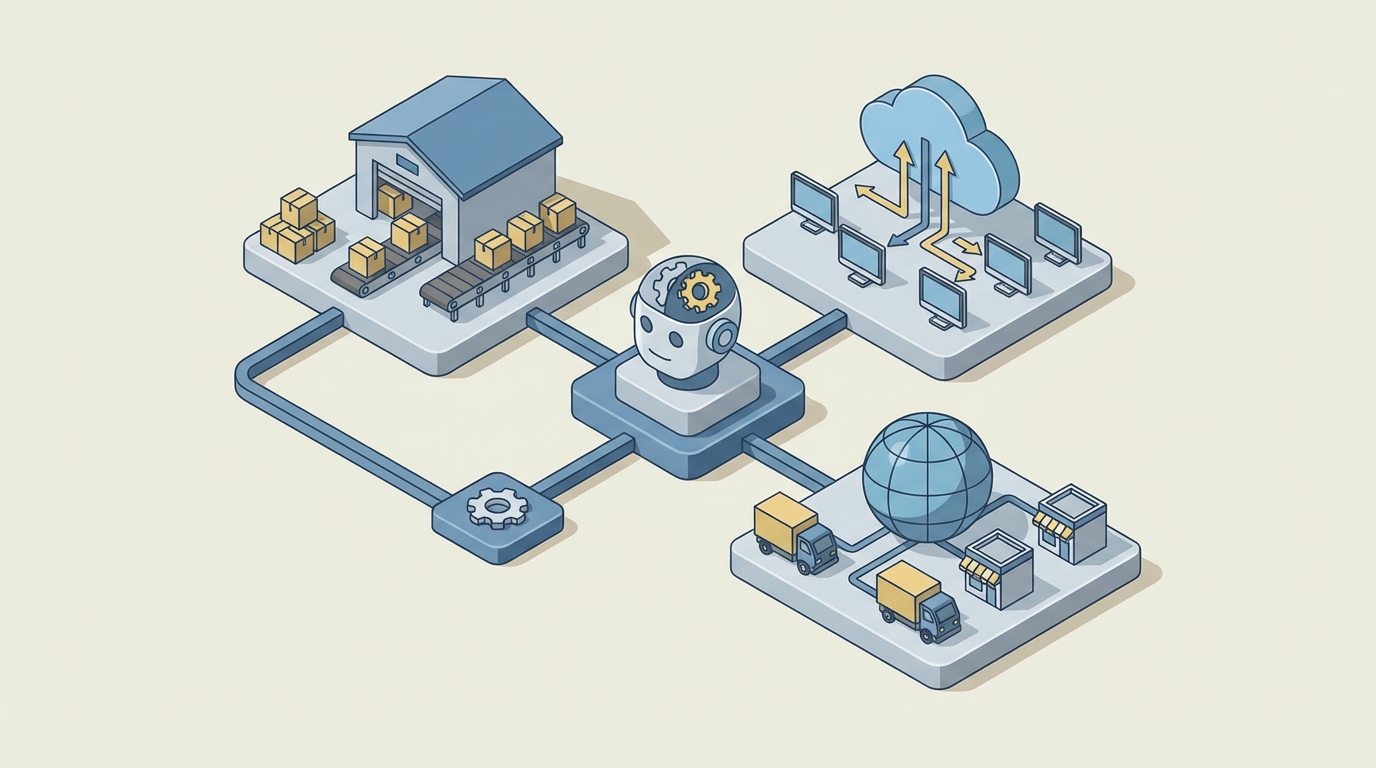
Most teams using Cin7 hit the same wall around month six.
The platform does what it says on the tin: it centralizes inventory, syncs orders across channels, and handles basic warehouse operations. It's solid infrastructure. But then the business grows. You add a second warehouse, a third marketplace, a wholesale channel with EDI requirements, and suddenly you're spending half your week doing things Cin7 was supposed to automate — investigating stock discrepancies, manually routing orders, exporting data to Excel just to answer basic questions, and babysitting integrations that break every time you change a product attribute.
Cin7's built-in automation engine is essentially an if-then rule builder with a handful of triggers. No loops, no complex conditions, no ability to call external systems, no intelligence whatsoever. It's fine for "when order status changes to X, do Y." It falls apart the moment you need anything resembling judgment.
This is where an AI agent comes in — not Cin7's own features, but a custom agent that sits on top of Cin7's API and actually thinks about your operations. And OpenClaw is the platform that makes building one practical without hiring a team of engineers.
Let me walk through what this looks like concretely.
What Cin7's API Actually Gives You to Work With
Before getting into the agent architecture, it's worth understanding the raw material. Cin7 (both Omni and Core) exposes a REST API with endpoints for:
- Products — full CRUD, variants, attributes, images
- Inventory — stock levels by location, adjustments, stock transfer history
- Sales Orders — create, update, retrieve, fulfill, void
- Purchase Orders — create, update, receive
- Customers & Suppliers — contact and pricing tier data
- Shipments & Tracking — dispatch records, carrier info
- Warehouses/Locations — multi-location stock visibility
- Kitting/Assembly — BOM consumption and build jobs
Authentication is API key (legacy) or OAuth2 (newer). Webhooks are available for order created/updated, inventory changed, and shipment dispatched events.
The API is functional but has real limitations: rate limits of 100–300 calls per minute depending on your plan, incomplete coverage of advanced WMS features (wave planning, cartonization), no GraphQL, and webhook delivery that can be unreliable under load. Complex queries like available-to-promise calculations often require chaining multiple API calls together.
In other words: the data is accessible, but making it useful requires middleware that can orchestrate calls, handle failures gracefully, and — critically — make decisions based on what it finds.
Why a Rule Engine Isn't Enough
Cin7's automation rules break down in predictable ways. Here are real scenarios that the built-in system simply cannot handle:
Stock discrepancy investigation. Amazon shows -3 units for SKU-4821, but Cin7 shows 12 available. Is it a sync delay? A cancelled return that didn't process? A warehouse miscount? Figuring this out manually means opening four different screens, cross-referencing timestamps, and checking the integration log. A rule engine can't do this. An AI agent can pull the stock history, check recent order and return events across channels, compare timestamps, identify the most likely root cause, and either auto-correct or flag it for human review with a full explanation.
Dynamic order routing. You have two warehouses and a 3PL. A rule that says "ship from closest warehouse" works until one location is backlogged, another has a carrier pickup window closing in 30 minutes, and the customer is a VIP wholesale account. The routing decision depends on cost, speed, inventory availability, customer tier, and current operational load — simultaneously. Rules can't weigh these factors. An agent can.
Intelligent reordering. Cin7 supports basic min/max reorder points. But real purchasing decisions factor in supplier lead time variability (Supplier A says 14 days but averages 21), current sales velocity trends, upcoming promotions, seasonal patterns, and cash flow constraints. A static min/max misses all of this.
Exception handling across systems. A supplier emails a revised price list as a PDF attachment. A customer sends a PO via EDI with non-standard formatting. A Shopify order comes in with a shipping address that doesn't match the billing country. Each of these requires cross-system reasoning that Cin7's rule engine was never designed to provide.
Building the Agent with OpenClaw
OpenClaw is purpose-built for exactly this kind of integration — connecting AI agents to business systems via their APIs and giving those agents the ability to take real actions, not just generate text.
Here's the architecture:
Cin7 API + Webhooks
       ↓
   OpenClaw Agent
   (with tool definitions for Cin7 endpoints,
    accounting system, carrier APIs, email)
       ↓
   Decision Layer
   (historical context, business rules,
    confidence-based escalation)
       ↓
   Actions or Human Escalation
The key insight is that OpenClaw lets you define tools — structured functions the agent can call — that map directly to Cin7's API endpoints. The agent doesn't just know about your inventory in the abstract; it can actually query stock levels, create purchase orders, update order statuses, and adjust inventory records.
Setting Up Core Tool Definitions
In OpenClaw, you'd define tools that wrap Cin7's API. Here's what the essential toolkit looks like:
# Tool: Get inventory levels across all locations for a SKU
def get_inventory_by_sku(sku: str) -> dict:
    """
    Queries Cin7 API for current stock levels across all
    warehouses/locations for a given SKU.
    Returns: {location_name: {available: int, committed: int, on_hand: int}}
    """
    response = cin7_client.get(f"/api/v1/inventory?sku={sku}")
    return parse_inventory_response(response)

# Tool: Get recent order history for a SKU
def get_recent_orders(sku: str, days: int = 30) -> list:
    """
    Pulls sales orders containing this SKU from the last N days.
    Includes order status, channel, timestamps, quantities.
    """
    cutoff = (datetime.now() - timedelta(days=days)).isoformat()
    response = cin7_client.get(
        f"/api/v1/salesorders?modifiedSince={cutoff}&sku={sku}"
    )
    return parse_orders(response)

# Tool: Create purchase order
def create_purchase_order(supplier_id: str, line_items: list, notes: str = "") -> dict:
    """
    Creates a PO in Cin7 for the specified supplier.
    line_items: [{sku, quantity, unit_cost}]
    Returns: PO number and status.
    """
    payload = build_po_payload(supplier_id, line_items, notes)
    response = cin7_client.post("/api/v1/purchaseorders", json=payload)
    return parse_po_response(response)

# Tool: Adjust inventory
def adjust_inventory(sku: str, location_id: str, adjustment: int, reason: str) -> dict:
    """
    Creates an inventory adjustment in Cin7.
    Positive = add stock, negative = remove stock.
    Reason is logged for audit trail.
    """
    payload = {
        "sku": sku,
        "locationId": location_id,
        "adjustment": adjustment,
        "reason": reason
    }
    response = cin7_client.post("/api/v1/inventory/adjust", json=payload)
    return response.json()

# Tool: Get supplier lead time history
def get_supplier_performance(supplier_id: str) -> dict:
    """
    Analyzes historical POs to calculate actual vs. promised lead times,
    fill rates, and quality rejection rates for a supplier.
    """
    pos = cin7_client.get(
        f"/api/v1/purchaseorders?supplierId={supplier_id}&status=completed"
    )
    return calculate_supplier_metrics(pos.json())
Each of these becomes a tool the OpenClaw agent can invoke when reasoning about a problem. The agent decides which tools to use, in what order, based on the question or trigger.
Webhook-Driven Monitoring
For proactive operations, you configure Cin7 webhooks to push events to your OpenClaw agent:
# Webhook handler for inventory changes
@app.post("/webhooks/cin7/inventory-change")
async def handle_inventory_change(payload: dict):
    sku = payload["sku"]
    location = payload["locationId"]
    new_level = payload["availableQuantity"]

    # Agent evaluates the change in context
    await openclaw_agent.evaluate(
        trigger="inventory_change",
        context={
            "sku": sku,
            "location": location,
            "new_level": new_level,
            "timestamp": payload["timestamp"]
        },
        instructions="""
        Check if this inventory level requires action:
        1. Is stock below reorder point? Consider sales velocity and supplier lead times.
        2. Does this create a discrepancy with any connected channel?
        3. Is this a negative stock situation that needs investigation?
        If action is needed, execute it. If confidence is below 80%, escalate to human.
        """
    )
This is the fundamental shift: instead of static rules that fire blindly, the agent receives the event and reasons about what to do, with access to full context across your systems.
Five Workflows That Actually Matter
1. Automated Stock Discrepancy Resolution
Trigger: Cin7 inventory webhook fires, or a scheduled check runs every 4 hours comparing Cin7 stock levels against each channel's reported inventory.
Agent behavior:
- Pulls current Cin7 stock for the flagged SKU across all locations
- Queries each connected channel (Shopify, Amazon, wholesale portal) for their current reported stock
- Retrieves the last 48 hours of order, return, and adjustment events
- Identifies the most likely root cause (sync delay, missed return processing, warehouse miscount, double-fulfillment)
- If it's a sync issue: triggers a forced inventory push to the affected channel
- If it's a potential miscount: creates an inventory count task for warehouse staff
- If it can't determine the cause with >80% confidence: sends a Slack message to the ops team with its analysis and recommended action
Impact: This alone can save 5–10 hours per week for a mid-size operation running 3+ channels. Most teams are doing this investigation manually, repeatedly, for the same types of issues.
2. Intelligent Purchase Order Generation
Trigger: Daily scheduled run, or real-time when stock drops below dynamic threshold.
Agent behavior:
- Calculates current sales velocity per SKU (7-day, 30-day, 90-day weighted)
- Factors in known upcoming events (promotions, seasonal trends from historical data)
- Checks supplier performance history (actual lead times, not promised)
- Compares multiple suppliers on price, reliability, and current lead time
- Generates PO recommendations with quantities optimized for cash flow constraints and warehouse capacity
- For high-confidence, routine reorders: creates the PO directly in Cin7
- For unusual situations (new supplier, unusually large quantity, price increase >10%): drafts the PO and sends for human approval
This is categorically different from Cin7's min/max alerts. The agent is making the same judgment call an experienced purchasing manager would make, but doing it across thousands of SKUs simultaneously and consistently.
3. Smart Multi-Warehouse Order Routing
Trigger: New sales order webhook from Cin7.
Agent behavior:
- Checks inventory availability at each fulfillment location
- Calculates shipping cost and transit time to the delivery address from each location
- Factors in current warehouse workload (orders in queue, staffing level if available)
- Considers customer tier (VIP gets fastest option, standard gets cheapest)
- For split-shipment scenarios: evaluates whether splitting across warehouses is actually cheaper than shipping from one location with higher shipping cost
- Routes the order and updates Cin7 with the fulfillment location assignment
The math here matters. Even a 5% improvement in routing decisions across thousands of orders per month can translate to tens of thousands in shipping cost savings.
4. EDI and B2B Order Intelligence
EDI is where Cin7 users feel the most pain. Trading partner requirements are strict, formatting is arcane, and errors mean chargebacks.
Agent behavior:
- Monitors incoming EDI documents (850 purchase orders, 860 changes)
- Validates against trading partner-specific requirements before processing
- Cross-references ordered quantities against available-to-promise inventory
- Flags potential issues: discontinued SKUs, unusual quantities, pricing mismatches against contracted rates
- Generates required response documents (855 acknowledgments, 856 ASNs) with correct formatting
- Tracks compliance metrics per trading partner
For companies doing EDI with major retailers (Walmart, Target, Costco), the chargeback prevention alone can justify the entire system.
5. Natural Language Operations Interface
This is the simplest to explain and possibly the highest-impact for day-to-day operations.
Instead of logging into Cin7, navigating to the right screen, setting filters, exporting to Excel, and building a pivot table, anyone on the team can ask:
- "What's our true available stock for the holiday bundle kit across all channels?"
- "Which SKUs have been in stock for more than 90 days with margins below 30%?"
- "Show me all orders from the last week that shipped more than 2 days late, grouped by warehouse."
- "What would happen to our stock levels if we run the 20% off promotion on the top 50 SKUs for two weeks?"
The agent translates these into the appropriate API calls, aggregates the data, and returns a clear answer. No Excel required. No Cin7 expertise required.
This democratizes access to operational data in a way that Cin7's reporting dashboard simply cannot match. Cin7's built-in reports are rigid, slow with large datasets, and require you to know exactly which report to run and how to filter it. The agent handles ambiguity.
Handling Cin7's API Quirks
A few practical notes for anyone building this:
Rate limiting. Cin7's 100–300 calls/minute limit means you need to batch intelligently. OpenClaw's tool execution layer should implement request queuing and caching. For inventory queries that don't need real-time precision, cache for 5–15 minutes.
Webhook reliability. Cin7 webhooks can be delayed or dropped under load. Build a reconciliation loop: every few hours, do a full sync check independent of webhooks. Treat webhooks as the fast path, not the only path.
Missing API coverage. Some Cin7 features don't have API endpoints. For these, the agent should know its own limitations and escalate to human action with clear instructions ("I can't trigger a wave pick via the API — please do this manually in Cin7 and confirm when done").
Data consistency. Cin7's eventual consistency model means that an inventory adjustment might not reflect immediately in a subsequent stock query. Build in appropriate delays and confirmation loops.
# Example: Resilient inventory check with retry
async def get_confirmed_stock(sku: str, location_id: str, max_retries: int = 3):
    for attempt in range(max_retries):
        stock = await get_inventory_by_sku(sku)
        location_stock = stock.get(location_id)
        if location_stock and location_stock.get("last_updated"):
            age = datetime.now() - parse(location_stock["last_updated"])
            if age < timedelta(minutes=5):
                return location_stock
        await asyncio.sleep(2 ** attempt)  # exponential backoff
    return stock.get(location_id)  # return best available
What This Costs vs. What It Saves
The honest math for a mid-market Cin7 user ($10M–$50M revenue, 3+ channels, 2+ warehouses):
Time savings:
- Stock discrepancy investigation: 5–10 hrs/week → 1–2 hrs/week
- Purchase order management: 8–12 hrs/week → 2–3 hrs/week
- Reporting and data pulls: 5–8 hrs/week → near zero
- Order routing decisions: 3–5 hrs/week → automated
Cost savings:
- Shipping optimization from better routing: 3–8% of shipping spend
- Reduced stockouts from smarter reordering: hard to quantify but material
- EDI chargeback prevention: $500–$5,000/month for heavy EDI users
- Reduced need for additional ops headcount as you scale
Error reduction:
- Fewer oversells from stale inventory data
- Fewer mis-ships from manual routing
- Fewer supplier issues caught late
The real value isn't just automation — it's that the agent handles the cognitive load of multi-system operations that currently lives in one or two people's heads. When those people go on vacation, get sick, or leave the company, the knowledge goes with them. The agent retains it.
Getting Started
If you're running Cin7 and spending more time wrestling with it than actually growing your business, here's the move:
- Identify your highest-pain workflow. Stock discrepancies? Reordering? Reporting? Pick one.
- Map the Cin7 API endpoints involved. What data do you need to read? What actions do you need to take?
- Build the agent in OpenClaw with tools for those specific endpoints. Start narrow, expand later.
- Set confidence thresholds. The agent should act autonomously for routine decisions and escalate for edge cases. You'll calibrate these over time.
- Run in shadow mode first. Have the agent make recommendations without executing for 2–4 weeks. Compare its decisions to what your team actually did. Adjust.
You don't need to automate everything on day one. The compounding value comes from the agent learning your operational patterns and gradually handling more.
If you want help scoping this out for your specific Cin7 setup — which workflows to automate first, how to handle your particular integration stack, what the realistic timeline and ROI look like — book a Clawsourcing session. We'll map your current Cin7 pain points to an OpenClaw agent architecture and give you a concrete implementation plan. No fluff, just the build spec.
Recommended for this post

Adam
Full-Stack Engineer
Your full-stack AI engineer that architects, builds, deploys, and automates entire applications from a single conversation. 23+ Core Capabilities.
 Clarence Maker
Your Linear expert that automates issue tracking, builds workflows, and streamlines project management.
 SpookyJuice.ai
Product Copywriter
Skill
SEO-optimized product descriptions in seconds. Just paste a URL.