AI Agent for ChowNow: Automate Restaurant Online Ordering, Marketing, and Customer Data
Automate Restaurant Online Ordering, Marketing, and Customer Data
Most restaurants on ChowNow are leaving money on the table. Not because ChowNow is bad — it's actually one of the better direct ordering platforms out there — but because they're using maybe 40% of what's possible with their own customer data and ordering infrastructure.
Here's the situation: You've got a branded ordering site, a POS integration, customer order histories, loyalty data, and a marketing toolset. But ChowNow's built-in automations are basic. Template-y emails. Weak segmentation. No real intelligence behind the customer interactions. The dashboard gives you surface-level numbers but can't tell you which 87 customers are about to stop ordering or that your chicken sandwich is quietly cannibalizing your burger sales.
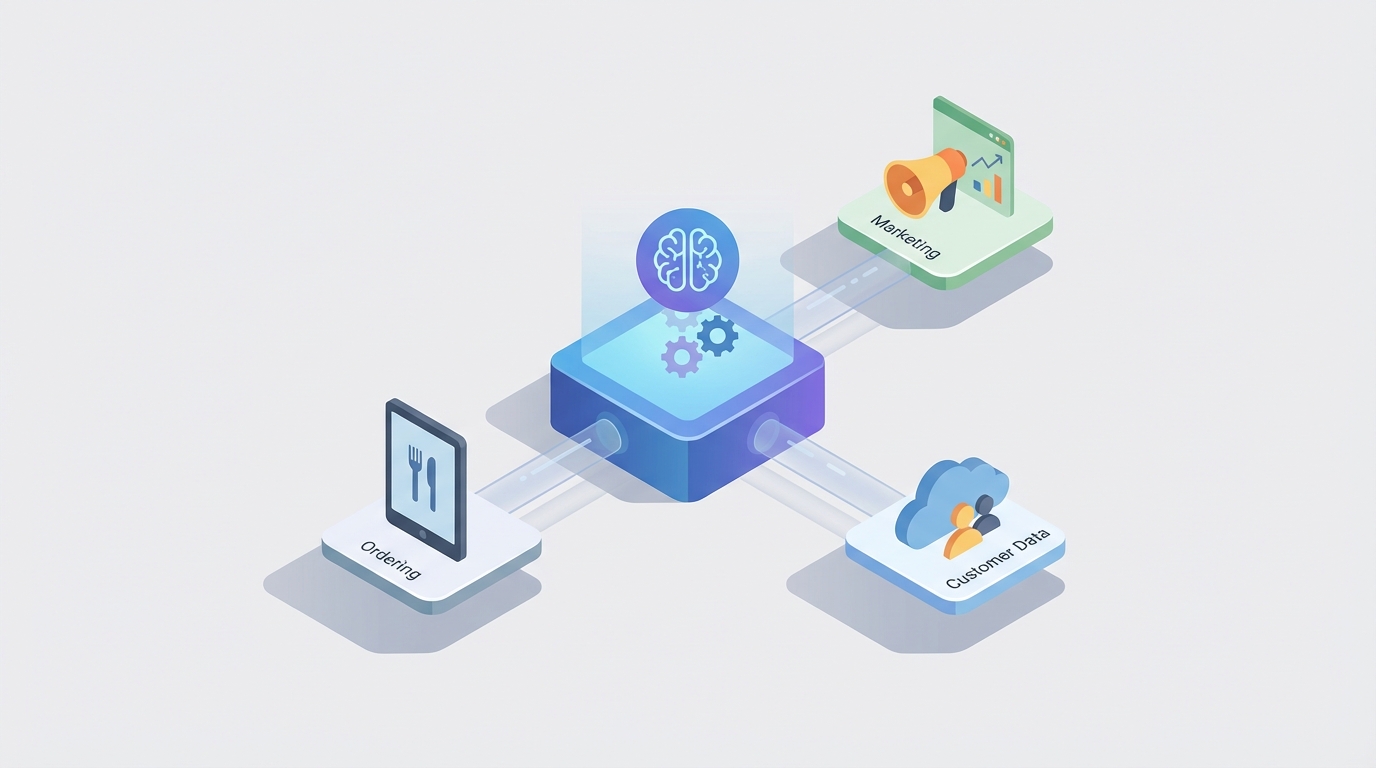
The fix isn't switching platforms. It's building an AI agent that sits on top of ChowNow and actually uses all the data and capabilities the platform exposes through its API. That's what OpenClaw does — and in this post, I'm going to walk through exactly how it works, what workflows matter, and what the implementation actually looks like.
What ChowNow's API Actually Gives You to Work With
Before we get into the agent architecture, you need to understand what's available. ChowNow's Partner API and webhook system expose more than most restaurant operators realize:
- Menus: Full menu structure — items, modifiers, schedules, availability, 86'd status
- Orders: Create orders, retrieve order details, get status updates
- Locations: Multi-location management endpoints
- Customers: Profiles, order history, loyalty points (with proper permissions)
- Webhooks: Real-time notifications for new orders, status changes, cancellations
The API is read-heavy and requires partner approval, so it's not something you just grab a key for and start hacking on. But once you're in, there's enough surface area to build genuinely useful automation.
The problem is that doing anything smart with these endpoints — combining customer history with menu data with order patterns with real-time kitchen status — requires an orchestration layer that ChowNow doesn't provide. That's the gap.
Where OpenClaw Fits
OpenClaw is the platform you use to build that orchestration layer. Instead of writing a fragile mess of scripts that poll APIs and fire off canned responses, you build an AI agent that:
- Ingests real-time data from ChowNow webhooks
- Maintains a living picture of your customers, menu, and operations
- Makes decisions and takes actions based on actual context
- Learns from outcomes over time
Think of it as the difference between a thermostat (ChowNow's built-in automations) and a building management system that knows the weather forecast, occupancy patterns, and energy prices (an OpenClaw agent connected to ChowNow).
Let me get specific about what this looks like in practice.
Workflow 1: Intelligent Customer Win-Back
The ChowNow default: Send the same "We miss you!" email to everyone who hasn't ordered in 30 days. Maybe a 10% off coupon. Low open rate, lower conversion.
The OpenClaw agent version:
The agent monitors customer order patterns through the ChowNow API. It doesn't use a flat 30-day rule — it calculates each customer's normal ordering cadence. Someone who orders every Tuesday and suddenly stops for two weeks is a very different signal than someone who orders once a month and it's been five weeks.
Here's a simplified version of how this logic gets configured in OpenClaw:
trigger:
  type: customer_order_pattern
  source: chownow_webhook
  condition: days_since_last_order > (avg_order_interval * 1.5)

context:
  - customer.order_history
  - customer.favorite_items
  - menu.current_availability
  - customer.loyalty_points

action:
  type: personalized_outreach
  channel: sms  # or email, based on customer preference
  content_generation:
    style: casual_friendly
    include:
      - reference_to_favorite_item
      - relevant_new_menu_items
      - loyalty_points_balance
      - time_sensitive_offer_if_high_value_customer
The agent generates a message like: "Hey Maria — your go-to pad thai is still here, and we just added a massaman curry that our pad thai people are loving. You've got 340 points sitting there too. Just saying."
That's not a template. That's the agent pulling Maria's order history, cross-referencing it with current menu availability, checking her loyalty balance, and generating a message that feels like it came from a person who actually knows her.
The conversion difference between that and "We miss you! Here's 10% off" is significant. We're talking 3-5x improvement in win-back rates based on what operators using similar personalization approaches report.
Workflow 2: Real-Time Order Intelligence and Smart Upselling
This one's more technical but the ROI is immediate.
When a customer places an order through ChowNow, the webhook fires and hits your OpenClaw agent before the order confirmation goes out. The agent evaluates the order against several data points:
- Customer history: What do they usually add? What have they never tried?
- Current kitchen load: Is the kitchen slammed? Don't suggest add-ons that slow things down.
- Inventory status: Is there a surplus of something that pairs well?
- Margin data: What items have the best margin that complement this order?
# OpenClaw agent tool definition for order analysis
@openclaw.tool("analyze_order_for_upsell")
async def analyze_order(order_id: str):
    order = await chownow.get_order(order_id)
    customer = await chownow.get_customer(order.customer_id)
    kitchen_load = await pos.get_current_load()

    # Don't upsell if kitchen is overwhelmed
    if kitchen_load.status == "slammed":
        return {"upsell": None, "reason": "kitchen_capacity"}

    history = await chownow.get_order_history(order.customer_id)

    # Find items they usually order but didn't this time
    usual_items = get_frequent_items(history)
    missing_usual = [i for i in usual_items if i not in order.items]

    # Find complementary items they haven't tried
    complementary = get_complementary_items(
        order.items,
        exclude=get_all_ordered_items(history),
        prefer_high_margin=True
    )

    return {
        "upsell_suggestions": prioritize(missing_usual + complementary, max=2),
        "customer_context": summarize_preferences(history)
    }
The agent then generates a contextual suggestion — not a generic "Add a drink for $2.99!" popup, but something like "Looks like you skipped your usual spring rolls — want to add them?" or a gentle intro to a new item that fits their demonstrated preferences.
This is the kind of thing that a great counter person does instinctively. The AI agent just does it for every single online order, 24/7.
Workflow 3: Proactive Operations Management
This is where it gets really interesting for multi-location operators.
The OpenClaw agent continuously monitors order flow, kitchen performance, and historical patterns across all your ChowNow locations. It can:
Predict rush periods and auto-adjust: Based on historical order patterns, weather data, local events, and current trajectory, the agent can trigger ChowNow's order throttling before the kitchen gets buried — not after.
Dynamic 86 management: When the POS shows inventory dropping on a key ingredient, the agent can preemptively flag items that will need to be 86'd and — if you give it permission — automatically update availability in ChowNow before a customer orders something you can't make.
Cross-location load balancing: For multi-location restaurants, the agent can detect when one location is getting crushed while another is quiet. It can adjust estimated prep times, suggest routing delivery orders differently, or trigger targeted promotions for the slower location.
monitor:
  type: continuous
  sources:
    - chownow_orders (all_locations)
    - pos_inventory (real_time)
    - historical_patterns

rules:
  - name: preemptive_throttle
    condition: projected_orders_next_30min > kitchen_capacity * 0.85
    action: enable_order_throttling
    notify: manager_on_duty

  - name: smart_86
    condition: ingredient_level < orders_requiring_ingredient * 1.2
    action:
      - flag_at_risk_items
      - if_approved: update_chownow_availability

  - name: cross_location_balance
    condition: location_a.load > 0.9 AND location_b.load < 0.5
    action:
      - adjust_prep_time_estimates
      - trigger_location_b_promotion
No restaurant operator has time to watch dashboards across multiple locations and make these micro-decisions all day. The agent does it in the background and either takes action within defined guardrails or surfaces recommendations with the relevant context.
Workflow 4: Customer Service Automation That Doesn't Suck
ChowNow doesn't have a customer service layer. When someone texts the restaurant asking "Where's my order?" or "Can I change my pickup time?" or "I'm allergic to tree nuts, is the pad thai safe?" — that's falling on whoever happens to answer the phone.
An OpenClaw agent connected to ChowNow can handle the vast majority of these interactions:
- Order status queries: Pull real-time status from ChowNow API, give an actual answer
- Modification requests: Check if the order hasn't entered prep yet, make the change through the API if possible, escalate to staff if not
- Menu questions: Reference the full menu data including allergen info, ingredients, modifiers
- Refund requests: Handle within defined policy parameters, escalate edge cases
The key architectural decision here is the escalation layer. You never want the agent handling something it shouldn't. OpenClaw lets you define clear escalation triggers:
escalation_rules:
  - condition: refund_amount > 50
    action: route_to_manager
  - condition: customer.sentiment == "angry" AND issue_unresolved_after_2_exchanges
    action: route_to_human
  - condition: request_type == "food_safety_complaint"
    action: immediate_human_escalation
The agent handles the routine stuff (which is 70-80% of inbound customer contacts), and humans deal with the situations that actually need a human. This alone can save a multi-location restaurant 15-25 hours of staff time per week.
Workflow 5: Marketing That Uses Your Actual Data
ChowNow's marketing tools let you send emails and SMS. What they don't let you do is think strategically about who gets what message when.
An OpenClaw agent connected to your ChowNow customer data can run continuous analysis:
- Cohort identification: Group customers by behavior, not just by arbitrary time periods. "High-frequency lunch orderers who haven't tried dinner" is a real segment with a real marketing play.
- Churn prediction: Flag customers whose ordering patterns suggest they're drifting away, before they're gone.
- Menu item performance: Not just "what sells" but "what drives repeat orders" and "what's ordered once and never again" — critical for menu engineering.
- Campaign optimization: Test different message angles, track results, automatically shift budget toward what works.
The agent doesn't just generate reports. It generates the actual marketing content — personalized for each segment, using the customer's own history and preferences — and sends it through ChowNow's messaging infrastructure or your own SMS/email provider.
The Technical Architecture
Here's what the full stack looks like:
ChowNow Webhooks → OpenClaw Ingestion Layer
                          ↓
                   Event Processing
                          ↓
              ┌───────────┼───────────┐
              ↓           ↓           ↓
        Customer      Operations    Marketing
        Service       Monitor       Engine
        Agent         Agent         Agent
              ↓           ↓           ↓
              └───────────┼───────────┘
                          ↓
                   Action Layer
              (ChowNow API + POS API
               + SMS/Email + Dashboard)
OpenClaw handles the agent orchestration, tool definitions, memory management, and guardrails. You define the tools (ChowNow API calls, POS queries, messaging actions), the context each agent has access to, and the boundaries of autonomous action.
The key components:
- Webhook ingestion: ChowNow events flow into OpenClaw in real-time
- Customer memory: A vector database maintaining rich customer profiles built from order history, interactions, and preferences
- Menu/inventory sync: Regular pulls from both ChowNow and POS to maintain current state
- Agent definitions: Each workflow gets its own agent with specific tools, context, and permissions
- Human-in-the-loop: Configurable escalation for anything outside defined parameters
What This Actually Costs vs. What It Saves
Let's be real about the math. A restaurant doing $3M in annual revenue through ChowNow is probably spending significant time on:
- Manual marketing creation and sending (5-10 hours/week)
- Customer service for online orders (10-20 hours/week)
- Menu management and 86 updates (3-5 hours/week)
- Analyzing sales data and making decisions (2-3 hours/week)
That's 20-38 hours of labor per week. At loaded restaurant management labor costs, you're looking at $1,500-$3,000/month in time spent on tasks an AI agent handles better and faster.
Add in the revenue impact — better win-back rates, smarter upselling, fewer lost customers, less food waste from better 86 management — and you're looking at a meaningful bottom-line improvement.
The setup through OpenClaw requires investment upfront: defining your workflows, configuring the ChowNow integration, training the agent on your specific menu and brand voice. But once it's running, it compounds. The agent gets smarter about your customers and operations over time.
Getting Started
If you're running a restaurant (or multiple locations) on ChowNow and you're feeling the limitations of the platform's built-in tools, here's what I'd suggest:
- Audit your current ChowNow data: What customer data do you actually have? What's your order history depth? This determines what's possible on day one.
- Pick your highest-pain workflow: Don't try to build everything at once. If customer service is eating your staff's time, start there. If you're losing customers and don't know why, start with win-back intelligence.
- Talk to the Clawsourcing team: This is exactly the kind of build they specialize in — connecting AI agents to existing restaurant tech stacks through OpenClaw, with proper guardrails and escalation. Start a conversation here.
The restaurants that are going to win the direct ordering game aren't the ones with the prettiest websites. They're the ones that use their customer data intelligently, respond faster than humanly possible, and make every interaction feel personal. That's what a well-built AI agent on top of ChowNow delivers.
ChowNow gives you the infrastructure. OpenClaw gives you the intelligence. The combination turns a good direct ordering platform into something that actually competes with the personalization and convenience of DoorDash — without giving up 30% of your revenue to do it.