AI Agent for Braze: Automate Cross-Channel Customer Engagement, Personalization, and Lifecycle Marketing
Automate Cross-Channel Customer Engagement, Personalization, and Lifecycle Marketing
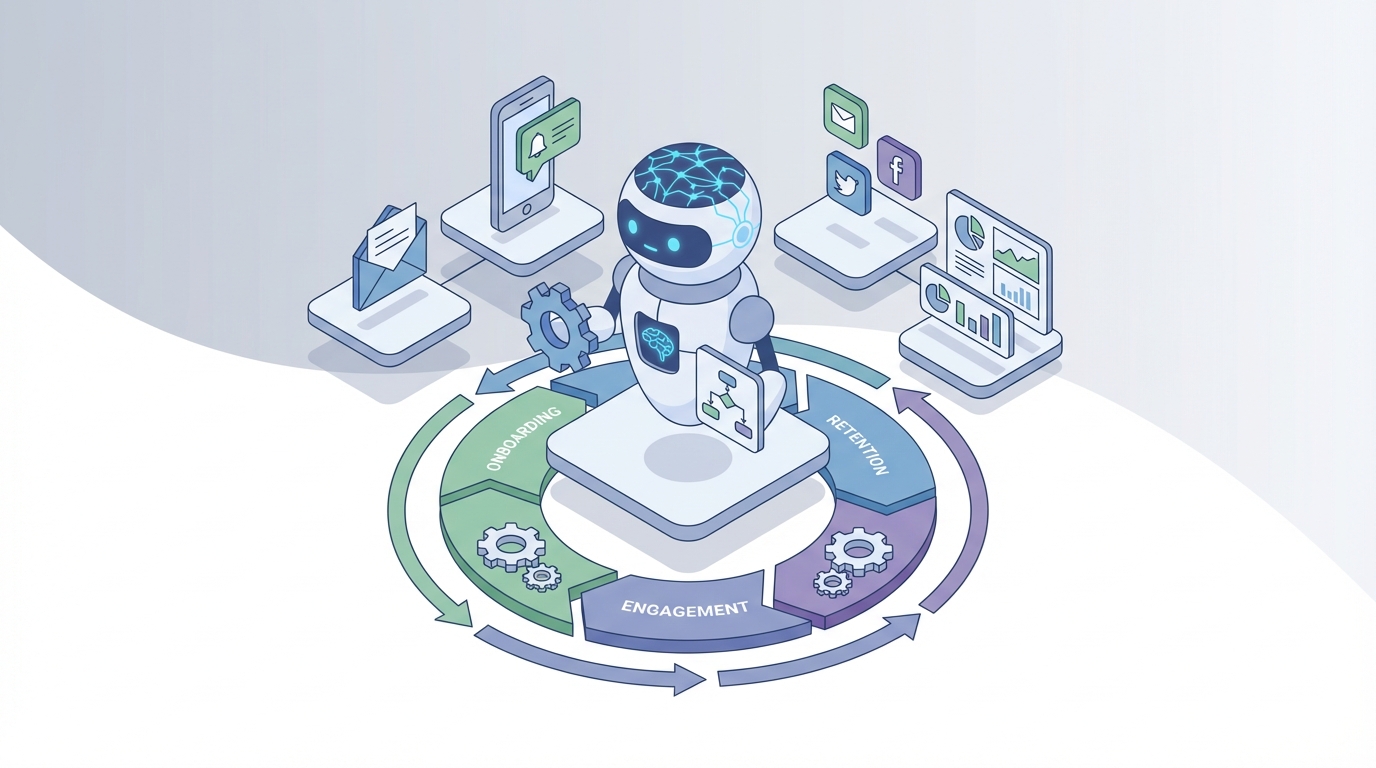
Most marketing teams using Braze are stuck in the same loop: build a Canvas, watch it get complex, watch it break, rebuild it, repeat. The platform itself is excellent — probably the best cross-channel engagement tool on the market — but it has a ceiling. And if you've been running Braze for more than six months, you've probably hit it.
The ceiling isn't about channels or deliverability. It's about logic. Braze gives you branching, delays, and Liquid templating. That covers maybe 70% of what you actually want to do. The other 30% — the stuff that would genuinely move retention and revenue numbers — requires intelligence that a visual flow builder simply cannot provide.
That's where a custom AI agent comes in. Not Braze's built-in AI features (which are useful but limited), but an external agent that connects to Braze's API and acts as a smart orchestration layer on top of everything you've already built. An agent that can make real-time decisions, generate personalized content, manage complex multi-system logic, and do things that would take your team weeks of Canvas spaghetti to approximate.
Let's get into the specifics of how this works, what it looks like in practice, and how to actually build it with OpenClaw.
The Problem with Canvas-Only Orchestration
If you're a Braze power user, you already know this pain. Canvas is a fantastic tool until it isn't. Here's where it consistently falls apart:
Spaghetti journeys. Once you have more than about 15-20 steps with multiple branches, Canvas becomes nearly impossible to maintain. Nobody on your team can look at it and understand what's happening. Debugging why a specific user didn't receive a message becomes a multi-hour investigation.
Static decision-making. Every branch in a Canvas is a rule: "If user has attribute X, go left. Otherwise, go right." That works for simple segmentation. It does not work when you need to factor in 15 different signals — recent support tickets, browsing behavior, purchase frequency trends, inventory availability, price sensitivity, channel preference — to decide what message to send, when, and where.
Content bottleneck. Even with Liquid and Content Blocks, you're still writing variants manually. You might have five versions of an abandoned cart email. You do not have 500 versions, each tuned to the specific user's history, tone preferences, and product affinity. Braze's AI Liquid helps, but it's a far cry from what a proper LLM can do with full context.
No cross-system reasoning. Connected Content lets you pull data from an external API at render time. That's great for grabbing a price or inventory count. It is not great for making a complex decision that requires calling your product usage database, your support system, and your pricing engine, synthesizing all of that, and then deciding what to do. You can't orchestrate multi-step logic in a Connected Content call.
Manual optimization. You run an A/B test. You look at the results in a week. You pick the winner. You set up another test. This is the 2019 approach. It works, but it's slow, and you're testing surface-level variables (subject line A vs. B) instead of fundamentally rethinking the strategy.
None of these are Braze bugs. They're inherent limitations of any visual flow builder. The solution isn't to abandon Braze — it's to put something smarter on top of it.
What an AI Agent Actually Does on Top of Braze
Let me be concrete. When I say "AI agent for Braze," I mean a software agent built on OpenClaw that has:
- Access to Braze's REST API as a set of tools (track users, trigger campaigns, trigger Canvases, send messages, manage catalogs, export data)
- Access to your internal systems (data warehouse, product database, support platform, pricing engine — whatever is relevant)
- LLM reasoning capabilities to synthesize information from multiple sources and make decisions
- Memory to maintain state across interactions and time horizons
- Autonomous execution ability — it doesn't just recommend actions, it takes them
The architecture looks like this:
[Braze Currents / Webhooks] → Event Stream → [OpenClaw Agent]
                                                    ↓
                                          [Reasoning + Decision]
                                                    ↓
                              [Braze API / Internal APIs / Data Warehouse]
Events flow out of Braze via Currents or webhooks. The OpenClaw agent processes those events, combines them with data from your other systems, reasons about what to do, and then acts — either by triggering a Braze campaign/Canvas via API, sending a message directly, updating user attributes, or taking some other action.
This is not theoretical. This is how sophisticated Braze customers are already working — they've just been building these systems from scratch with duct tape and Python scripts. OpenClaw gives you the framework to do it properly.
Five Workflows That Actually Matter
Let me walk through specific, high-value workflows where an AI agent dramatically outperforms what you can do with Canvas alone.
1. Intelligent Next-Best-Action Decisioning
The Canvas approach: You build branching logic. "If user hasn't purchased in 30 days AND has opened an email in the last 7 days AND is in the 'high value' segment, send them a 15% off email." You end up with dozens of branches trying to account for every combination.
The agent approach: The OpenClaw agent receives an event (e.g., user visited the site but didn't purchase). It pulls the user's full profile from Braze via /users/export, checks their recent support tickets via your helpdesk API, looks at their purchase history and product affinity scores from your data warehouse, checks current inventory and margin data from your product system, and then reasons:
"This user has bought three times in the last 90 days, averaging $85 per order. They browsed running shoes today but didn't convert. Their last support ticket (2 days ago) was about a sizing issue that was resolved positively. They respond best to push notifications, historically opening 73% of them. Running shoes in their preferred size are in stock. Margin on the product they viewed is 42%. Recommendation: Send a push notification in 3 hours (their highest-engagement window) highlighting the specific shoe they viewed, referencing that we've got their size in stock, with free returns messaging to address potential sizing concerns. No discount needed — their purchase history suggests they convert without incentives."
The agent then calls /campaigns/trigger/send with the appropriate campaign ID and personalization properties. One API call, but informed by reasoning that would require an impossibly complex Canvas to replicate.
Here's what the tool configuration looks like in OpenClaw:
tools = [
    {
        "name": "braze_export_user",
        "endpoint": "https://rest.iad-01.braze.com/users/export/ids",
        "method": "POST",
        "headers": {"Authorization": "Bearer {{BRAZE_API_KEY}}"},
        "parameters": {
            "external_ids": ["{{user_id}}"],
            "fields_to_export": ["custom_attributes", "custom_events", "purchases", "push_tokens"]
        }
    },
    {
        "name": "braze_trigger_campaign",
        "endpoint": "https://rest.iad-01.braze.com/campaigns/trigger/send",
        "method": "POST",
        "headers": {"Authorization": "Bearer {{BRAZE_API_KEY}}"},
        "parameters": {
            "campaign_id": "{{campaign_id}}",
            "recipients": [{"external_user_id": "{{user_id}}"}],
            "trigger_properties": {}  # Agent fills these dynamically
        }
    },
    {
        "name": "query_data_warehouse",
        "endpoint": "https://your-internal-api.com/user-insights",
        "method": "GET",
        "parameters": {"user_id": "{{user_id}}"}
    }
]
2. Dynamic Content Generation at Scale
The Canvas approach: You write 3-5 copy variants. You use Liquid to swap in the user's first name and maybe a product name. You A/B test subject lines. It's fine. It's what everyone does.
The agent approach: The OpenClaw agent generates truly personalized content for each user at send time. Not "Hi {{first_name}}" personalization — actual contextual personalization.
For a streaming service, instead of:
"Hey Sarah, check out what's new this week!"
The agent generates:
"Sarah — since you binged all of Severance in two days and gave The Bear 5 stars, you'll probably want to know that the director of Severance just dropped a new limited series. First episode is live."
This works by having the agent pull the user's viewing history, ratings, and preferences, then generate copy that references specific, relevant details. The agent calls Braze's /messages/send endpoint or populates trigger_properties on a campaign with the generated content.
The key insight: you don't generate content for every user proactively. You use Braze's event triggers to initiate the flow, and the agent generates content on-demand for the users who actually qualify for a message. This keeps costs manageable and latency low.
3. Cross-System Win-Back Sequences
The Canvas approach: "User hasn't opened the app in 14 days → send email → wait 3 days → send push → wait 3 days → send SMS with 20% off." It's linear. It doesn't account for what's actually happening with the user.
The agent approach: The OpenClaw agent monitors for dormancy signals (via Braze Currents) and then orchestrates a genuinely intelligent re-engagement sequence:
- Day 1: Agent checks — did the user recently file a support ticket? If so, the win-back approach should be fundamentally different (address the issue, not offer a discount).
- Day 3: Agent checks — has the user visited the website even though they haven't used the app? Maybe the problem is app-specific. Send a deep link or highlight a web-specific feature.
- Day 7: Agent checks — what's the user's predicted LTV? High-LTV users get a personalized outreach. Low-LTV users get a standard sequence. The agent pulls the prediction from your ML model and decides.
- Throughout: The agent tracks responses across all channels and adjusts. If the user opened the email but didn't act, the next touchpoint references something different. If they replied to the SMS saying "stop sending me stuff," the agent updates their Braze profile via
/users/trackand halts the sequence immediately.
Each of these steps is an API call the agent makes to Braze — updating attributes, triggering campaigns, or adjusting Canvas entry properties. The intelligence lives in the agent. The execution lives in Braze.
4. Proactive Anomaly Detection and Response
This one is underrated. Most Braze teams are reactive — they look at dashboards after the fact and respond to problems days later.
An OpenClaw agent can monitor Braze Currents data in real time and flag problems:
- Deliverability drops: "Email open rates for the 'Weekly Digest' campaign dropped 40% in the last 2 hours. This may indicate a deliverability issue. Here's what changed between the last send and this one."
- Canvas bottlenecks: "87% of users entering the onboarding Canvas are dropping off at step 4. The message at step 4 references a feature that was deprecated last month."
- Segment drift: "The 'High Value' segment has grown 300% in the last week, which suggests the underlying event tracking may have changed. Investigate before the next campaign."
The agent doesn't just alert you — it can take corrective action. Pause a campaign via the API. Update user attributes to reroute users in a Canvas. Trigger a fallback message.
5. Natural Language SMS and WhatsApp Conversations
Braze can send SMS and WhatsApp messages. It cannot understand and respond to freeform replies intelligently. Its automation is keyword-based: reply "YES" to confirm, reply "STOP" to unsubscribe.
An OpenClaw agent can process inbound messages (received via Braze webhooks or Currents), understand the intent using LLM reasoning, and respond appropriately:
- User replies to a shipping notification: "Where's my order?" → Agent checks order status via your fulfillment API, generates a natural language response with tracking info, sends via Braze
/messages/send. - User replies to a promotional message: "Do you have this in blue?" → Agent checks inventory, responds with availability, and includes a direct purchase link.
- User expresses frustration: "This is the third time my order was wrong" → Agent recognizes the sentiment, escalates to the support team, sends an empathetic holding message, and updates the user's Braze profile to suppress future promotional messages until the issue is resolved.
This transforms SMS and WhatsApp from broadcast channels into genuine conversational channels — without building a full chatbot infrastructure from scratch.
Implementation: How to Actually Build This
Here's the practical path to getting an AI agent running on top of your Braze instance with OpenClaw.
Step 1: Map your highest-value workflow. Don't try to agent-ify everything at once. Pick the one workflow where Canvas limitations are most painful and the business impact of improvement is highest. Usually this is either next-best-action decisioning or win-back sequences.
Step 2: Configure your Braze API access. Create a dedicated API key in Braze with the specific permissions your agent needs. Don't give it full admin access. Scope it to the endpoints it'll use — typically users.track, campaigns.trigger.send, canvas.trigger.send, users.export.ids, and maybe catalogs.
Step 3: Set up event ingestion. Configure Braze Currents to stream events to your agent's intake endpoint (or use webhooks for specific Canvas steps). This is how your agent "listens" to what's happening.
Step 4: Build the agent in OpenClaw. Define your tools (Braze API endpoints + internal system APIs), write your system prompt with clear decision-making criteria, and configure the agent's reasoning loop. OpenClaw handles the orchestration — tool calling, memory management, error handling, retries.
Step 5: Run in shadow mode. Before letting the agent take autonomous action, have it log its decisions alongside what your current Canvas would have done. Compare the two. This builds confidence and catches edge cases.
Step 6: Go live incrementally. Start with a small segment. Monitor closely. Expand as you validate results.
What You're Not Doing Here
To be clear about what this approach is not:
- Not replacing Braze. Braze remains your execution layer. It handles deliverability, channel management, compliance, template rendering, and all the infrastructure. The agent handles the decision-making and content intelligence.
- Not building a chatbot. This is an operational agent that works with your existing marketing infrastructure. It's not customer-facing (except in the SMS/WhatsApp use case).
- Not a science project. Every workflow described above ties directly to retention, revenue, or operational efficiency. If it doesn't move a business metric, don't build it.
The Bottom Line
Braze is great at what it does: multichannel message delivery, audience management, and journey execution. What it can't do is think. It can't synthesize signals from multiple systems, generate genuinely personalized content, handle complex conditional logic gracefully, or optimize itself autonomously.
An OpenClaw agent doesn't replace Braze — it makes Braze dramatically more effective by adding an intelligence layer that the platform was never designed to provide. The API surface is already there. The event streaming is already there. You're just connecting a brain to the existing nervous system.
The teams that figure this out first will have a meaningful, compounding advantage in customer engagement. The teams that keep building increasingly tangled Canvases will keep wondering why their metrics plateau.
Want help building an AI agent for your Braze stack? Talk to our Clawsourcing team — we'll scope the integration, identify your highest-impact workflow, and get an OpenClaw agent connected to your Braze instance.