AI Agent for Bloomerang: Automate Donor Management, Retention Tracking, and Fundraising Campaigns
Automate Donor Management, Retention Tracking, and Fundraising Campaigns
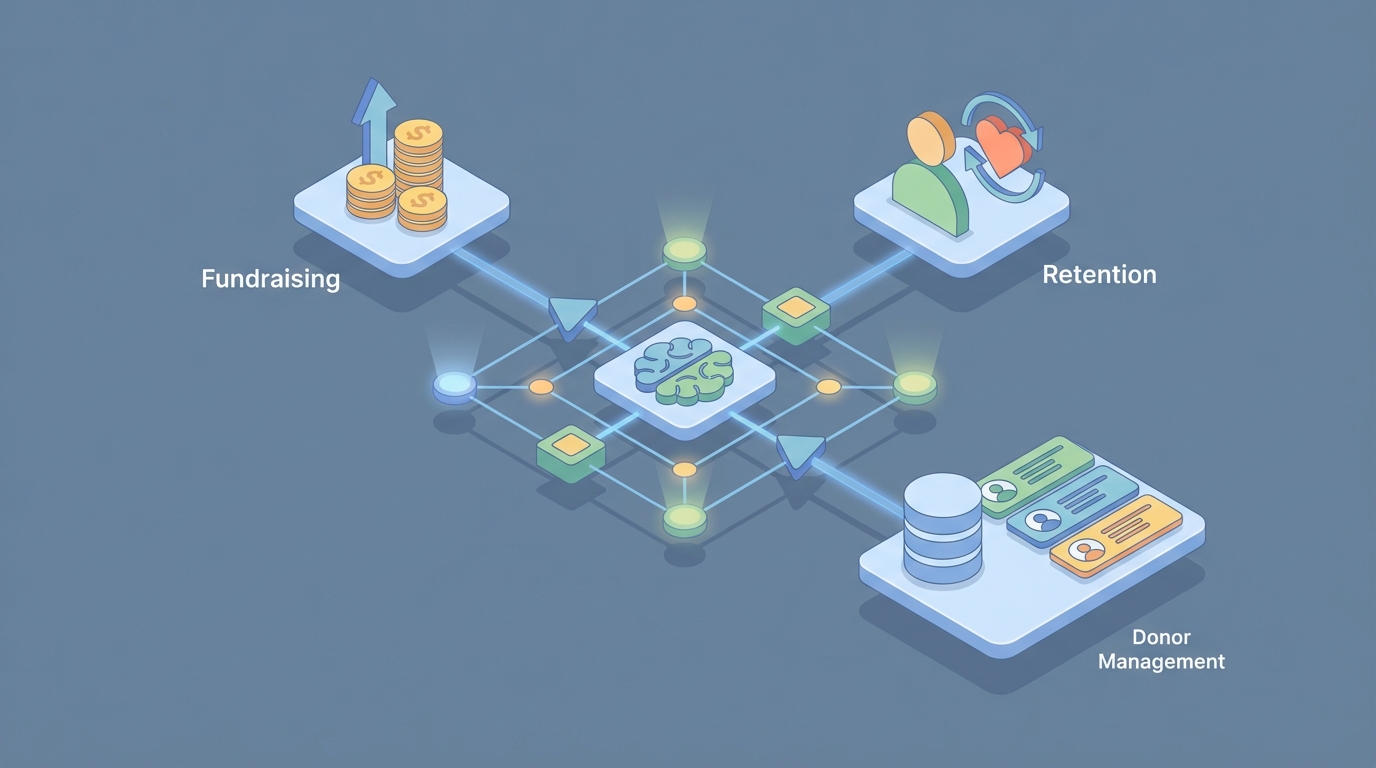
Most nonprofit teams I talk to aren't struggling because they picked the wrong CRM. They picked Bloomerang, it's solid, they like the retention dashboard, the QuickBooks sync is great, and they can process gifts without wanting to throw their laptop out a window. That's more than you can say for a lot of nonprofit tech.
The problem shows up about 18 months in.
You've got 4,000 donor records. Your major gift officer wants to know which scholarship donors from the last three years haven't been contacted in six months and have high engagement scores. Your ED wants a personalized thank-you letter that references each donor's specific giving history and program interests. Your development director wants a multi-step stewardship sequence that branches based on whether someone opened the last email.
And Bloomerang's automation engine — which is basically "if tag added, then create task" — just stares at you blankly.
This isn't a knock on Bloomerang. It's genuinely one of the better nonprofit CRMs for small-to-mid-sized shops. But its automation ceiling is low, its segmentation requires multiple exports to Excel to do anything complex, and its API, while functional, doesn't expose things like the Bloomerang Score calculation or email campaign management. You hit walls.
The answer isn't ripping out Bloomerang and migrating to Salesforce Nonprofit Cloud (which will take six months, cost $80k in consulting, and make your program staff cry). The answer is layering intelligence on top of what you already have.
That's what this post is about: building a custom AI agent with OpenClaw that connects to Bloomerang's API, adds the automation and intelligence Bloomerang doesn't have, and lets your team operate like an organization three times your size.
What Bloomerang Can and Can't Do (The Honest Version)
Before we build anything, let's be precise about what we're working with.
Bloomerang's API (v2, REST, OAuth 2.0) gives you solid access to:
- Full CRUD on constituents (accounts), donations/transactions, and interactions (notes, calls, meetings)
- Soft credits, relationships, tags, custom fields
- Funds, campaigns, appeals
- Webhooks for donation created, constituent updated, and payment failed events
What the API does NOT give you:
- No access to the Bloomerang Score via API
- No endpoints for email campaigns or marketing automation
- No ability to trigger or read Rules/Automations
- No bulk upsert (you have to check for existence before writing each record)
- Low rate limits on write operations
- No GraphQL — verbose REST payloads only
What the built-in automation can't do:
- No multi-step workflows with time delays
- No branching logic (if/else)
- No external data lookups
- No dynamic content generation
- No predictive triggers
- No cross-platform orchestration (SMS, Slack, etc.)
This is the gap. And it's a big one if you're trying to do personalized donor engagement at any kind of scale.
The Architecture: OpenClaw + Bloomerang
Here's what the integration looks like in practice. OpenClaw acts as the brain that sits between your team and Bloomerang, pulling data through the API, reasoning about it, taking action, and writing results back.
Bloomerang API + Webhooks
        ↕
    OpenClaw Agent
    (reasoning + retrieval + action)
        ↕
    Output Channels
    (Bloomerang write-back, email, SMS via Twilio, Slack, dashboards)
OpenClaw handles the parts Bloomerang can't: multi-step conditional logic, natural language querying, personalized content generation, predictive modeling, and orchestration across multiple tools. It connects to Bloomerang's REST API for reads and writes, listens to webhooks for real-time triggers, and maintains a retrieval layer (RAG) over your donor history so the agent can reference specific giving patterns and interactions when generating content or recommendations.
The key thing: your staff keeps using Bloomerang as their daily CRM. Nothing changes about how they enter gifts or look up donors. The OpenClaw agent works alongside it — enriching records, triggering actions, and surfacing insights they'd never get from the native platform alone.
Five Workflows That Actually Matter
I'm going to skip the theoretical stuff and go straight to the workflows nonprofit teams actually need. Each of these addresses a specific Bloomerang limitation and shows how OpenClaw fills the gap.
1. Natural Language Segmentation
The problem: Your development director wants "all donors who gave $500+ to the capital campaign in 2023 or 2026, haven't been contacted in 90 days, and are tagged as 'board prospect.'" In Bloomerang, this requires building multiple filtered views, possibly exporting to Excel, running VLOOKUP or pivot tables, and importing a list back. It takes 30–45 minutes and happens maybe once a month because it's painful.
The OpenClaw workflow:
Your team member messages the OpenClaw agent (via Slack, a web interface, or whatever channel you configure):
"Show me capital campaign donors from the last two years who gave $500 or more and haven't had an interaction logged in 90 days. Filter for anyone tagged 'board prospect.'"
The agent parses this into API calls against Bloomerang's constituent and transaction endpoints. It queries transactions filtered by fund/campaign and date range, cross-references against the interactions endpoint to check last contact date, filters by tag, and returns a clean list with names, last gift amount, last gift date, and last interaction date.
# Simplified example of the API query logic OpenClaw executes

import requests
from datetime import datetime, timedelta

BLOOMERANG_BASE = "https://api.bloomerang.co/v2"
HEADERS = {"Authorization": "Bearer YOUR_OAUTH_TOKEN"}

# Step 1: Get transactions for capital campaign, $500+, last 2 years
params = {
    "campaign": "capital-campaign",
    "minAmount": 500,
    "startDate": (datetime.now() - timedelta(days=730)).isoformat(),
    "endDate": datetime.now().isoformat()
}
transactions = requests.get(f"{BLOOMERANG_BASE}/transactions", headers=HEADERS, params=params).json()

# Step 2: Get unique constituent IDs
constituent_ids = list(set([t["AccountId"] for t in transactions["Results"]]))

# Step 3: For each constituent, check last interaction date and tags
results = []
ninety_days_ago = datetime.now() - timedelta(days=90)

for cid in constituent_ids:
    constituent = requests.get(f"{BLOOMERANG_BASE}/constituent/{cid}", headers=HEADERS).json()
    interactions = requests.get(f"{BLOOMERANG_BASE}/constituent/{cid}/interactions", headers=HEADERS).json()

    tags = [t["Name"] for t in constituent.get("Tags", [])]
    if "board prospect" not in tags:
        continue

    last_interaction = max(
        [i["Date"] for i in interactions.get("Results", [])],
        default=None
    )

    if last_interaction and datetime.fromisoformat(last_interaction) > ninety_days_ago:
        continue

    results.append({
        "name": f"{constituent['FirstName']} {constituent['LastName']}",
        "last_gift": transactions["Results"][0]["Amount"],  # simplified
        "last_contact": last_interaction
    })
The agent handles pagination, rate limiting, and the fact that Bloomerang's API doesn't support compound queries natively. Your team gets the answer in seconds instead of 45 minutes.
Why this matters: Segmentation frequency goes from monthly to daily. You find the right donors at the right time instead of whenever someone has time to wrestle with Excel.
2. Automated Stewardship Journeys (With Actual Branching Logic)
The problem: Bloomerang's rules engine can send one email when a gift comes in. That's it. No "wait 7 days, then check if they opened it, then send a different follow-up." No branching. No multi-step sequences. Every nonprofit knows that a single acknowledgment email isn't stewardship — it's table stakes.
The OpenClaw workflow:
When Bloomerang fires a webhook for a new donation, OpenClaw catches it and kicks off a stewardship journey based on the gift amount, donor history, and fund:
For a first-time donor giving $100 to general fund:
- Immediately: Generate a personalized thank-you email referencing their specific gift amount and the program it supports. Write an interaction record back to Bloomerang.
- Day 3: Send an impact story email about the program they funded (pulled from your content library via RAG).
- Day 14: Check if they opened either email. If yes → send an invitation to an upcoming event. If no → send a shorter, text-based "just wanted to make sure you saw this" follow-up.
- Day 30: Create a task in Bloomerang for a staff member to make a personal phone call. Include talking points generated by the agent based on the donor's profile.
- Day 90: Check if they've given again. If yes → move to recurring donor journey. If no → trigger a soft re-engagement email.
For a $5,000+ gift from a returning donor:
- Immediately: Alert the major gift officer via Slack with a full donor briefing (giving history, engagement score, last interactions, any notes from previous conversations).
- Within 1 hour: Generate a personalized handwritten-note draft for the MGO to review and send.
- Day 7: Create a task to schedule a face-to-face meeting.
- Day 30: Generate a custom impact report for this specific donor.
This is the kind of multi-step, conditional, time-delayed orchestration that Bloomerang simply cannot do natively. OpenClaw manages the entire journey, writing interactions and tasks back to Bloomerang at each step so your CRM stays the single source of truth.
3. Predictive Retention (Beyond the Bloomerang Score)
The problem: The Bloomerang Score is useful but opaque — you can't access its calculation via API, and it doesn't incorporate external signals. It also doesn't tell you what to do about at-risk donors, just that they exist.
The OpenClaw workflow:
OpenClaw pulls historical giving data, interaction frequency, gift timing patterns, and engagement signals from Bloomerang's API on a nightly batch. It builds a retention model that identifies:
- Donors whose giving frequency is declining (gave quarterly, now annually)
- Donors who typically give in a specific month but haven't yet (it's March and they always give in January)
- Donors whose average gift size is dropping while frequency stays the same (possible capacity change or declining interest)
- Donors with zero interactions logged in 6+ months despite consistent giving (they're being ignored)
Each morning, the agent surfaces a prioritized list to the appropriate staff member:
"3 donors flagged for retention risk today:
Margaret Chen — Typically gives $2,500 in January (has for 4 consecutive years). No gift yet. Last interaction: October phone call. Recommended action: Personal call from Sarah (her usual contact). Draft talking points available.
Robert & Linda Thompson — Average gift dropped from $1,000 to $400 over last 3 gifts. Engagement still high (attending events). Recommended action: Invite to donor appreciation dinner. May be capacity issue — avoid hard ask.
David Park — Gave $10,000 two years ago. One $500 gift since. No interactions logged in 14 months. Recommended action: Major gift officer outreach. Full briefing available."
This is actionable. It tells you who, why, and what to do — not just a number on a dashboard.
4. Conversational CRM Interface
The problem: Not everyone on your team is a power user. Your ED wants to check on a donor before a board meeting but doesn't want to log in and click through six screens. Your program director wants to know total giving to their program this quarter but doesn't know how to run reports.
The OpenClaw workflow:
Staff message the agent in plain English:
- "What's the total raised for the scholarship fund this fiscal year?"
- "Pull up everything on John and Maria Vasquez — I'm meeting them Thursday."
- "How many new donors did we get last month compared to the same month last year?"
- "Draft a thank-you letter for the board to sign for anyone who gave $10k+ this year."
The agent queries Bloomerang's API, processes the data, and responds with formatted answers. For the donor meeting prep, it compiles giving history, all logged interactions, relationships, tags, custom fields, and any notes — essentially building a one-page briefing that would take a staff member 15 minutes to assemble manually.
For content generation, the agent uses RAG over your donor data and program descriptions to draft contextually accurate, personalized communications. Your staff reviews, edits, and sends — the agent handles the first draft.
5. Data Quality and Deduplication Agent
The problem: Bloomerang's duplicate detection is mediocre. Imports frequently create duplicates if names are slightly different ("Bob Smith" vs. "Robert Smith" vs. "Bob & Janet Smith"). Over time, you end up with fragmented donor records, inaccurate giving totals, and embarrassing situations where a $50k donor gets a first-time donor acknowledgment.
The OpenClaw workflow:
OpenClaw runs a nightly deduplication scan using fuzzy matching on names, addresses, email, and phone. It identifies likely duplicates with confidence scores:
- High confidence (>90%): "Robert J. Smith (ID: 4521) and Bob Smith (ID: 8903) — same email, same address, giving to same fund. Recommend merge."
- Medium confidence (60–90%): "Janet Thompson (ID: 2340) and Janet M. Thompson-Davis (ID: 6712) — same address, different last name. Possible name change. Flag for review."
High-confidence matches can be auto-merged (with the agent writing the merge via API and preserving all giving history on the surviving record). Medium-confidence matches get surfaced to a staff member for review.
The agent also monitors incoming data for quality issues: missing email addresses on major donors, phone numbers in wrong formats, addresses that don't validate, and constituents with no tags or fund associations.
Implementation: What It Actually Takes
Let's be real about scope. You're not building this in a weekend, but you're also not looking at a six-month enterprise implementation.
Phase 1 (Weeks 1–2): Foundation
- Set up OpenClaw with Bloomerang API connection (OAuth 2.0 credentials, webhook endpoints)
- Build the data retrieval layer — constituent, transaction, interaction, and fund queries
- Stand up the conversational interface (Slack integration is usually fastest)
- Deploy natural language segmentation (the fastest win your team will see)
Phase 2 (Weeks 3–4): Stewardship Automation
- Configure webhook listeners for new donations
- Build stewardship journey templates (first-time donor, major gift, recurring gift, lapsed donor)
- Set up email sending via your preferred provider (Bloomerang's native email isn't API-accessible, so you'll typically use SendGrid or your existing Mailchimp account)
- Configure write-back to Bloomerang (interactions, tasks, tags)
Phase 3 (Weeks 5–8): Intelligence Layer
- Build retention prediction model on historical giving data
- Set up nightly batch processing for at-risk donor identification
- Deploy deduplication agent
- Add donor research enrichment (LinkedIn, news monitoring) for major gift prospects
Phase 4 (Ongoing): Refinement
- Tune models based on actual outcomes (did the donors we flagged actually lapse?)
- Add new journey templates as your team identifies needs
- Expand to SMS via Twilio for time-sensitive communications
- Build board reporting dashboards with natural language generation
The Rate Limit Reality
One thing you need to plan for: Bloomerang's API rate limits are relatively low, especially on write operations. OpenClaw handles this through intelligent queuing and caching — batch reads happen during off-peak hours, frequently accessed data is cached locally, and write operations are queued and executed within rate limits.
For organizations with 5,000+ records, the nightly sync approach works better than real-time API calls for analytics and segmentation. Webhooks handle real-time triggers (new donation, updated constituent), while batch processing handles everything else.
What This Looks Like in Practice
A 15-person environmental nonprofit I've seen implement a similar architecture went from:
- 2 hours/week building segments manually → 5 minutes asking the agent
- One generic acknowledgment email for all gifts → 4 distinct stewardship journeys based on gift size, donor history, and fund
- Quarterly retention reviews (when someone remembered) → Daily prioritized action lists for the development team
- Approximately 800 duplicate records accumulated over 3 years → Cleaned in one week, with ongoing prevention
Their retention rate moved from 41% to 53% in one year. That's not magic. That's just what happens when you actually follow up with the right donors at the right time with the right message — consistently, every single time, without relying on someone remembering to check a spreadsheet.
What This Costs You (Honest Version)
You can do this yourself if you have technical staff or a good volunteer developer. The Bloomerang API is well-documented enough, and OpenClaw provides the agent framework so you're not building from scratch.
If you don't have technical resources — or you'd rather have someone who's done this before handle the implementation — that's exactly what Clawsourcing is for. The team builds custom OpenClaw agents on top of the tools you already use. No migration, no rip-and-replace, no six-month implementation timeline.
Talk to Clawsourcing about building an AI agent for your Bloomerang instance →
Next Steps
If you're running Bloomerang and feeling the automation ceiling:
-
Audit your current workflows. Where are you exporting to Excel? Where are you doing manual follow-up that should be automated? Where are donors falling through cracks? Those are your highest-value agent use cases.
-
Check your API access. Make sure you have API credentials and webhook access enabled in your Bloomerang account. If you're on an older plan, you may need to contact Bloomerang support.
-
Start with segmentation. It's the fastest win, the easiest to implement, and it immediately changes how your team interacts with donor data. Everything else builds from there.
-
Don't boil the ocean. Pick two workflows, implement them well, measure the impact, then expand. The organizations that try to automate everything at once end up automating nothing.
Bloomerang is good at what it does. OpenClaw makes it do things it was never designed to do. That's the whole point — you don't need a new CRM. You need a smarter layer on top of the one you already have.