AI Agent for AfterShip: Automate Shipment Tracking, Delivery Notifications, and Returns
Automate Shipment Tracking, Delivery Notifications, and Returns
Most e-commerce brands treat AfterShip like a set-it-and-forget-it tool. Install the app, connect your carriers, maybe customize the tracking page with your brand colors, and call it done. The tracking emails go out, customers can check their order status, and everything hums along fine.
Until it doesn't.
A package gets stuck in Memphis for four days. A VIP customer's fifth order this year is delayed, and they get the same generic "your package is delayed" email that a first-time buyer gets. A carrier starts silently failing on 20% of West Coast deliveries, and nobody notices until the WISMO ("where is my order?") tickets pile up in Gorgias. A customer replies to a shipping notification asking to change their delivery address, and the email goes into a black hole.
AfterShip is genuinely good at what it does — centralized tracking across 1,000+ carriers, branded tracking pages, and status-triggered notifications. But it's a tracking tool, not a thinking tool. Its automation engine is limited to simple if-then rules: if status equals delayed, send email. That's it. No complex logic, no external data, no decision-making, no natural language understanding.
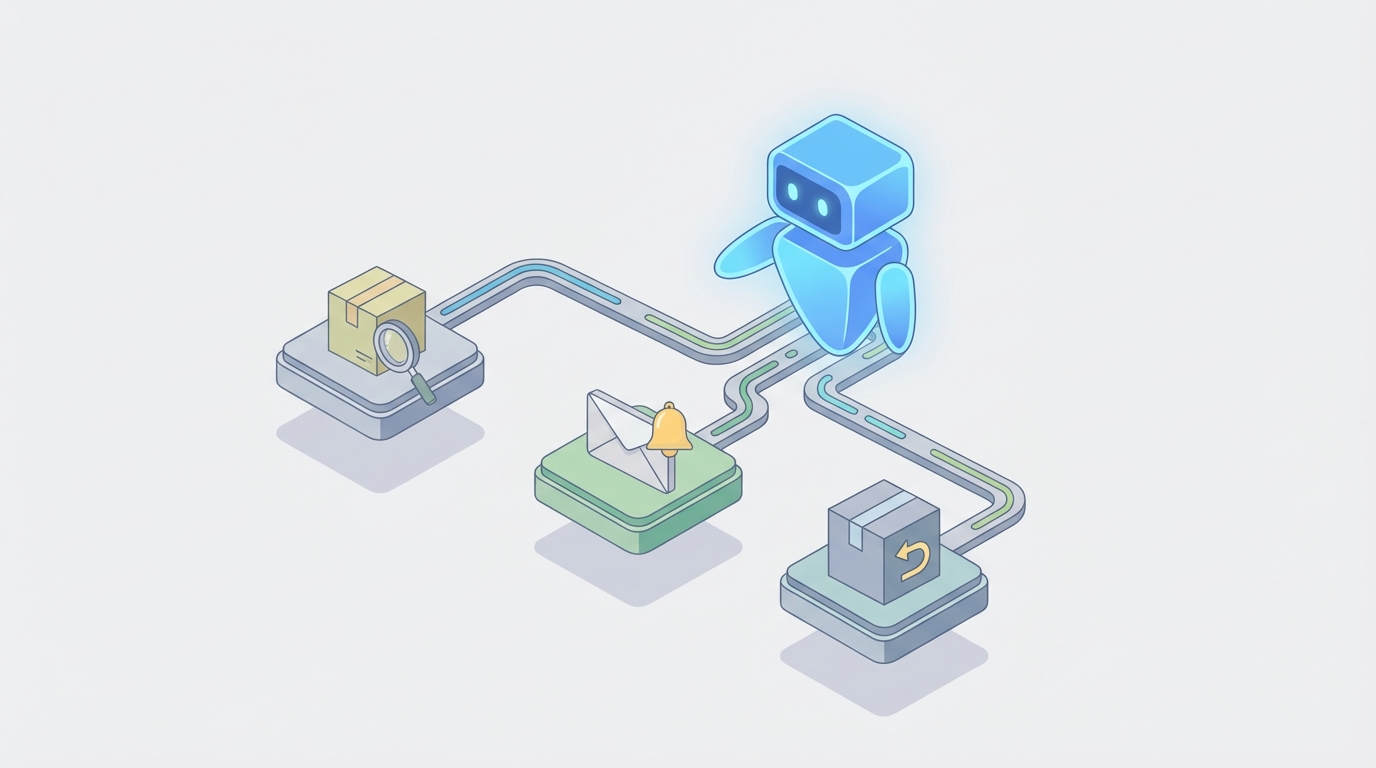
The interesting opportunity isn't replacing AfterShip. It's building an intelligence layer on top of it. A custom AI agent that consumes AfterShip's data in real time, enriches it with everything else you know about your customers and operations, and actually does things — autonomously, intelligently, without a human babysitting every exception.
That's exactly what OpenClaw is built for.
What AfterShip Does Well (And Where It Stops)
Let's be specific about the boundaries, because this matters for understanding what the agent needs to handle.
AfterShip handles:
- Carrier detection and tracking number ingestion (auto or via API)
- Real-time status updates via carrier APIs and webhooks
- Branded tracking pages
- Template-based email and SMS notifications at each status change
- Basic analytics — delivery times, carrier performance, on-time rates
- A self-service returns portal (separate product, but integrated)
- Estimated delivery date predictions
AfterShip does NOT handle:
- Complex, multi-condition automation ("if VIP customer AND delay > 3 days AND order value > $150, then offer compensation")
- Pulling in external data — customer lifetime value, support ticket history, subscription status, inventory levels
- Natural language understanding ("where the hell is my package?" or "I need this by Friday")
- Autonomous decision-making (should we reroute? offer a discount? escalate to a human?)
- Proactive outreach before a problem becomes a support ticket
- Learning from outcomes to improve future responses
- Dynamic notification content that adapts to individual customer context
Their API is solid — good webhook coverage, batch operations, tracking CRUD, carrier detection, even returns endpoints. The data is there. What's missing is the brain.
The Architecture: OpenClaw + AfterShip
Here's the concrete setup. OpenClaw acts as the orchestration layer — it ingests AfterShip data via webhooks, enriches it with data from your other systems, runs it through decision logic powered by LLMs and your business rules, and executes actions across your entire stack.
Data Flow:
AfterShip Webhooks → OpenClaw Agent → Decision Engine → Actions
                                          ↑
                              Shopify / Klaviyo / Gorgias /
                              Recharge / Internal DB
Step 1: Webhook Ingestion
AfterShip fires webhooks on every major status change — InTransit, OutForDelivery, Delivered, Exception, Expired, AttemptFail. Your OpenClaw agent subscribes to all of these.
When a webhook hits, the agent doesn't just log it. It kicks off an enrichment pipeline:
{
  "event": "tracking_update",
  "msg": {
    "id": "abc123",
    "tracking_number": "1Z999AA10123456784",
    "slug": "ups",
    "tag": "Exception",
    "subtag": "Exception_011",
    "title": "Delivery attempted - no access to delivery location",
    "order_id": "SHOP-48291",
    "checkpoints": [...]
  }
}
Step 2: Context Enrichment
This is where it gets interesting. The agent pulls context from everywhere:
- Shopify: Order value, product details, customer email, shipping address, order history
- Klaviyo or your CDP: Customer segment, LTV, engagement score, email/SMS preferences
- Gorgias or Zendesk: Open tickets, past complaint history, sentiment from previous interactions
- Recharge (if subscription): Subscription status, renewal date, churn risk
- Internal data: Previous delivery issues to this address, carrier performance for this route
Now instead of "tracking ABC123 has an exception," the agent knows: "This is a $340 order for Sarah Chen, a VIP customer with $4,200 LTV who had a delivery issue two months ago and left a negative review. She's on her third subscription renewal and has a Gorgias ticket open about a different order."
Step 3: Intelligent Decision-Making
This is the part AfterShip simply cannot do. The OpenClaw agent evaluates the enriched context against your business rules and makes a decision. Not a simple if-then — a layered, weighted decision that considers multiple factors simultaneously.
For the scenario above, the agent might decide:
- Don't send the generic delay email. Sarah has already gotten one this month. Notification fatigue is real.
- Proactively reach out via SMS (her preferred channel based on Klaviyo data) with a personalized message: "Hi Sarah, we noticed UPS couldn't access your delivery location today. They'll retry tomorrow. Want us to hold it at a UPS Access Point near you instead?"
- Pre-authorize a recovery offer — if the delivery fails again tomorrow, automatically send a 15% discount code with free expedited reshipping.
- Flag internally — add a note to her Gorgias profile so if she does reach out, the support agent has full context immediately.
- Log the carrier issue — increment the failure counter for UPS on this specific route for the weekly ops report.
All of this happens in seconds, without a human touching it.
Five Workflows That Actually Matter
Let me walk through the specific workflows where this agent creates real, measurable value.
1. Intelligent Exception Resolution
AfterShip detects exceptions. That's great. But what it does with them is basically: send an email that says "there's a problem." The OpenClaw agent turns exception detection into exception resolution.
The flow:
- Exception webhook received
- Agent classifies exception type (carrier delay, failed delivery attempt, customs hold, damaged, lost)
- Agent pulls customer context and order details
- Decision tree executes based on exception type + customer value + order details + carrier history
Example decision matrix the agent implements:
| Exception Type | Customer Tier | Order Value | Action |
|---|---|---|---|
| Carrier delay (2-3 days) | Standard | < $75 | Updated ETA email, no compensation |
| Carrier delay (2-3 days) | VIP | Any | SMS with apology + tracking link + proactive offer |
| Carrier delay (5+ days) | Any | > $100 | Auto-reship or refund offer via preferred channel |
| Failed delivery attempt | Any | Any | SMS with pickup location options or reschedule link |
| Lost/no update 7+ days | Any | Any | Auto-create support ticket + send customer proactive email with resolution options |
This isn't hypothetical. These are real rules you configure in OpenClaw, and the agent executes them against live AfterShip data.
2. Conversational Tracking via SMS or Email
Customers don't want to click through to a tracking page. They want to text "where's my order" and get an answer.
The OpenClaw agent can handle inbound messages across channels — SMS, email, WhatsApp, even chat widgets — parse the natural language, look up the relevant tracking via AfterShip's API, and respond conversationally.
Customer texts: "hey when is my stuff coming"
Agent process:
- Identify customer from phone number (Shopify lookup)
- Find active orders and tracking numbers
- Query AfterShip API for latest status
- Generate natural language response with real data
Agent responds: "Hi! Your order #48291 is currently in transit with UPS — it's in Louisville, KY as of this morning. Expected delivery is Thursday by end of day. Want me to text you when it's out for delivery?"
No support ticket created. No human involved. Customer is happy.
If the customer follows up with "can I change the delivery to my office address?" the agent can check if rerouting is available via the carrier's API, or create a Gorgias ticket with full context if it needs human help.
3. Proactive Delay Communication
This is the most valuable workflow and the one AfterShip is worst at handling natively.
Instead of waiting for a customer to ask "where's my package?" or for AfterShip's generic delay email to fire, the OpenClaw agent monitors tracking data and reaches out before the customer even realizes there's a problem.
How it works:
The agent runs a continuous evaluation loop (via AfterShip webhook events and periodic API polling):
For each active tracking:
  - Calculate expected_delivery vs. current_trajectory
  - If likely_late AND customer hasn't been notified:
    - Determine delay severity
    - Pull customer context
    - Craft personalized message
    - Send via preferred channel
    - Log outreach + set follow-up trigger
The key insight: AfterShip's estimated delivery dates are based on carrier data alone. The OpenClaw agent can factor in additional signals — weather data, carrier performance trends on specific routes, historical patterns for the destination ZIP code, even holiday shipping volume — to predict delays earlier and more accurately than AfterShip's native EDD.
4. Smart Returns Processing
AfterShip's returns portal handles the mechanics — customer initiates return, gets a label, ships it back. But there's zero intelligence in the process.
The OpenClaw agent adds a decision layer:
- Before the return: Customer says "I want to return this." Agent checks order details, customer history, and product type. For a VIP customer returning a low-cost item? "We'll refund you immediately — no need to send it back." For a high-value item from a first-time buyer? Standard return process, but with proactive status updates throughout.
- During the return: Agent monitors the return shipment via AfterShip tracking and proactively updates the customer: "We received your return at our warehouse today. Your refund will hit your card within 2-3 business days."
- After the return: Agent triggers a Klaviyo flow with a personalized win-back offer based on the return reason. Returned because of sizing? Send a size guide + 10% off to try again. Returned because they didn't like the product? Recommend alternatives based on purchase history.
5. Operational Intelligence & Carrier Accountability
This one's for the ops team, not the customer. The agent aggregates all AfterShip tracking data and produces actionable intelligence.
Weekly automated report:
- Carrier performance by route (e.g., "FedEx Ground is failing on 18% of deliveries to the Pacific Northwest, up from 7% last month")
- Average delay duration by carrier and region
- Exception patterns and root causes
- Customer impact analysis (how many VIP customers were affected, estimated revenue at risk)
- Specific recommendations ("Consider switching PNW shipments to UPS Ground based on 90-day performance data")
This isn't a dashboard you have to go look at. The agent compiles it and drops it into Slack every Monday morning, with the three most important things highlighted at the top.
Implementation: Getting This Running
Here's the practical path to building this with OpenClaw.
Phase 1: Foundation (Week 1-2)
- Connect AfterShip webhooks to your OpenClaw agent endpoint
- Set up Shopify and Klaviyo data connections in OpenClaw
- Configure the agent's core function: receive webhook → enrich → classify → log
- Build the conversational tracking capability (this gives you immediate value and a way to test the pipeline)
Phase 2: Exception Handling (Week 3-4)
- Define your exception decision matrix (like the table above)
- Configure the agent's action capabilities — sending SMS via Twilio, creating Gorgias tickets, applying Shopify discount codes
- Implement the proactive delay detection loop
- Test with real shipments (start with internal/test orders)
Phase 3: Advanced Workflows (Week 5-8)
- Smart returns processing integration
- Carrier performance analytics and automated reporting
- Outcome learning — track which interventions actually reduce support tickets and improve customer satisfaction, and feed that back into the decision engine
- Fine-tune thresholds and rules based on real data
Phase 4: Optimization (Ongoing)
- A/B test notification strategies (does proactive outreach reduce WISMO tickets? By how much?)
- Expand carrier performance analysis
- Add new data sources as needed (weather, social sentiment, etc.)
- Refine the agent's language and tone based on customer feedback
What This Actually Saves You
Let's talk numbers, because this isn't a feel-good exercise.
WISMO tickets: Typically 30-50% of e-commerce support volume. If the agent handles even half of these conversationally, you're looking at a 15-25% reduction in total support tickets. For a brand doing 500 tickets/week at $5-8/ticket, that's $1,500-$4,000/week in savings.
Customer retention: Proactive delay communication reduces churn from delivery issues by an estimated 20-40%. For a subscription brand with 5% monthly churn, even a 0.5% improvement compounds significantly.
Operational efficiency: Automated carrier performance reporting saves your ops team 5-10 hours per week of manual data pulling and analysis.
Revenue recovery: Smart exception handling with personalized recovery offers (instead of generic apology emails) can recover 10-20% of at-risk orders that would otherwise result in refund requests or chargebacks.
The Bigger Picture
AfterShip gives you tracking infrastructure. OpenClaw turns that infrastructure into an intelligent system that actually makes decisions and takes action. The tracking data is the foundation — it's valuable, and AfterShip does a solid job collecting it. But data without intelligence is just a dashboard nobody looks at often enough.
The brands that will win the post-purchase experience aren't the ones with the prettiest tracking page. They're the ones that detect a problem at 2am, figure out the right response based on who the customer is, execute that response automatically, and log the outcome so the system gets smarter over time.
That's not what AfterShip is built to do. It is what OpenClaw is built to do.
Ready to build this? Our Clawsourcing team will design and implement your AfterShip AI agent, tailored to your specific carriers, customer segments, and operational workflows. No generic templates — a custom agent built on OpenClaw that actually understands your post-purchase operations.